
Cooking a full pan of soup
You want to purée cooked, roasted pumpkin in the pan for several people. Ease of handling, cord length and the recommended operating time may all be worth considering.


For roasted pumpkin soup, choose a hand blender that feels comfortable to use in the pan; extra accessories are only useful if you’ll use them for other dishes too. Before switching it on, place the blending foot on the bottom of the pan to help prevent splashes, and check the instructions for your exact model to make sure it can be used with hot soup. A higher stated wattage alone doesn’t prove that a blender will purée soup better.
You want to purée cooked, roasted pumpkin in the pan for several people. Ease of handling, cord length and the recommended operating time may all be worth considering.
You want to keep the blender under control while puréeing. The position of the blending foot and how the controls work matter more than the wattage alone.
You may also want to use your hand blender to chop ingredients or whisk. If so, check which accessories are actually included with the version you’re considering.
When making a pan of roasted pumpkin soup for several people, ease of use in the pan, splash control and any other tasks you have in mind all matter. Each row below focuses on the main reason for choosing a particular feature.
| What to consider | What to look for | Who should prioritise this? |
|---|---|---|
| Puréeing a pan of soup | Compare the grip, blending foot and cord reach. The Consumers’ Association recommends a cord longer than 150 cm for convenience; its advice of at least 600 W applies to heavier puréeing and chopping tasks, not as a universal minimum for soup. | If I want to purée soup for several people in the pan, I want to hold the appliance comfortably and have enough room to move it around. Around 36% of consumers prioritise puréeing a pan of soup. |
| Keeping splashes to a minimum | Check the controls and whether it has variable speed settings. The Consumers’ Association advises placing the blending foot on the bottom of the pan or bowl before switching the blender on. | I want to start the blender in a controlled way and avoid getting soup around the pan. Around 29% of this group prioritise splash control. |
| Handling and cleaning | Check whether the blending foot is detachable and which parts the instructions say are dishwasher-safe. | If I’m blending for longer, I want the appliance to feel comfortable to hold and the parts to be easy to clean afterwards. Around 21% of consumers prioritise handling and cleaning. |
| Using accessories | Check what’s included with the exact version you’re considering. A chopper or whisk is only relevant if you need those functions too. | I want to chop ingredients or whisk as well as make soup, but I don’t want to store attachments I won’t use. Around 14% of consumers prioritise extra functions. |
A stated wattage isn’t an independent measure of how smooth your soup will be, how much the blender will splash or how comfortable it is to hold.
First decide whether you’ll only be puréeing cooked soup or tackling heavier jobs too. Then compare the controls and, where available, test results for the exact model you’re considering.
An included beaker is designed for the tasks it’s suitable for; puréeing in a beaker isn’t the same as blending in your own soup pan.
Assess the blending foot, the pan and the instructions for your exact model separately from the capacity of the beaker supplied.
Pouring the soup into batches unnecessarily can mean extra work.
Cleaning instructions can vary between parts and models.
Check the instructions for how to clean each attachment. Unplug the appliance before removing any parts.
Philips lists soup as a suitable use for the HR2521/40 from the 3000 Series, a version aimed at those who mainly want to purée.
According to Bosch, the ErgoMixx MSM66120 combines twelve speed settings, a detachable metal foot and an included chopper.
Braun lists the MultiQuick 7 MQ7045X as having variable speed control, a 350 ml chopper and a whisk.
According to Tefal, the Quickchef HB659838 has twenty speed settings, a detachable stainless steel foot, a measuring beaker and a chopper.
These hand blenders are for anyone looking to purée soup and considering adjustable controls, splash control or accessories for other recipes.
 No image available
An option if you want to adjust the speed while puréeing and value one-handed operation.
The product description lists 21 speeds, SplashControl, a 1000 W motor and a beaker for small portions.
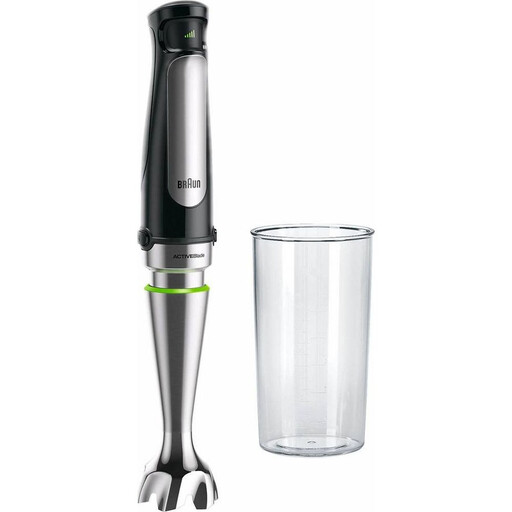 No image available
An option if you want to adjust the speed while puréeing and are looking for a design with a stated splash-reducing feature.
The product description lists 1000 W, 30 speeds, Easy SmartSpeed and SplashControl.
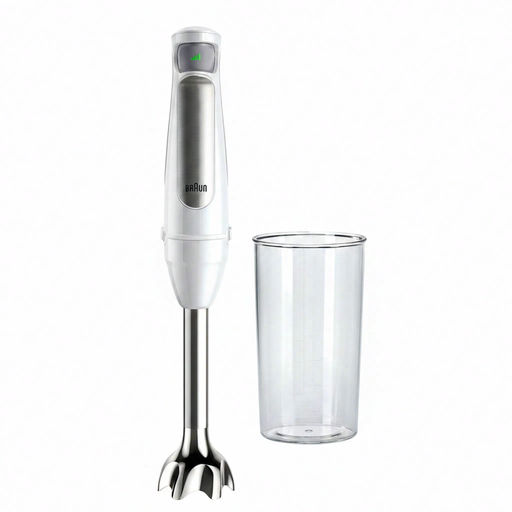 No image available
An option if you want to purée soup with speed control operated at the touch of a button.
The product description lists 1000 W, SmartSpeed, SplashControl and a dual whisk as an included accessory.
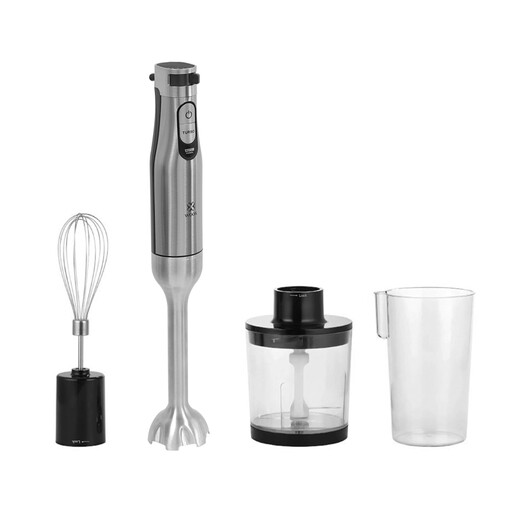 No image available
An option if you want to chop or whisk as well as make soup, and are looking for variable speed control.
The product description lists 1200 W, variable trigger control, a chopper, a measuring beaker and a whisk.
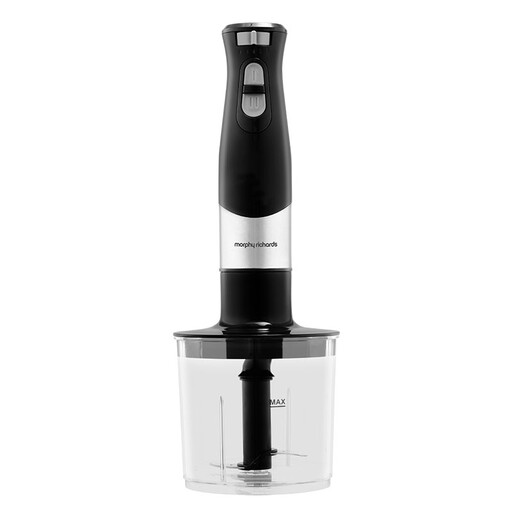 No image available
An option if you want several speed settings for soup and would like to remove the blending foot for separate cleaning.
The product description lists five speeds, a turbo function, a detachable stainless steel blending foot, a 700 ml measuring beaker, a whisk and a chopper bowl.
Not just to use a hand blender: the Consumers’ Association describes puréeing in a pan or bowl. Check the instructions for your exact appliance for guidance on temperature and operating time when preparing hot food.
The Consumers’ Association advises placing the blending foot on the bottom of the pan or bowl before switching the blender on. Variable speed can help you control the process, but it can’t guarantee that there’ll be no splashes.
First unplug it and detach the attachments. Check the instructions to see which removable parts can go in the dishwasher; don’t assume this applies to every part.
No. According to the Dutch Government, the Netherlands has no fixed statutory warranty period; you’re entitled to a product that meets what you can reasonably expect. If a product is faulty, contact the seller; a manufacturer’s warranty may offer additional cover.
Yes. The Netherlands Food and Consumer Product Safety Authority states that CE marking is mandatory for electrical consumer products. A CE mark isn’t a test result for blending performance and doesn’t prove that any specific model mentioned here has been independently checked.