
Making smoothies for one
You want to blend a pear directly in a beaker and don’t need a chopper or whisk. The Consumers’ Association describes hand blenders as suitable for puréeing fruit and making smoothies.


For a single pear smoothie, a hand blender with a suitable beaker and an easy-to-clean, detachable blending foot is a sensible place to start. A chopper or whisk is useful mainly if you’ll use it for other things too. Also consider the controls, splash reduction and any information about noise. Before buying, check the CE marking on the specific item being offered: a manufacturer’s claim that it prevents splashes doesn’t guarantee a clean worktop.
You want to blend a pear directly in a beaker and don’t need a chopper or whisk. The Consumers’ Association describes hand blenders as suitable for puréeing fruit and making smoothies.
You want to minimise splashes and clean the parts you’ve used before a colleague uses the kitchen. The Consumers’ Association says a detachable foot is easier to clean; the Netherlands Nutrition Centre recommends washing and cleaning fruit, vegetables and kitchen utensils thoroughly.
You want to know in advance whether the noise will be acceptable in your workplace. Wattage or a claim that a model prevents splashes says nothing about its noise level; the Consumers’ Association includes noise in its testing method.
Start by deciding whether you only want to purée fruit or make other things too. Then compare the beaker, cleaning requirements, splash reduction and information about noise for your shared workspace.
| What to consider | What should you check? | Who is this most relevant to? |
|---|---|---|
| Puréeing a serving of pear | Check whether the exact model comes with a suitable beaker and whether you can adjust the speed. If available, look for a relevant independent smoothie test. | If I want to make one serving, I’m looking for a beaker I can blend in directly and don’t want unnecessary accessories. Around 31% of consumers say puréeing a serving is their main consideration. |
| Reducing splashes | Look at the shape of the blending foot and check whether a suitable beaker is included. A claim that a model prevents splashes doesn’t guarantee splash-free blending with pear. | In a shared kitchen, I want to leave the worktop tidy for the next person. Around 31% of consumers are mainly concerned with reducing splashes. |
| Cleaning after use | Check whether the foot is detachable and which parts the manual says are dishwasher-safe. | If others need to use the kitchen soon afterwards, I want to clean the parts I’ve used without unnecessary effort. Around 23% of consumers put ease of cleaning first. |
| Noise near workspaces | Look for a comparable noise measurement for the exact model; wattage isn’t a noise rating. Also consider whether using it briefly is suitable for the workspace. | If the kitchen is close to desks, I want to know whether the noise from blending could disturb my colleagues. Around 15% of consumers say noise is their main consideration. |
Wattage is an appliance specification. On its own, it doesn’t show how smooth a pear smoothie will be or how much noise the blender makes. The Consumers’ Association treats smoothie results and noise as separate parts of its testing.
Where possible, compare test results for the exact model and check that they cover smoothies and noise.
A chopper and whisk are designed for tasks other than puréeing fruit. Extra attachments also mean more parts to clean and store in a shared kitchen.
Choose extra accessories only if you’ll use them too, for example, to chop or whisk ingredients.
A claim that a model prevents splashes is specific to that model and comes from the manufacturer; it isn’t an independent test of pears in your beaker. The result may depend on the combination of blender, beaker and how you use it.
Check that the beaker is included with the model and follow the instructions. When you start blending, keep the blending foot beneath the surface of the ingredients.
The MultiQuick 7 MQ7000WH is an example of a hand blender designed for puréeing.
According to Bosch, the ErgoMixx MSM64110 has two speeds and a measuring beaker for small quantities.
The Quickchef+ HB67MB is worth considering if you also want to use the supplied chopper and whisk for things other than smoothies.
These product picks are intended for making a pear smoothie in a shared office. They include both straightforward hand blenders and sets with extra accessories.
 No image available
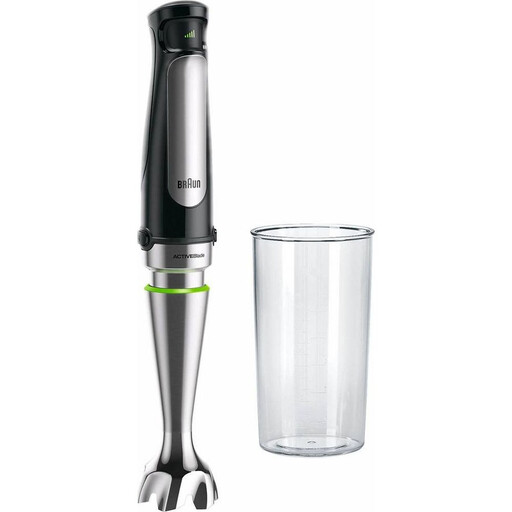
The included beaker and detachable parts are handy for making and tidying up after a single serving. SplashControl is described as a splash-reducing feature, not a guarantee of a clean worktop.
The product description lists a 600 ml blending and measuring beaker, Easy SmartSpeed and parts that can be cleaned by hand or in the dishwasher.
 No image available
The beaker is intended for making smoothies; the chopper and whisk are extra parts to clean and store.
The product name lists up to 1200 W, 15,000 rpm, a 700 ml beaker and a 500 ml chopper. Don’t use the appliance for more than 1 minute at a time; then leave it to rest for 1 minute.
 No image available
The beaker is intended for smoothies; the set also includes a chopper, whisk and meat grinder, so there are extra parts to clean and store.
The product name lists two speeds, an 800 ml beaker and a 500 ml chopper. The blending shaft is detachable and described as easy to clean.
No, not if you only want to purée fruit. The Consumers’ Association describes a standard hand blender as suitable for fruit and smoothies; a chopper is designed for separate chopping tasks.
Wash the pear under running water and clean any kitchen utensils you’ve used thoroughly. Check the manual to see which parts of your chosen model are dishwasher-safe; according to the Consumers’ Association, a detachable foot is easier to clean.
For an opened pack of the product type ‘smoothie, fruit’, the Netherlands Nutrition Centre recommends keeping it in the fridge for 1–2 days. This advice applies to that product type; different advice may apply to a freshly made smoothie or one with added ingredients.
When you buy as a consumer, the product must meet the expectations you can reasonably have of it. The Dutch Government explains that if a product is faulty, the seller must provide a solution; a manufacturer’s guarantee doesn’t replace this legal right.
Yes. The Netherlands Food and Consumer Product Safety Authority states that CE marking is compulsory for electrical products, including electrical kitchen appliances. Check the marking on the specific item being offered; a brand name or product listing doesn’t confirm that this particular item has been checked.