
If you occasionally blend a small portion
You want to purée peaches without leaving an appliance on the worktop. The Consumers' Association lists hand blenders without a chopper or whisk attachment as an option if all you need to do is purée.


For small portions of peach purée and limited permanent worktop space, a hand blender with a suitable beaker is a sensible starting point: blend directly in the beaker, then put the blender away. A mini blender is a better fit if you regularly make a jug or beaker of purée and have room for it. For either option, compare the texture you want, portion size, cleaning requirements and the safety information for the exact model.
You want to purée peaches without leaving an appliance on the worktop. The Consumers' Association lists hand blenders without a chopper or whisk attachment as an option if all you need to do is purée.
You regularly make a portion and are weighing up the space needed for a compact blender base against the convenience of using a jug. Philips markets the HR2510/90 for smoothies and sauces.
Consider more than just the motor unit: think about the beaker, blades and any separate attachments too. Philips describes parts of the HR2510/90 as dishwasher-safe; always check the instructions for every part of the model.
A good fit for: small portions you want to purée directly in a suitable beaker, and an appliance you can put away after use.
Keep in mind: extra attachments also take up cupboard space, so check which parts come with the version you’re considering.
A good fit for: regularly making purée or smoothies in a jug or beaker, if you have space for the base unit and its parts.
Keep in mind: check the usable filling capacity and the cleaning instructions for the beaker and blades.
| What to consider | What to look for | Who this matters to |
|---|---|---|
| Worktop and storage space | Measure the space available while you’re using the appliance, then compare it with the room needed for the beaker and separate parts. | I want to clear the worktop again after blending and put the appliance away. That’s why around 36% of consumers prioritise limited worktop and storage space. |
| Texture you want | Compare the preparation method you have in mind with the instructions; wattage alone doesn’t predict the texture. | If getting an even peach purée matters to me, I look at the preparation method that suits the job, not just the power. Around 29% of consumers put their preferred texture first. |
| Portion size | Check the fill markings and instructions; the stated beaker capacity isn’t automatically the suitable working quantity. | I want to know whether my usual amount will fit in the beaker each time. Around 21% of consumers give their preferred portion size the most weight. |
| Cleaning | Check which parts can be removed and which can go in the dishwasher according to the model instructions. | After blending, I want to know how many parts I need to clean and which ones have to be washed by hand. Around 14% of consumers make ease of cleaning their top priority. |
A compact base or blender doesn’t tell you how much space the beaker, blades and separate attachments will take up.
Compare the complete set with the space available on your worktop and in your cupboard.
Extra parts need storage space, even if the motor unit is small.
The stated motor power isn’t a measured result for peach purée; the type of appliance and how you use it matter too.
First choose based on portion size, the texture you want and the space available, then follow the instructions for the exact model.
Having a similar range name doesn’t necessarily mean the model numbers or included parts match.
Check the full model number and what’s in the box before choosing a version.
The ErgoMixx MSM66110 is a hand blender with a detachable foot.
Philips markets the HR2510/90 as a mini blender for smoothies and sauces.
The MultiQuick 1 MQ 100 is a hand blender supplied with a measuring beaker.
The Original 600 NB603DG is a personal blender.
The Quickchef+ HB67G8 is a hand blender set with several attachments.
The Joybuy options below are hand blenders for puréeing fruit. Before buying, check the safety information for the exact model and, where applicable, the relevant CE and conformity information; a product listing alone doesn’t confirm this.
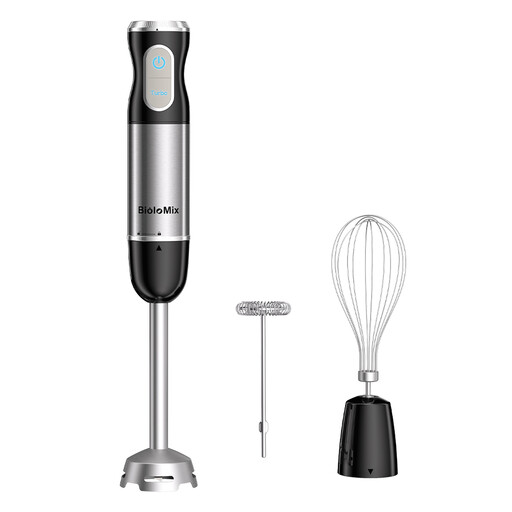 No image available
The description mentions puréeing and making smoothies. The product name specifies a detachable design and turbo function; check which parts are included with this version.
 No image available
The description mentions puréeing and blending. The product name specifies 800 W, a stainless steel design and variable speed.
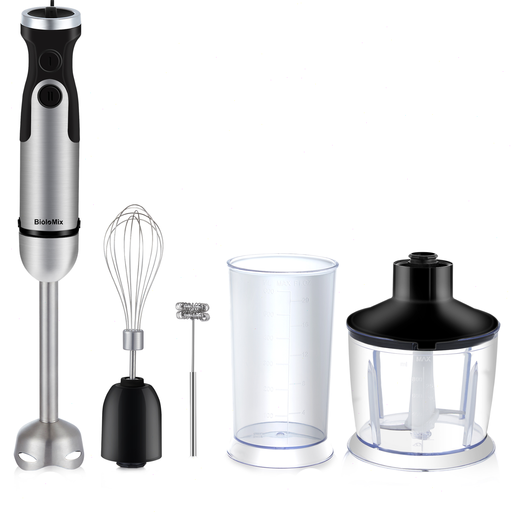 No image available
The description mentions puréeing and making smoothies. The product name specifies 1,200 W, six speeds and a turbo setting; according to the description, the set also includes a whisk and chopper, which need storage space.
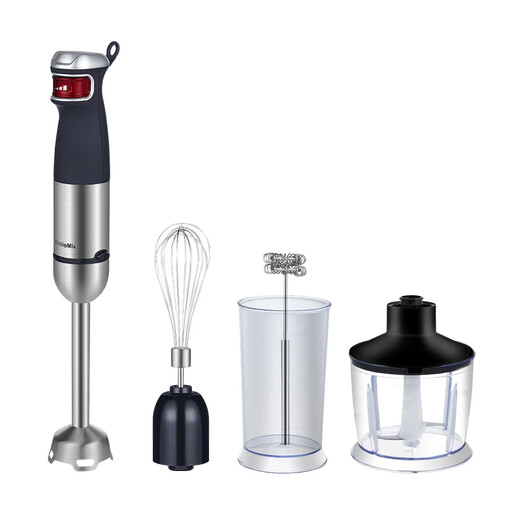 No image available
The description mentions puréeing and making smoothies. The product name specifies 1,200 W and stepless speed control; the extra attachments need storage space too.
 No image available
The description mentions puréeing with the blender shaft, speed settings and a turbo function. The set also includes a whisk, chopper and masher; allow for storage space for these too.
Yes. The Consumers' Association’s hand blender buying guide lists puréeing fruit as a suitable use. Wash the peach under running water, remove the stone and use a beaker that’s suitable for your appliance, following its instructions.
Don’t assume so. Philips lists dishwasher-safe parts for the HR2510/90; nutribullet says to wash the blade assembly of the NB603DG by hand and place the beakers on the top rack. Follow the instructions for each part of your model.
The Netherlands Nutrition Centre says peeled peach can be kept in the fridge for two days and recommends storing pieces covered. This advice for peach pieces doesn’t automatically apply to every type of prepared purée.
Not necessarily. The Dutch government says there’s no fixed statutory two-year warranty period in the Netherlands and that the seller must provide a solution if a product is faulty. First compare what a paid-for extended warranty would add.
Check the safety information for the exact model. According to Business.gov.nl, electrical appliances must meet the applicable European requirements. Where CE rules apply, the manufacturer affixes a CE marking after assessing conformity and draws up an EU declaration of conformity. A shop listing alone doesn’t confirm conformity.