
Family cook who mainly purées
You want an easy-to-handle hand blender for puréeing cooked peas, without buying attachments you won’t use. The Dutch Consumers’ Association lists puréeing as a common use for a hand blender.


If you mainly want to purée peas, a hand blender with a detachable blending foot and simple controls may be all you need. Only choose extra attachments if you’ll use them for other recipes too. If you’re blending in or near a pan, also consider the grip, splash control and distance to the nearest socket. The Dutch Consumers’ Association recommends at least 600 W for heavier tasks such as blending and chopping, but wattage alone doesn’t tell you how smooth your pea purée will be.
You want an easy-to-handle hand blender for puréeing cooked peas, without buying attachments you won’t use. The Dutch Consumers’ Association lists puréeing as a common use for a hand blender.
You blend in or near a pan and want to consider the speed settings, grip and shape of the blending foot. Bosch and Braun highlight splash control on specific models, but that doesn’t mean they’re always splash-free.
As well as making purée, you use the appliance for tasks such as chopping onions or herbs, or whisking. Check which accessories come with the exact model you’re considering.
Choose this if: you mainly want to purée cooked peas and don’t need a separate chopper or whisk.
The trade-off: fewer accessories to store and clean, but fewer options for other cooking tasks.
Choose this if: you regularly want to chop ingredients or whisk something as well as making purée.
The trade-off: extra attachments need storage space and cleaning; check what’s included with the exact model.
Choose this if: you also want to use functions such as grating, slicing or kneading.
The trade-off: these extra functions aren’t needed just for pea purée, and they do mean more parts to store and clean.
| What to consider | What to look for | Who is this most important for? |
|---|---|---|
| Puréeing for a meal | Check the blending foot and controls. The Dutch Consumers’ Association recommends at least 600 W for heavier tasks such as blending and chopping; this doesn’t guarantee a particular result. | If I mainly want to blend cooked peas to the texture I like, the blending function comes first. Around 36% of consumers put effective blending at the top of their list. |
| Splashing and control | Consider the grip and splash-control design, and measure the distance from your cooking area to the socket. The Dutch Consumers’ Association says a cord longer than 150 cm is useful if the socket is further away. | When blending in or beside a pan, I want to control the speed easily and minimise splashing. Around 29% of consumers prioritise controlled blending and ease of handling. |
| Cleaning | A detachable blending foot can be cleaned separately. Follow the instructions for each part, and don’t assume the whole set is dishwasher-safe. | If I want to clean the hand blender quickly after a family meal, I look for detachable parts and clear cleaning instructions. Around 21% of consumers put easy cleaning first. |
| Extra functions | Check which chopper, whisk or other attachments come with the exact model. If buying extra attachments later, check that the connector is compatible too. | If I want to chop, whisk or prepare other recipes as well as making purée, the included accessories matter. Around 14% of consumers prioritise extra cooking functions. |
Wattage is an appliance specification, not a model-specific measurement of pea purée. Braun’s official page lists both 1000 W in the text and 750 W in the technical specifications for the MQ 50236 M.
Compare the blending foot and controls too, and check any conflicting specifications for the exact model before comparing wattages.
A chopper and whisk are designed for different tasks from blending with the blending foot.
Only choose accessories if you’ll use them, and check what’s included with the exact model.
Extra parts need storage space and must be cleaned after use.
Manufacturers use different connection systems, so an accessory won’t necessarily fit every hand blender from the same brand.
Before buying a separate attachment, check the connection system and the full model number.
The Bosch ErgoMixx MSM66110 is an example of a simple hand blender with a detachable metal blending foot, two speeds and 600 W. These features apply to this model, not every Bosch hand blender.
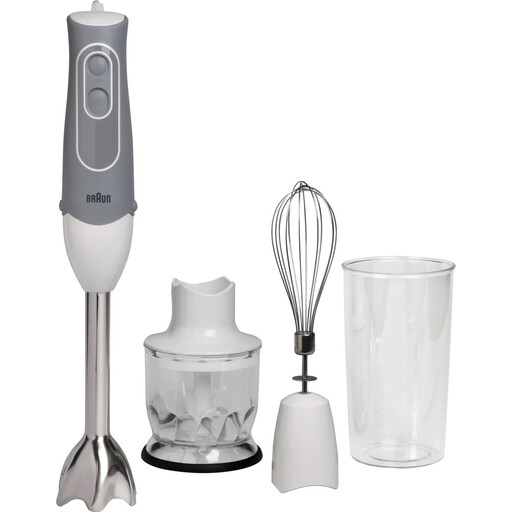
The Braun MultiQuick 5 MQ 50236 M combines a blending foot with a 500 ml chopper, a whisk and 21 speed settings. It’s for anyone who makes other recipes as well as purée.
The Tefal Quickchef+ HB67G8 is an example of a set with a 5-in-1 food processor attachment, chopper and whisk.
Joybuy picks for making pea purée, including hand blenders with extra accessories for other cooking tasks.
 No image available
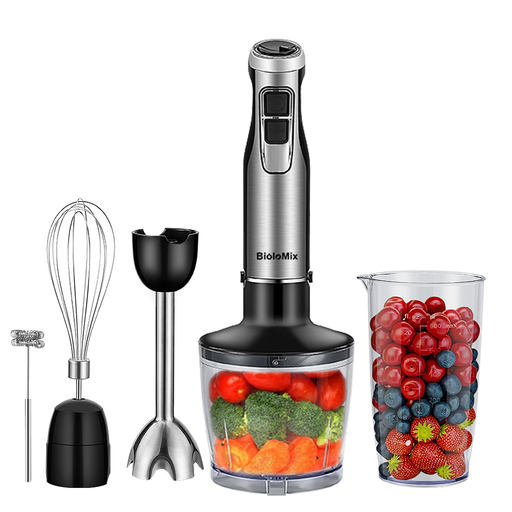
A set for puréeing peas, as well as chopping or whisking.
The product name specifies a black and stainless steel design; the product description mentions a detachable blending foot.
 No image available
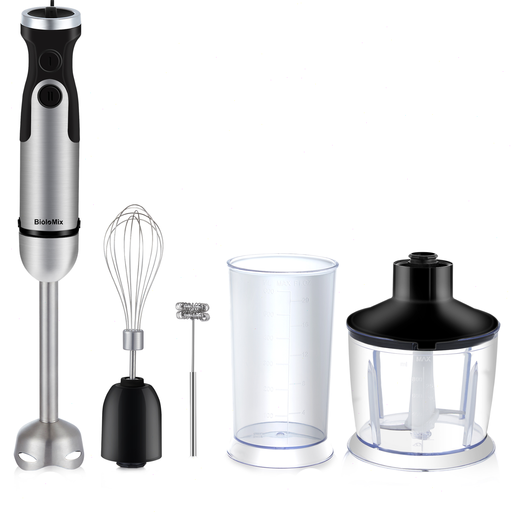
An option if you want a chopper and whisk as well as a blending function.
The product name lists six speeds, 1200 W, a stainless steel blade and an anti-splash system; the description mentions a chopper and whisk.
 No image available
This set is suited to anyone who wants to purée peas and use accessories for other recipes too.
The product name lists 1200 W and a stainless steel blade. The description mentions six speeds, a turbo setting, a chopper and a whisk.
 No image available
A hand blender for puréeing, with accessories for anyone who also wants to chop or whisk.
The product name lists 220 V, 600 W and two speeds; the description mentions an anti-splash design, detachable parts, a chopper and a whisk.
 No image available
A model for puréeing, with extra options for anyone who also wants to chop.
The product description lists 21 adjustable speeds, SplashControl, a chopper and dishwasher-safe parts.
No. You can purée peas with a hand blender; a separate purée attachment isn’t generally necessary. The Dutch Consumers’ Association describes a separate attachment specifically for mashed potatoes, so choose accessories based on what else you want to make.
Blending in a pan is one of the stated ways to use a hand blender. Check the instructions for your model and make sure you have enough room to work; a detachable foot can be cleaned separately. Follow the cleaning instructions for each part, and don’t assume the whole set is dishwasher-safe.
The Netherlands Nutrition Centre advises not leaving leftovers out of the fridge for more than 2 hours. Cool them quickly and store them in a sealed container; the Netherlands Nutrition Centre gives general storage times of 2 days in the fridge or 3 months in the freezer for leftovers.
No. According to the Dutch government, there’s no fixed statutory guarantee period in the Netherlands. How long you’re entitled to a product that works properly depends on the product and the circumstances; if something goes wrong, contact the seller. A manufacturer’s guarantee is in addition to your statutory rights.
According to the Netherlands Food and Consumer Product Safety Authority (NVWA), an electric hand blender placed on the Dutch market as an electrical product must carry the applicable CE marking. The marking is the manufacturer’s declaration that the product complies with the relevant EU rules; it isn’t, by itself, proof of independent testing or performance testing.