
Making soup after class
You want to blend mushroom soup in the pan with minimal fuss, then get the washing-up done quickly. The Consumers' Association advises placing the blending foot on the bottom of the pan before switching on the hand blender.


For mushroom soup that you blend in the pan, a hand blender with a suitable blending foot, variable speed and parts that are easy to clean according to the instructions is a sensible place to start. You don’t need an extensive set if you only make soup; a chopper is mainly useful if you also want to chop ingredients. Place the blending foot in the pan before switching the appliance on, and check the instructions for your model.
You want to blend mushroom soup in the pan with minimal fuss, then get the washing-up done quickly. The Consumers' Association advises placing the blending foot on the bottom of the pan before switching on the hand blender.
You value a controlled start and less splashing more than extra attachments. The Consumers' Association points out that how you switch on the hand blender matters too.
You want to chop ingredients such as onions or herbs as well as make soup. According to the Consumers' Association, a chopper is designed for these extra tasks; it isn’t essential for blending soup.
When blending soup in the pan after an evening class, texture, splashing and cleaning all matter; extra features are worthwhile mainly if you’ll use them.
| What to consider | What to look for | Who should prioritise this? |
|---|---|---|
| Smooth soup | Look at the blending foot and speed settings; a test of the exact model may provide information about how fine and evenly it blends. | If I mainly want evenly blended soup, I look beyond wattage alone; around 31% of consumers prioritise blending results. |
| Less splashing | Check the shape of the foot and the speed settings; a splash-reducing design doesn’t guarantee splash-free use. | If I’m blending in the pan, I want to start gently and reduce splashing; around 25% of consumers make splash control their top priority. |
| Cleaning | Check whether the foot is detachable and which parts are dishwasher-safe according to the instructions. | After cooking, I want as few loose parts as possible to clean; around 19% of consumers prioritise ease of cleaning. |
| Only the features you need | Check which accessories come with the exact version and whether you really want to use them. | If I mainly use the hand blender for soup, I don’t want to choose attachments I won’t use; around 13% of consumers say avoiding unnecessary equipment is their main consideration. |
| Preparing ingredients | Check whether the set includes a chopper and which ingredients it’s suitable for. | If I also want to chop onions or herbs for the soup, I look for a set with a suitable chopper; around 12% of consumers prioritise this extra preparation. |
The stated power alone doesn’t tell you how finely or evenly a hand blender will blend mushroom soup. The Consumers' Association considers factors including fineness and consistency when assessing blending results. Braun’s MQ50001M page lists both 1,000 W and 750 W; don’t compare these figures as if one were definitive.
Check the specifications for the exact version and, if available, look at a relevant independent test of that model.
A chopper and whisk are designed for tasks other than blending soup. A set also gives you more parts to store and clean.
Choose these attachments only if you plan to use them regularly, and check exactly what comes with the version you’ve chosen.
Cleaning instructions apply to specific parts and can vary by model.
Unplug the hand blender before cleaning it, and follow the instructions for the separate parts.
The MultiQuick models are worth considering if you’re comparing a standalone hand blender with a set that includes attachments.
The ErgoMaster and ErgoMixx ranges include models you can compare as standalone hand blenders or as sets.
The Quickchef+ HB67MB30 is worth considering if you want to use a chopper and whisk as well as blend soup.
These hand blenders are suited to blending soup, with some models offering extra features for splash control, cleaning or chopping ingredients.
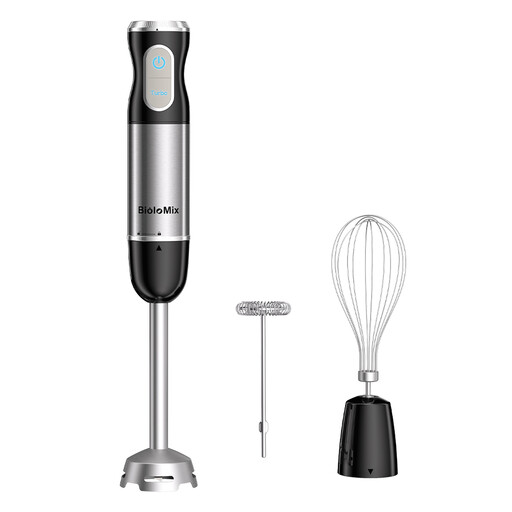 Image unavailable
The product description mentions blending soup and a design that helps reduce splashing.
The description lists 1,200 W, six speeds, a turbo setting and a detachable shaft.
 Image unavailable
The product description mentions blending thick soups and a splash guard.
The description lists 20 speeds, a turbo setting and detachable dishwasher-safe parts.
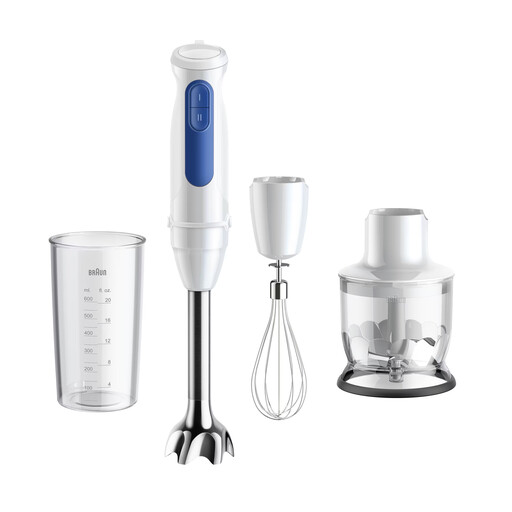 Image unavailable
The product description mentions blending soup and SplashControl.
The description lists two speeds, a detachable blending shaft and dishwasher-safe separate parts.
 Image unavailable
This set is designed for blending soup and, according to the product description, also includes a chopper.
The description lists 25 speeds, a turbo setting, SplashControl and a chopper with three texture settings. The product description advises against processing boiling liquids.
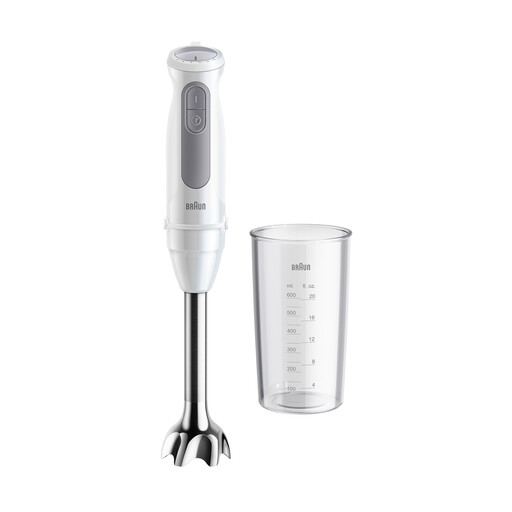 Image unavailable
The product description mentions blending with a PowerBell VPlus blending foot and SplashControl.
The description lists 21 speeds, a variable speed button, a measuring beaker for small portions and dishwasher-safe separate parts.
Place the blending foot in the pan first, then switch on the hand blender. The Consumers' Association recommends this to help prevent splashing. Also check your model’s instructions for using it with hot ingredients; a splash-reducing design doesn’t make careless use safe.
Don’t assume the whole appliance is dishwasher-safe. Unplug it, detach only the separate parts and check the instructions to see which ones can go in the dishwasher.
No, you don’t need a chopper to blend soup; you use the blending foot for that. A chopper is mainly useful if you also want to chop ingredients such as onions or herbs. Check which accessories are included with the exact set.
For an electric hand blender placed on the market in the Netherlands, the responsible economic operator must comply with the applicable European requirements. The Dutch government’s Business.gov.nl explains that, after assessment, the manufacturer affixes a CE mark and draws up an EU declaration of conformity. This general requirement does not, by itself, prove that a specific item has been checked individually.