
Cook with limited cupboard space
You mainly blend soup and don’t want to store a chopper or whisk you never use. The Dutch Consumers’ Association’s selection guide distinguishes between hand blenders designed just for blending.


If you’re making mushroom soup and short on cupboard space, a standalone hand blender without an unused chopper or whisk is the most practical choice. The Dutch Consumers’ Association recommends at least 600 W for heavier blending tasks. That power alone won’t guarantee smooth soup, so also compare the blending foot, controls and cord with your pan and kitchen.
You mainly blend soup and don’t want to store a chopper or whisk you never use. The Dutch Consumers’ Association’s selection guide distinguishes between hand blenders designed just for blending.
You blend more often or work with firmer ingredients, so you pay attention to the controls and blending foot. For tougher blending tasks, the Dutch Consumers’ Association recommends at least 600 W.
You want to minimise splashes and easily detach and clean the blending foot after use. The Dutch Consumers’ Association advises switching the hand blender on only once the foot is in the pan.
| What to consider | What should you look for? | Who should pay particular attention? |
|---|---|---|
| Storage space and attachments | Check which parts are included in the box and whether the blending foot is detachable. | If I mainly make soup, I don’t want to keep unused accessories in my cupboard. Around 36% of consumers make storage space their top priority. |
| Blending soup | Compare the stated power and speed settings for the exact model. For heavier blending tasks, the Dutch Consumers’ Association recommends at least 600 W. | If I regularly blend firmer ingredients, I want a blender that’s up to the task. Around 29% of consumers make blending their top priority. |
| Splashes in the pan | Look at the shape of the blending foot and follow the instructions; place the foot in the pan before switching the appliance on. | I want to blend mushroom soup in the pan without making an unnecessary mess. Around 21% of consumers focus mainly on splash control. |
| Cleaning after use | Check whether the blending foot can be detached and follow the cleaning instructions for each part of the model. | If I want to tidy up quickly after cooking, I need to know how the parts can be cleaned. Around 14% of consumers make ease of cleaning their top priority. |
A chopper and whisk are designed for tasks other than blending soup, and they take up extra storage space.
Check what’s included with the model you’re choosing, and only opt for attachments you’ll actually use.
Philips lists its 3000 Series HR2521/40, with 400 W and ProMix, for uses including soup.
Bosch lists 600 W, two speed settings, a detachable metal blending foot and a 140 cm cord for the ErgoMixx MSM66110.
Braun lists 1000 W, 21 speeds and SplashControl for the MultiQuick 5 MQ50001M.
The Dutch product information lists a wall hook as a storage option for the Turbomix Plus HB1011.
These hand blenders are listed as suitable for making soup; some models come with extra attachments.
 Image unavailable
An option if you want to blend soup and adjust the speed; the product description lists soup as one of its uses.
The description specifies 800 W, 20 speeds and a turbo setting.
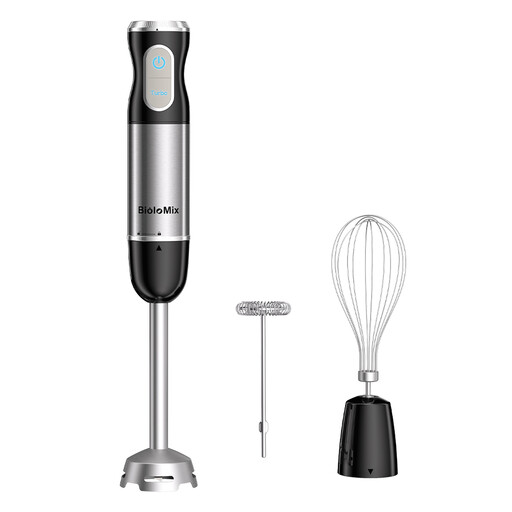 Image unavailable
The product description lists soup as one of its uses and says its detachable design makes it easy to store.
It also mentions a turbo function and a splash-resistant design. Check which attachments are included with this model.
 Image unavailable
This set is listed as suitable for blending soup; bear in mind that extra attachments take up more storage space.
The description lists a detachable stainless steel blending shaft, chopper, whisk and measuring jug. For hot ingredients, it recommends using a heat-resistant bowl.
 Image unavailable
The product description lists soup as one of its uses and includes a chopper, which you’ll need space to store.
The description specifies 25 speeds and a turbo function. It warns against processing boiling liquids, so follow the instructions for this model.
 Image unavailable
The product description lists soup as one of its uses; this set also includes a chopper and whisk that you’ll need to store.
The description specifies a rated power of 1000 W, a maximum of 1200 W, variable speed control, a 700 ml measuring jug and a 500 ml chopper. Continuous use is limited to 1 minute, followed by 1 minute of rest.
No, not for blending the soup itself. A chopper is designed for tasks such as chopping onions, herbs and nuts; a whisk is for things like whipping cream. Only choose these attachments if you’ll use them for those kinds of tasks too.
Place the blending foot in the pan before switching the appliance on, as advised by the Dutch Consumers’ Association. After use, unplug it, detach the attachments and follow the cleaning instructions in the manual. Don’t assume every part is dishwasher-safe.
If you bought it in the Netherlands and the product is faulty, the seller must provide a solution, according to the Netherlands Government’s guidance on statutory guarantees. Any manufacturer’s or extended guarantee is in addition to your statutory rights and does not replace them.
CE marking is required for electrical products covered by the Commodities Act Decree on Electrical Equipment. The Netherlands Food and Consumer Product Safety Authority (NVWA) states that the underlying low-voltage rules apply to a rated AC voltage of 50 V to 1000 V; check which rules apply to the specific model.
The Netherlands Nutrition Centre advises cooling cooked leftovers quickly and putting them in the fridge or freezer within two hours. According to the Centre, leftovers can be kept in the fridge for up to two days.