
Cook with a large soup pan
You want to blend soup for guests straight in the pan, so you’re focused on how easy the blender is to use, the space you have to work in and the control it offers while blending.


For soup that you want to blend directly in a large pan, a comfortable hand blender with a detachable blending foot and suitable speed settings is a sensible place to start. Check that the cord length and operating time suit your pan and the way you cook; a higher wattage alone doesn’t guarantee better results with mushroom soup. A chopper or whisk is most useful if you’ll also use it for other preparation tasks.
You want to blend soup for guests straight in the pan, so you’re focused on how easy the blender is to use, the space you have to work in and the control it offers while blending.
You want to blend mushrooms to an even consistency, so you’re comparing the blending function and speed settings rather than treating wattage as a guarantee of the result.
You may use a hand blender for other recipes too, and want to know whether a chopper or whisk is worth the extra attachments for you.
| What to consider | What should you check? | Who is this important for? |
|---|---|---|
| Blending in the pan | Check the grip, cord length, speed settings and instructions for blending in a pan. Place the blending foot on the bottom of the pan before switching the blender on. | When I’m blending a full pan of soup for guests, I want the blender to be easy to handle and to minimise splashing. Around 36% of consumers prioritise control in the pan and splash reduction. |
| Even texture | Compare the speed settings and any available blending test results. The Consumentenbond assesses factors including how finely and evenly cooked vegetables are blended; this is not a specific test of mushroom soup. | I want the mushrooms to be blended evenly, not just a motor with a high stated wattage. Around 29% of consumers give even blending top priority. |
| Cleaning | Check the cleaning instructions for each part. Unplug the blender before removing an attachment. | After cooking for a group, I want to know which parts are easy to clean and how to take the blender apart safely. Ease of cleaning comes first for around 21% of consumers. |
| Extra attachments | Check whether the exact version includes a chopper or whisk and what each is designed for. The capacity of an attachment is not the capacity of your soup pan. | If I want to chop ingredients or whisk something as well as make soup, a set with extra attachments could be useful. Around 14% of consumers prioritise these other preparation tasks. |
Wattage is a specification, while fineness and evenness are separate results. The Consumentenbond recommends at least 600 W for more demanding blending and chopping tasks, but this doesn’t guarantee a particular result with mushroom soup.
Compare wattage as one factor among several, and look for relevant blending test results where available. Check any conflicting specifications against the exact model before comparing them.
The capacity stated for an accessory describes that attachment, not how much soup you can blend in a pan at once.
Choose accessories for tasks you actually do, and assess how well the blender works in your soup pan separately.
Cleaning instructions can vary from one part to another.
Check the manual for each attachment and unplug the blender before removing anything.
The ErgoMixx MSM66110 is a straightforward model to compare, while the ErgoMaster MSM6M810 offers a wider range of speed settings.
The MultiQuick 5 is worth comparing if you’re considering a model with a chopper and whisk as well as blending functions.
According to Tefal, the Quickchef HB659838 combines adjustable speed with a detachable metal blending foot and a chopper.
This selection includes hand blenders for soup, from simple models to sets with a whisk or chopper. Check the instructions for use and cleaning for the exact version, and ask if necessary about the applicable CE marking and EU declaration of conformity.
 No image available
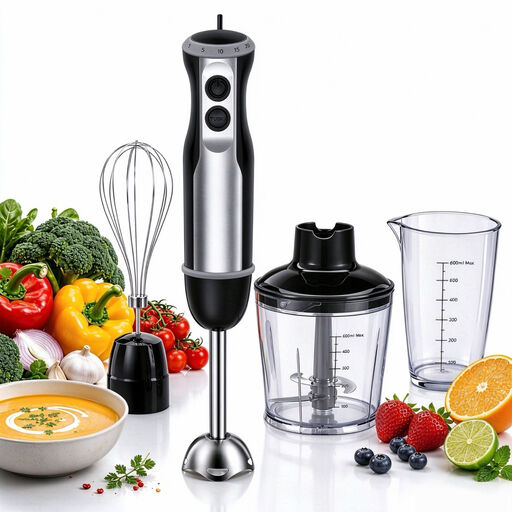
A set for blending soup and carrying out other preparation tasks too.
The description lists a whisk, a 500 ml chopper and a 600 ml measuring jug.
 No image available
A model to consider if you’d like to use a chopper as well as blend.
The product description lists 25 speeds, a turbo function and a chopper with three texture settings. It warns against processing boiling liquids.
 No image available
A straightforward hand blender to compare if you mainly want to blend and adjust the speed.
The product description lists 21 speeds and dishwasher-safe parts. It warns against prolonged continuous use; check the manual for the recommended operating time.
 No image available
This set is designed for soup and purée, with attachments for other preparation tasks.
The product name states 600 W. The description lists two speeds, a whisk, a 500 ml chopper and an 800 ml measuring jug.
 No image available
A model with a long blending shaft to consider if you want to blend soup in a deep pan.
The product description lists a reach of 36.5 cm, a 1.5 m cord and two settings. Claims about reducing splashes and protecting the pan are product claims, not independent test results.
Not on the basis of wattage alone. The Consumentenbond recommends at least 600 W for more demanding blending and chopping tasks, but it also assesses blending results for fineness, evenness and preparation time. For a large batch, also check the selected model’s manual for the permitted operating time and any required breaks.
The Consumentenbond’s usage tips say to place the blending foot in the pan before switching the blender on. After use, unplug it before removing any attachments; the model’s manual will tell you which parts are dishwasher-safe.
The Voedingscentrum advises cooling leftovers quickly, storing them covered in the fridge or freezer, and not leaving them out of the fridge for more than 2 hours. Check the storage advice that applies to the ingredients in your soup.
No. According to ACM ConsuWijzer, your statutory rights apply alongside any seller’s or manufacturer’s guarantee. A product must meet the standard you could reasonably expect when used normally; if it is faulty, the seller is responsible for providing an appropriate solution.
Electrical appliances must meet the applicable European safety requirements. According to Dutch government information, after carrying out a conformity assessment, the manufacturer must affix the required CE marking and draw up an EU declaration of conformity. A product page alone does not confirm that a specific item being offered meets these requirements.