
Vandaag of morgen in huis

Kwaliteit gegarandeerd

Welkomstaanbiedingen ontgrendelen: GRATIS bezorging | Tot 80% korting | Gratis 30 dagen JoyPlus-proefperiode
Download de app
A hand blender seems simple: switch on the motor, blend the ingredients and you’re done. Yet many households buy a model that disappoints after just a few weeks. The power turns out to be insufficient for hard ingredients, accessories remain unused in the kitchen cupboard and cleaning takes longer than expected.
If you’re looking for a hand blender, powerful hand blender or multifunctional hand blender, it’s therefore worth looking beyond wattage and a long list of features. Below, you’ll find out which features make a practical difference and which models suit different ways of using them.
A high wattage can indicate a powerful motor, but it doesn’t tell you everything about the final performance. The blades, blending foot design, controls and recommended operating time also play a part. A 1,200 W motor is useful for heavier preparations, but a lighter model may be perfectly adequate for a simple sauce or small smoothie.
Also look out for contradictory or missing product information. The stated power should clearly be identified as motor power and not confused with speed, peak power or a marketing term.
A hand blender with accessories may come with a whisk, chopper, measuring jug or extra blending foot. This makes a set versatile, but only if you actually need these components. For smoothies and soup, a blending foot and measuring jug are usually enough. If you also want to chop onions, herbs or nuts, a hand blender with chopper is a better choice.
Also check whether the accessories are dishwasher-safe and whether replacement parts or additional attachments are available.
Sharp blades, a blending foot that is difficult to detach or a motor unit that cannot come into contact with water can make everyday use less convenient. So look for:
Never use a hand blender with the blades moving while detaching or cleaning it. Always unplug it and allow hot liquids to cool according to the instructions. For some models, a temperature below 80 °C is recommended to help reduce splashing and burns.
For soup, sauces, baby food and soft smoothies, a model between approximately 350 and 650 W is often sufficient. If you regularly process hard vegetables, nuts or ice, you may want to consider a powerful hand blender rated at 800 to 1,200 W. This does not guarantee a particular result: always check whether the manufacturer explicitly permits processing hard ingredients.
A hand blender for soup should also have a blending foot that reaches deep enough into the pan or bowl. A longer foot is useful for large pans, but may feel heavier when preparing small portions.
A single speed is simple and suitable for basic use. Two or three speeds give you more control when making mayonnaise, dips and smoothies, for example. A dial with many settings may sound appealing, but it’s mainly useful if you regularly want to adjust the texture.
A turbo or pulse setting can help with short, intensive blending tasks. Use this function at short intervals and observe the maximum operating time stated in the instructions.
A hand blender with whisk is useful for whipped cream, egg whites, batter or mayonnaise. A chopper is suitable for smaller quantities of herbs, onion or nuts. Check the capacity of the measuring jug and chopping bowl: 500 to 600 ml is practical for everyday portions, while a larger jug may be more suitable for families.
A cordless hand blender gives you greater freedom of movement, but pay attention to charging time, operating time and charger availability. A corded model works directly from the mains, but its cable, usually around 1 to 1.5 metres long, may determine where you can use it in your kitchen.
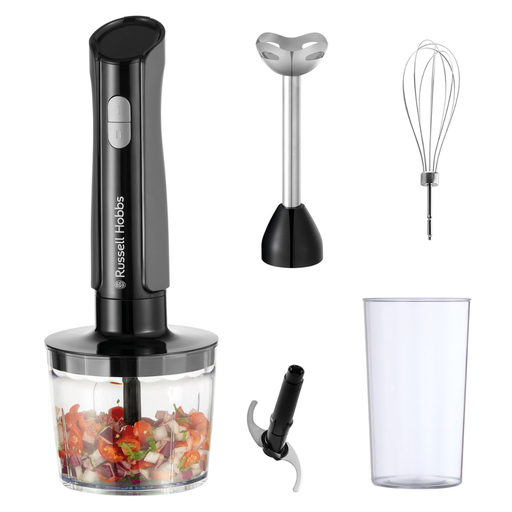
Why it suits this profile: This set lets you blend, chop and whisk with one appliance. With 500 W, two speeds, a 500 ml chopping bowl and 600 ml blending jug, it is designed for everyday use without complicated controls.
The functions are clearly specified and, according to the product information, the detachable parts are dishwasher-safe. This keeps maintenance practical.
3-in-1 use, two speeds, non-slip feet and two useful containers.
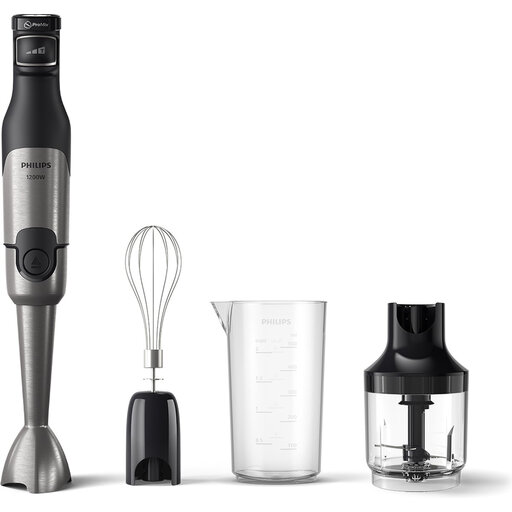
Why it suits this profile: The 1,200 W motor, three speeds and included chopper, whisk and measuring jug are ideal for households looking for one versatile kitchen helper for soups, smoothies, sauces and preparations involving harder ingredients.
The accessories and motor power are clearly stated. The splash protection around the blades is designed to help reduce splashing while blending.
1,200 W, three speeds and a BPA-free 0.5-litre measuring jug.
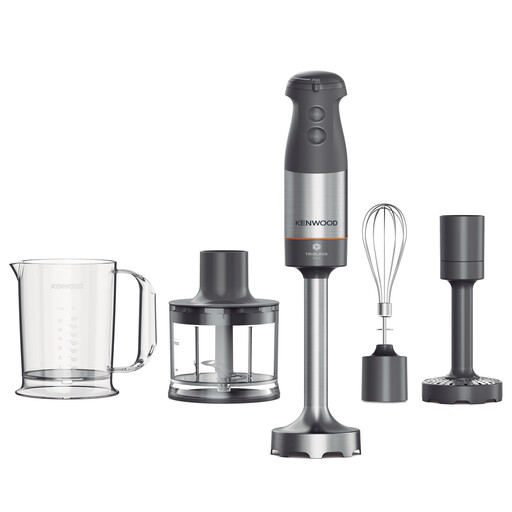
Why it suits this profile: The 1,000 W motor, longer XL blending foot and included whisk, chopper, measuring jug and masher are designed for larger quantities and a wide range of kitchen tasks.
The long blending foot reduces the need to transfer large quantities to another container. According to the product information, the accessories are dishwasher-safe.
1,000 W, an XL blending foot and four different accessories, including a masher.
We’ve put together a complete, up-to-date list of products that fully meet these strict selection criteria and the applicable European safety regulations.
A hand blender will generally last longer when you use it according to the instructions. Keep these points in mind:
The statutory guarantee in the European Union is at least two years for this product category, although additional rights may apply under Dutch consumer law. Check the specific guarantee terms for the product and seller.
That depends on the model and its instructions. Allow the soup to cool to the temperature specified by the manufacturer first. Keep the blending foot fully submerged to reduce splashing and use a sufficiently deep pan or bowl.
For sauces, baby food and soft smoothies, around 350 to 650 W is often practical. For nuts, harder vegetables or ice, models rated at 800 to 1,200 W are more suitable, provided these uses are permitted according to the product information. Wattage alone does not determine the overall result.
A hand blender’s electricity consumption is usually limited because the appliance is only used for short periods. With a cordless model, battery life, charging time and battery lifespan are particularly important. A corded model does not need recharging, while a cordless model offers greater freedom of movement.
