
Raita lover who likes chunks
You want to see and taste the cucumber. The Netherlands Nutrition Centre’s recipe calls for coarsely grating and draining the cucumber, so first consider whether a hand blender would add anything.


You don’t need a hand blender for cucumber raita with recognisable chunks: the Netherlands Nutrition Centre describes a method using coarsely grated, drained cucumber stirred into yoghurt. If you’d also like to chop herbs or blend other sauces until smooth, choose based on those additional tasks and check the accessories and cleaning instructions for the exact model. A stated capacity doesn’t prove that an accessory will handle your smallest portion well.
You want to see and taste the cucumber. The Netherlands Nutrition Centre’s recipe calls for coarsely grating and draining the cucumber, so first consider whether a hand blender would add anything.
You make small quantities of sauce and sometimes chop herbs. Compare the mixing beaker and chopper supplied, but don’t assume that the stated capacity tells you the smallest quantity they can process.
You also use a hand blender to purée sauces. The Consumers’ Association describes puréeing and blending as uses for a hand blender; you can add the grated cucumber to the raita after blending.
First decide whether you want to grate the cucumber and stir it into the yoghurt, or whether you’ll also use the hand blender for other sauce-making or chopping tasks.
| What to consider | What to look for | Who is this most important for? |
|---|---|---|
| Cucumber texture | Grate and drain the cucumber if you want distinct chunks; keep it separate while blending a sauce base. | If I want to taste the cucumber in the raita, I’ll grate and stir it in. Around 36% of people with this preparation preference prioritise texture. |
| Small quantities | Check the shape of the beaker and attachment, and consult the manual for the quantity you usually make; the stated capacity isn’t a minimum quantity. | For a very small portion of sauce, I want to know whether the attachment is suitable for the quantity I’m making. Around 29% of this group prioritise processing small portions. |
| Cleaning | Choose accessories you’ll use, and check the manual for each part before putting anything in the dishwasher. Unplug the appliance before removing attachments. | If I often make small quantities, I don’t want to wash more parts than necessary. Around 21% of consumers give easy cleaning top priority. |
| Blending until smooth | Compare the speed settings if you want to use them for other recipes; wattage alone won’t tell you how the raita will turn out. | If I want to use the same appliance to blend other sauces until smooth, I’ll look at the controls. Around 14% of consumers prioritise this additional blending capability. |
For the grated texture in the Netherlands Nutrition Centre’s raita recipe, grate the cucumber, leave it to drain and stir it into the yoghurt.
First decide whether you’ll also use the appliance for other sauces or chopping tasks.
According to Braun, the MultiQuick 1 MQ10.201MWH is equipped for blending and small chopping tasks.
The ErgoMixx MSM66120 could be a good fit if you want to chop as well as blend, and adjust the speed.
According to Tefal, the Quickchef HB656838 comes with several accessories for different tasks.
This selection focuses on hand blenders for a smooth sauce base and, depending on the set, additional chopping tasks. The stated bowl and beaker capacities don’t prove the minimum quantity a model can process.
 No image available
A set for blending a sauce base, as well as chopping or whisking ingredients. The product information lists a chopper, whisk, measuring beaker and detachable parts; for raita with recognisable chunks, keep the cucumber separate.
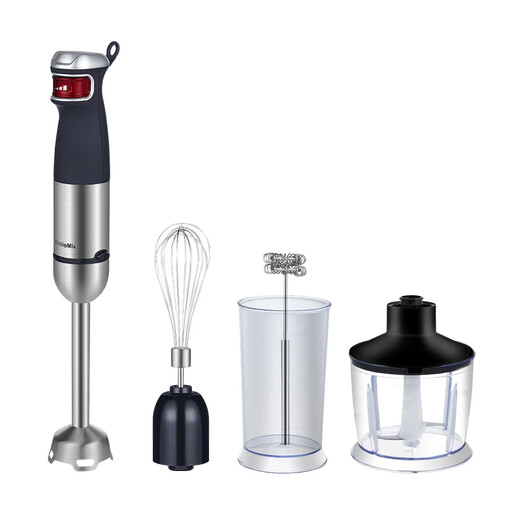 No image available
This set is designed for blending and puréeing, with extra functions for other tasks. The product name lists 1200 W, variable speed control and a stainless steel blade; the product description also mentions chopping.
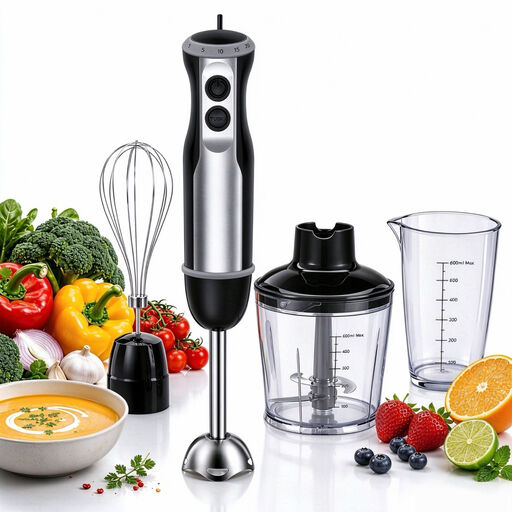 No image available
An option if you want to chop or whisk ingredients as well as make a smooth sauce base. The product information lists 6 speeds, a turbo function, a 500 ml chopper, a 600 ml measuring beaker and a whisk. Check the dishwasher instructions for each part.
 No image available
Worth comparing if you want to chop ingredients to different consistencies as well as blend. The product information lists 25 speeds, a turbo function and a chopper with three texture settings; the listed parts are dishwasher-safe.
 No image available
A hand blender for making sauces and preparing other dishes. The product name lists 800 W and a stainless steel design; the product information mentions 20 speeds, a turbo function and detachable parts.
No, not if you want the texture in the Netherlands Nutrition Centre’s recipe: coarsely grate the cucumber, leave it to drain, then stir it into the yoghurt. A hand blender can be useful for a separate, smooth sauce base.
The Consumers’ Association advises switching on the blending foot only once it’s in the bowl. After use, unplug the appliance and remove the attachments; check your model’s manual before putting parts in the dishwasher.
Cover any leftovers and store them in the fridge, ideally set to 4 °C. The Netherlands Nutrition Centre gives a general maximum storage time of 2 days in the fridge for leftovers; also bear in mind the use-by dates of the ingredients you’ve used.
No. According to the Dutch Government, you’re also entitled to a statutory guarantee; there’s no fixed statutory guarantee period in the Netherlands. If a product isn’t as it should be, contact the seller. An additional guarantee doesn’t replace those rights.
The Netherlands Food and Consumer Product Safety Authority (NVWA) states that products covered by the applicable CE rules must carry a CE mark. For electrical equipment within the applicable AC voltage range of 50 V to 1000 V, the NVWA also describes requirements under the Commodities Act Decree on Electrical Equipment. A CE mark is a declaration by the manufacturer; it doesn’t indicate how well an appliance makes raita.