
Cooking with a large soup pan
You want to blend cooked celeriac in the pan for several guests. So look for a blender that’s easy to handle, with a suitable cord length and a blending foot that’s easy to clean.


For a large pan of celeriac soup, the key things to consider first are comfortable handling in the pan, a good grip and a blending foot that’s easy to clean. Only choose a chopper if you’ll also use it for other ingredients. The Consumentenbond recommends at least 600 W for tougher blending and chopping tasks, but wattage or an anti-splash claim alone won’t tell you how smooth your soup will be.
You want to blend cooked celeriac in the pan for several guests. So look for a blender that’s easy to handle, with a suitable cord length and a blending foot that’s easy to clean.
You’re working with hot soup and want to start the blender in a controlled way and adjust the speed as needed. An anti-splash claim is no substitute for careful use.
You want to chop ingredients such as onions or herbs as well as make soup. Check which chopper is included with the exact model.
First, consider how the blender will work in your pan and kitchen. Only then add attachments for tasks you’ll actually do.
| What to consider | What to look for when buying | Who is this important for? |
|---|---|---|
| Reach in the soup pan | Compare your pan with the length of the blending foot, how it feels to hold and the cord length. The Consumentenbond says a cord longer than 150 cm is useful if the socket is further away. | If you’re blending a larger pan of soup for several guests, you’ll want to be able to move the blender around easily. Around 36% of consumers prioritise reach and control for this task. |
| Splashes and speed | Check whether the speed is adjustable and follow the instructions. The Consumentenbond advises only switching the blender on once the foot is at the bottom of the pan or bowl. | When making hot soup, you’ll want to start carefully and adjust as needed. Around 29% of consumers give controlling splashes and speed top priority. |
| Chopping other ingredients | Check the accessory list for the exact model and the chopper’s capacity. The capacity of a chopper or measuring beaker doesn’t tell you how much soup you can blend in the pan. | A chopper may come in handy if you want to chop onions or herbs as well as make soup. Around 21% of consumers prioritise this extra food preparation feature. |
| Cleaning and maintenance | Check the cleaning instructions for each part and see which parts are available for the model. Unplug the blender before removing attachments. | Easy cleaning matters after blending a large pan of soup, especially if you use your blender often. Around 14% of consumers give maintenance and cleaning top priority. |
A measuring beaker or chopper is a separate attachment. The size of your soup pan and the reach of the blending foot determine how you can use the blender in the pan.
Compare your pan, the length of the blending foot and your workspace separately from the capacity of the accessories.
In its blending tests, the Consumentenbond also assesses how fine and even the result is and how long preparation takes. The stated wattage is a different measure and won’t, on its own, tell you how your soup will turn out.
Use wattage as one point of comparison and consider how the blender is controlled, too. Don’t draw conclusions about celeriac soup from a test using different ingredients.
A chopper and whisk are designed for tasks other than blending soup, and different versions within the same product range may vary.
Check the full model number and the parts included. Unused attachments take up storage space and need extra cleaning.
The ErgoMixx MSM66120 is a model to compare if you’re looking for a hand blender with variable speed and a chopper.
According to Tefal, the Quickchef HB659838 comes with a blending foot and a separate chopper.
The MultiQuick 5 range includes models with speed control. Compare the full model number and the parts included.
The 5000 Series is worth comparing if you’re looking for a hand blender with a stated motor output and, depending on the version, a chopper.
This selection features hand blenders for soup, with different speed settings and attachments for each model. Check which parts are included with each version.
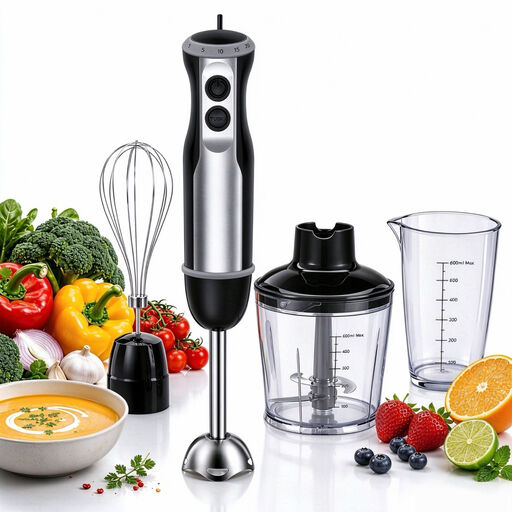 No image available
An option if you want to blend soup and chop ingredients as well.
The product name lists 6 speeds and a turbo function.
 No image available
For making soup and preparing other ingredients, too; check which attachments are included with this version.
Braun lists 1000 W, 25 speed settings and a turbo function for the MQ 55254 M. The product description warns against processing boiling liquids.
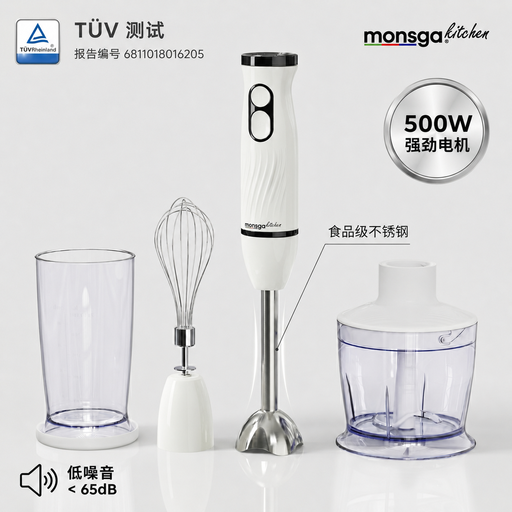 No image available
A version for anyone who wants to blend soup and use a chopper, too.
The product name lists a 500 ml chopper, a 500 ml measuring beaker, a 1.5 m cord and NORMAL and TURBO settings.
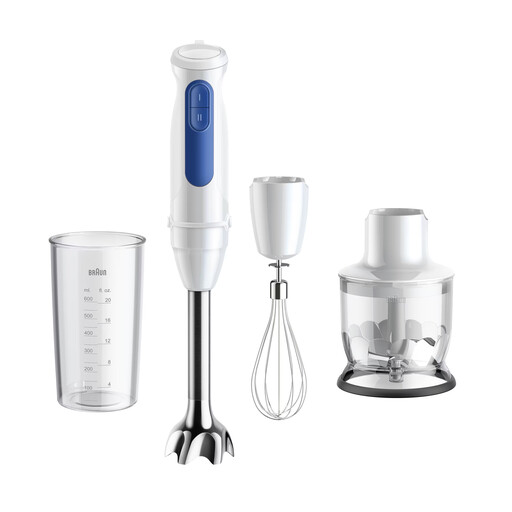 No image available
An option if you want to blend soup and clean the removable parts after use.
The product description limits continuous use to a maximum of 1 minute; let the appliance cool down afterwards.
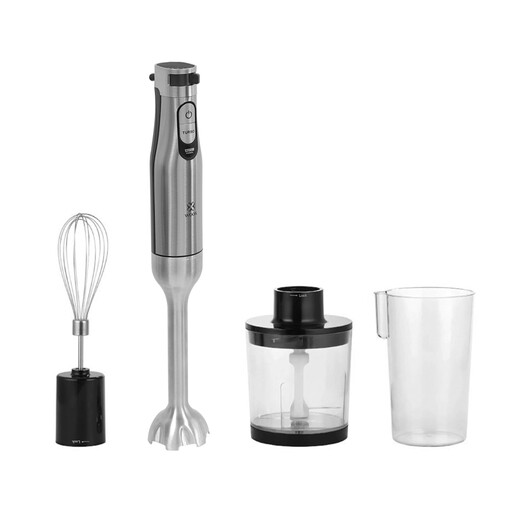 No image available
For blending soup as well as chopping or whisking; check which accessories are included in the set.
The product name lists 1200 W and variable speed control.
The Consumentenbond advises only switching the hand blender on once the foot is at the bottom of the pan or bowl. Start carefully using your model’s speed control; an anti-splash design can’t guarantee that hot soup will never splash.
It depends on the part and the model. Unplug the appliance first and remove the attachments, then check the instructions before putting any parts in the dishwasher.
The Voedingscentrum advises covering leftovers, letting them cool and putting them in the fridge or freezer within 2 hours of cooking. Set your fridge to 4 °C. If needed, divide a large amount between suitable containers so it can cool.
No. According to the Dutch government, there is no fixed period for statutory guarantees in the Netherlands. If a product is faulty, contact the seller; normal wear and tear or damage caused by your own use doesn’t automatically entitle you to a free repair.
EU rules for low-voltage equipment apply to electrical equipment designed for 50–1000 V AC. When placing a product on the EU market, manufacturers must meet requirements including safety assessment and CE marking. For a specific model, check the stated voltage and product information. The CE mark is not an independent performance test or proof that a blender is suitable for your soup.