
Vandaag of morgen in huis

Kwaliteit gegarandeerd

Welkomstaanbiedingen ontgrendelen: GRATIS bezorging | Tot 80% korting | Gratis 30 dagen JoyPlus-proefperiode
Download de app
A hand blender may seem like a simple purchase, but the differences between models can be significant. If you only use it for soup, you will need different features than if you also want to make dough, nuts, dips or smoothies. Choosing the wrong model often results in a device that lacks power, is difficult to clean or comes with accessories you hardly ever use.
This buying guide will help you assess the key specifications and choose a hand blender based on how you plan to use it.
Higher wattage sounds appealing, but it does not tell you everything about ease of use or results. The shape of the blending foot, the type of blade, speed control and recommended operating time also play a role. A powerful hand blender is particularly useful for thick mixtures and larger quantities, but it may be heavier and take up more space.
As well as checking the power, look at:
A hand blender with accessories may include a whisk, chopper, measuring jug or additional blending foot. This is useful if you will actually use these functions. For whipped cream, batter and egg whites, a hand blender with whisk is a sensible choice. For herbs, onions and smaller quantities of nuts, a hand blender with chopper is more practical.
If you mainly make smoothies, you may be better off looking at a separate smoothie blender or a blender with a drinking cup. A hand blender is flexible, but it is not automatically suitable for every preparation.
Food residue can quickly collect around the blade or inside an accessory that is difficult to reach. Look for a detachable blending foot and parts that the product information confirms are dishwasher-safe. The motor unit should never be placed in water or in the dishwasher.
Also check whether the instructions provide clear guidance on:
For sauces, soft vegetables and baby food, an entry-level model with one or two speeds is often sufficient. For thick soups, hummus and hard ingredients, a motor of around 600 to 1,000 watts offers more flexibility. Power should always be considered alongside operating time. Some models may only run for a short period at a time and then need to cool down.
A model with several settings gives you more control over the texture. Start with liquids and soft ingredients at a low speed to reduce splashing. Use a higher setting for thicker mixtures, provided this is permitted by the product instructions.
A 600 to 800 ml measuring jug is suitable for one or a few portions. A chopper of around 500 ml is ideal for small quantities of onion, herbs or vegetables. For family-sized portions, a blender with a larger jug is more convenient.
A multifunctional hand blender can replace several kitchen appliances, but make sure you have somewhere to store all the parts. Look for:
A cordless blender or portable blender is suitable for the office, gym or travelling. Capacity is usually around 400 to 600 ml and the battery needs recharging over time. A corded model makes more sense for everyday cooking, as you do not need to keep an eye on the battery level.
For a cordless model, check the charging port, charging time, capacity, cup locking mechanism and the instruction not to blend hot liquids. With a corded model, a suitable position near a socket and safe cable routing are important.
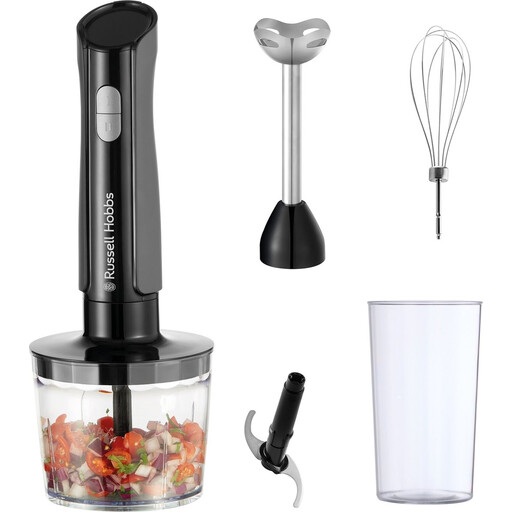
Why it suits this profile: This model combines 500 watts of power with a whisk, chopper attachment and mixing beaker. It is suitable for simple soups, sauces, whipped cream and small chopping tasks.
The two speed settings let you get started easily without paying for a large number of settings you may not need. According to the product information, the detachable parts are dishwasher-safe.
500 ml chopping bowl, 600 ml mixing beaker, whisk and a 1.2-metre cord.

Why it suits this profile: The 1,000-watt motor, 25 speeds and turbo function provide plenty of flexibility for sauces, soups and thicker mixtures.
The included chopper offers three texture settings, so you need to switch between different appliances less often. According to the product information, the parts are dishwasher-safe.
25 speeds, turbo function, splash protection and a 3-in-1 chopper.

Why it suits this profile: This set is designed for users who regularly prepare soup, sauces, smoothies, eggs and chopped ingredients, and want several functions in one appliance.
The specified operating time is one minute, followed by one minute of rest. This makes the limitation clear before you buy. According to the description, the accessories can be placed in the dishwasher at temperatures below 60 °C.
1,000 watts rated power, up to 1,200 watts, 700 ml beaker and 500 ml chopper.

Why it suits this profile: This compact model is designed for smoothies and shakes in places without a socket, such as the office, when travelling or at the gym.
The 475 ml capacity clearly indicates the portion size. Its portable design and rechargeable battery mean you do not need to use a large appliance for a single smoothie.
USB charging, a stated charging time of approximately one hour and more than 15 blending cycles per charge according to the product information.
We have compiled a complete, up-to-date list of products that fully meet these strict selection criteria and the applicable European safety regulations.
A hand blender will remain usable for longer when you follow the manufacturer’s instructions. Bear these basic rules in mind:
Under EU consumer rules, many new appliances are covered by a statutory guarantee of at least two years. Check the specific terms and conditions for the product and seller.
Yes, a hand blender can purée soup directly in a saucepan. Allow the soup to cool sufficiently first if the instructions do not permit use with hot liquids. Keep the blending foot below the surface to reduce splashing and use a suitable pan without touching the bottom.
For simple sauces, soft vegetables and smoothies, around 450 to 600 watts is often sufficient. For thicker mixtures or frequent use, 1,000 watts can provide more headroom. Always consider the speed control, blade design and maximum operating time as well.
A cordless blender uses electricity while charging. Total consumption depends on the battery capacity and the number of charging cycles. For everyday cooking, a corded model is usually more practical; for a smoothie on the go, portability often matters more than the small amount of electricity used for charging.
