
Vandaag of morgen in huis

Kwaliteit gegarandeerd

Welkomstaanbiedingen ontgrendelen: GRATIS bezorging | Tot 80% korting | Gratis 30 dagen JoyPlus-proefperiode
Download de app
A hand blender may seem like a simple kitchen appliance, but there can be significant differences between models. One appliance may be designed mainly for soups and sauces, while another can also chop, whisk and prepare smoothies. If you only look at the wattage or the number of accessories, you could end up making the wrong choice.
Pay particular attention to these three common pitfalls:
For light tasks such as baby food, milkshakes and soft vegetables, a compact model with 300 to 500 watts may be sufficient. If you regularly process thick soup, nuts, pesto or hard vegetables, you should look instead for a powerful hand blender of around 800 to 1,000 watts.
However, wattage is no guarantee of a smooth result. Also check:
For example, the ROUNY hand blender lists a power rating of 1,000 watts, a maximum power of 1,200 watts and an operating cycle of one minute running followed by one minute resting. This is relevant information if you want to process larger quantities or firm ingredients.
A hand blender with accessories can combine several kitchen tools in one appliance. A whisk is useful for cream, egg whites or batter. A chopper is suitable for herbs, onions, nuts and small portions of vegetables. A measuring beaker is helpful for smoothies, sauces and baby food.
Do not just look at the number of components, but also at their capacity:
A hand blender with whisk is not the same as an electric hand mixer. A hand mixer, such as the Philips 5000 Series HR3745/00, is designed for batter and dough and works with beaters and dough hooks. A hand blender uses a blending foot with blades and is mainly suitable for puréeing and mixing.
Check whether the blending foot or accessories can be removed. According to the product information, some components are dishwasher-safe, while the motor unit should always be cleaned with a damp cloth. Consult the manual, as “dishwasher-safe” may vary depending on the component and temperature.
Also look for:
Do not use a hand blender in boiling liquid if the manual advises against it. Allow soup to cool to a safe temperature first. Keep hands, cutlery and clothing away from moving blades, and unplug the appliance before changing accessories.
Within the European Union, consumers also benefit from at least the statutory protection against lack of conformity. A visible CE mark is a conformity marking, not an independent assessment of quality. Always compare the complete product specifications and safety instructions.
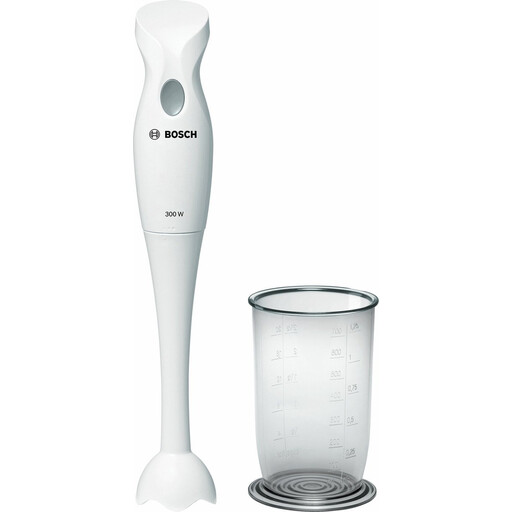
Why it suits this profile: A compact model for anyone who mainly wants to purée soup, sauce or soft ingredients without an extensive set of accessories.
The specifications are straightforward: 300 W, one speed, a measuring beaker and a 1.5-metre cable. You therefore do not pay for accessories you may never use.
Compact design, turbo function according to the product information, and removable parts that can go in the dishwasher.
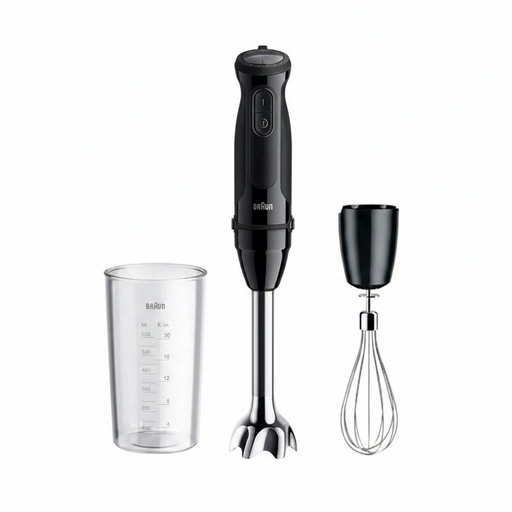
Why it suits this profile: For home cooks who want control over different preparations and regularly use a whisk or chopper.
This model combines 1,000 W with 21 speeds, so you are not limited to relying on a single high-powered turbo setting.
21 speeds, a whisk, a chopper and dishwasher-safe parts according to the product description.

Why it suits this profile: For families and keen home cooks who want one appliance for soup, smoothies, sauces, eggs and chopping.
The set lists not only the maximum power, but also the rated power of 1,000 W, an operating limit and a rest period. This makes the operating boundaries clearer.
4-in-1 set with a 700 ml beaker, 500 ml chopper, whisk, variable speed control and stainless steel shaft.
If you only want to make soup, baby food or sauce, you do not always need a multi-functional hand blender. A model with one or two settings is simpler to operate and often quicker to clean. For smoothies containing frozen fruit, nuts or thick mixtures, the beaker’s capacity is more important than the speed alone.
If you mainly bake, you would be better off choosing a separate hand mixer with a whisk and dough hooks. A hand blender is not a substitute for kneading bread dough. Conversely, an electric hand mixer is less suitable for puréeing soup directly in a pan.
We have compiled a complete, up-to-date list of products that fully meet these strict selection criteria and the applicable European safety regulations.
This depends on the manual and the material of the blending foot. If in doubt, allow the soup to cool first and avoid splashing. Always immerse the hand blender before switching it on, and keep the motor unit out of the liquid.
Its lifespan depends on use, cleaning and storage. Do not overload the motor, follow the stated operating time and check the blades and accessories regularly. A removable shaft and replaceable original parts can make maintenance easier.
A higher power rating can use more electricity per minute, but the total cost also depends on how long you use the appliance. As a hand blender usually runs for only a short time, the difference in daily consumption is often limited. Focus on choosing the right motor power for your recipes and avoid unnecessarily long operating times.
