
Vandaag of morgen in huis

Kwaliteit gegarandeerd

Welkomstaanbiedingen ontgrendelen: GRATIS bezorging | Tot 80% korting | Gratis 30 dagen JoyPlus-proefperiode
Download de app
A hand blender may seem simple at first glance: motor, blending shaft and a button. Yet models vary considerably in power, controls, accessories and ease of cleaning. You often only notice you have made the wrong choice once you start using it. The motor heats up quickly, the beaker is too small or the whisk ends up unused in a kitchen cupboard.
Joybuy Product Recommendation Officer helps you see past the marketing terminology. Pay particular attention to these three common pitfalls:
For soup, sauces, purée and soft vegetables, a model of around 450 to 600 watts may be sufficient. If you regularly process hard ingredients, nuts or frozen fruit, you may want to look at a powerful hand blender from around 800 watts. Use wattage as a point of comparison, but not as your only criterion.
A single speed works for simple preparations, but two speeds, variable control or a turbo setting give you more control. A low setting is useful, for example, when mixing liquids; a higher setting can be used for a smoother purée.
A stainless-steel blending shaft is generally sturdy and suitable for regular use. Also consider its length. A 25 cm blending shaft, such as the one on the Fritel HB 2870, is practical for a tall saucepan. An extra-long 36.5 cm housing may be suitable for deep stockpots, but takes up more space in a drawer or cupboard.
The number of blades is not decisive on its own. More important are the blade shape, splash guard and distance from the bottom. When using the blender in a pan, always check the model’s temperature limit. For example, Fritel’s product information states that you should not process liquids above 60 °C. Other models may have a different limit.
A hand blender with measuring beaker is useful when you want to blend directly in a suitable beaker. For a family, 700 to 900 ml is often more practical than a small beaker. A chopper is suitable for smaller portions of herbs, vegetables or nuts; a hand blender with whisk can help with batter, cream or egg whites.
Check the following before buying:
Some models have a short operating cycle followed by a cooling period. This is particularly important when preparing several portions of soup or purée one after another.
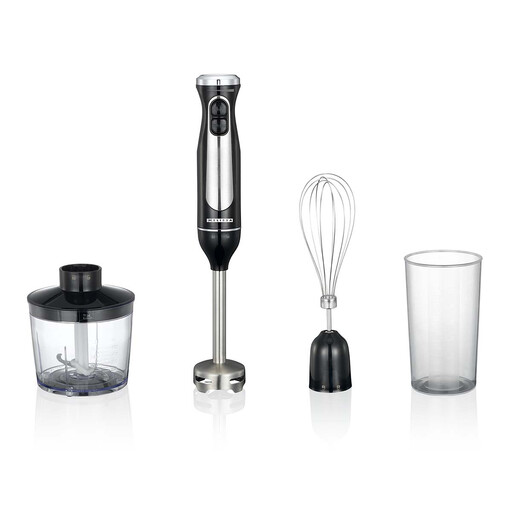
Why it suits this profile: This 3-in-1 hand blender combines a blending shaft, mini chopper and whisk. This gives you several functions without having to buy separate kitchen appliances.
The accessories are clearly specified, and the set includes a 700 ml measuring beaker and a 500 ml chopper bowl. This lets you check in advance whether the capacities suit your portions.
600 W, two speeds plus variable control, turbo function and dishwasher-safe parts according to the product information.
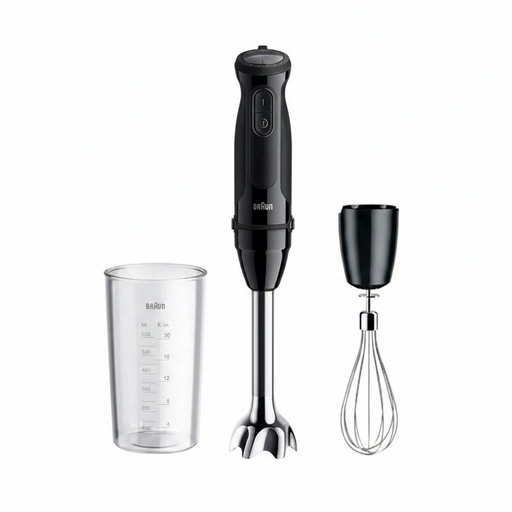
Why it suits this profile: The 1000 W motor, 21 speeds and included whisk offer plenty of adjustment options for everyday cooking and different textures.
Variable speed control means you are not limited to choosing between a low and high setting. The product information also states that the removable food-contact parts are dishwasher-safe.
1000 W, 21 speeds, 1.2-metre cord, whisk and EasyClick system for changing accessories.

Why it suits this profile: This model is designed for smoothies, shakes, ice and frozen ingredients. The included travel cup with carry case also makes it suitable for drinking on the go.
The product description specifies more than just motor power: it also lists three automatic programmes, a pulse function and the precise 710 ml capacity.
1100 W, three automatic programmes, pulse function, leak-proof cup and dishwasher-safe removable parts according to the product information.
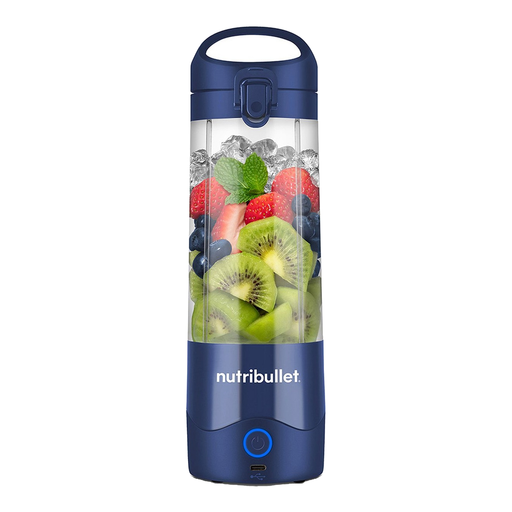
Why it suits this profile: This cordless blender is compact, rechargeable via USB and fitted with a handle and drinking lid. That makes it suitable for use at the office, in the gym or while travelling.
Its portability is supported by specific details: a 475 ml capacity, a charging time of approximately one hour and more than 15 blending cycles according to the product information.
17,000 revolutions per minute, USB-rechargeable battery, removable parts and a leak-proof drinking lid.
We have put together a complete, up-to-date list of products that fully meet these strict selection criteria and the applicable European safety regulations.
This depends on the instructions and the maximum temperature. If in doubt, allow soup to cool first and check whether the blending shaft is suitable for use in a pan. Never process hot liquids in a portable blender or sealed cup if the manufacturer prohibits this. Steam and pressure can cause the lid to come off.
Its lifespan depends on how often you use it, the ingredients, cleaning and whether you follow the maximum operating time. Allow the motor to cool down when instructed to do so in the manual, and do not use the blades for ingredients the model is not designed to handle. A removable blending shaft and replaceable or easy-to-clean parts can make everyday use more convenient.
A USB-C blender or other cordless blender uses electricity while charging, but does not need to be connected to the mains while blending. Actual consumption depends on the battery capacity, charging frequency and number of blending cycles. For large quantities of soup, a conventional corded hand blender is usually more practical; for a single smoothie on the go, a portable blender offers greater freedom of movement.
