
Vandaag of morgen in huis

Kwaliteit gegarandeerd

Welkomstaanbiedingen ontgrendelen: GRATIS bezorging | Tot 80% korting | Gratis 30 dagen JoyPlus-proefperiode
Download de app
A hand blender is handy for soups, sauces, smoothies, baby food and desserts. However, not every model is suited to the same tasks. A low wattage can disappoint with thick mixtures, while a comprehensive set takes up unnecessary space if you only purée soup.
If you’re looking to buy a hand blender, it’s worth looking beyond just the wattage or the number of accessories. Below, you’ll discover which features make a practical difference, which marketing claims you should take with a pinch of salt, and which models suit different cooking habits.
A powerful hand blender sounds appealing, but wattage doesn’t tell you everything about how it performs. The blade design, the shape of the blending foot, the speed control and the permitted running time all play a part. A 150 W model can be fine for simple soups and sauces, whereas an 800 or 1000 W motor makes more sense for thicker preparations or regular chopping.
Also check whether the manufacturer states a maximum continuous running time. Some models, for example, must not run for longer than one minute at a time and need to cool down afterwards.
A hand blender with accessories may include a whisk, measuring jug and chopper. That’s useful if you regularly prepare herbs, nuts, vegetables or whipped cream. If you only use the appliance for soup, extra parts can simply mean more washing up and storage space.
Also pay attention to the capacity of the accessories. A 350 ml chopper and a 700 ml mixing beaker suit different portion sizes. So check whether the capacity matches your household.
The motor unit must not be submerged in water. The detachable blending foot and accessories should therefore be easy to remove. Dishwasher-safe parts can save time, but always check the manual to see which parts can actually go in the dishwasher.
Extra care is needed with hot ingredients. Allow boiling liquids to cool down first and keep the blade foot below the surface to reduce splashing. According to the product information from some brands, a splash guard helps to minimise mess; this is no guarantee of a completely splash-free kitchen.
For occasional smoothies, thin sauces and soft vegetables, a model with 300 to 450 W can be sufficient. If you often make soup, process hard vegetables or are looking for a powerful hand blender, consider models with 800 to 1000 W. The stated wattage is a technical specification, not a direct promise about the end result.
A hand blender for soup and smoothies works best with a blending foot that reaches deep enough into the pan or beaker. Always use a suitable bowl or measuring jug and follow the maximum fill level.
Simple operation with a single speed is practical for short, fixed tasks. Multiple speeds give you more control with, for example, runny soup, thick hummus or whipped cream. A turbo setting can provide extra power temporarily, but check the recommended running time.
A push button, rotary dial or stepless control each feel different to use. If you want to work with one hand, a well-placed speed button may be more useful than a large number of settings.
A hand blender with chopper is interesting for herbs, onions and small quantities of ingredients. A hand blender with whisk can complement a separate hand mixer, but it’s not the same as a full stand mixer for larger amounts of dough.
Look at:
A cordless model, such as a portable blender, is especially handy for smoothies on the go. It is not automatically a replacement for a hand blender for hot preparations.
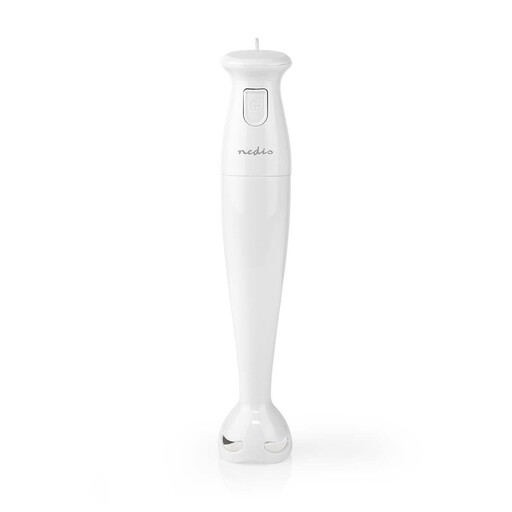
Why this suits the profile: This model is designed for simple daily tasks such as puréeing vegetables, making sauce and mixing milkshakes. Its compact shape takes up little cupboard space.
The product information clearly states 150 W, one speed and no chopper or measuring jug. So you’re not paying for accessories you may not need.
150 W motor, one-button operation, 1-metre cord and a length of 35.5 cm.
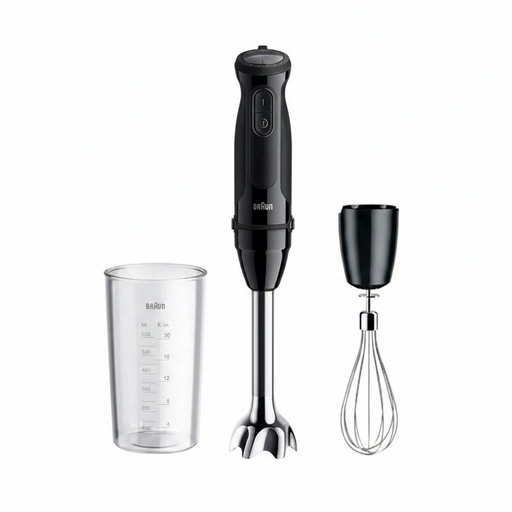
Why this suits the profile: The combination of 1000 W, 21 speeds and a whisk is aimed at home cooks who prepare different textures and recipes.
The many speeds offer more adjustment than a single-speed model. The manufacturer also states a splash control system and dishwasher-safe food contact parts.
1000 W, 21 speeds, turbo, whisk, EasyClick system and a 1.2-metre cord.

Why this suits the profile: The set is aimed at users who, besides puréeing, want to chop ingredients into different textures and regularly use multiple functions.
The included SizeControl chopper has three texture settings according to the product description. This makes the accessory choice more specific than just a general claim about versatility.
1000 W, 25 speeds, turbo, whisk, 3-in-1 chopper and dishwasher-safe detachable parts.
We’ve put together a full, up-to-date list of products that fully meet these strict selection criteria and current European safety regulations.
For soft ingredients and simple sauces, 300 to 450 W can be enough. For thicker mixtures, regular chopping or more intensive use, 800 to 1000 W is more suitable. Also look at the speeds, blade construction and running time.
That depends on the manufacturer’s instructions. In any case, do not let soup boil while blending and avoid splashing liquid. The product information for your chosen model will determine whether and under what conditions hot ingredients are allowed.
It can save space and an extra purchase when you actually use the chopper or whisk. The running costs mainly depend on the wattage and usage time. So don’t just compare the number of functions, but also your daily cooking routine.
