
Vandaag of morgen in huis

Kwaliteit gegarandeerd

Welkomstaanbiedingen ontgrendelen: GRATIS bezorging | Tot 80% korting | Gratis 30 dagen JoyPlus-proefperiode
Download de app
A hand blender takes up very little space, yet it can handle plenty of kitchen tasks. You can use one to make smoothies, soup, sauces, baby food, batter and dips. But the range can be more complicated than it first appears. Power, accessories and ease of cleaning are often highlighted, while important limitations may be less obvious.
Use this practical guide to look beyond the marketing claims and focus on specifications you can check, as well as what you need from your hand blender.
A powerful hand blender with a high wattage won’t necessarily be suitable for every recipe. Wattage tells you something about the motor, but not directly about the blade design, controls, maximum running time or quality of the accessories. A 350-watt model may be enough for soft fruit and vegetables, while thicker mixtures put more strain on the motor.
So, also check:
A hand blender with accessories may come with a whisk, chopper, beaker or extra blade. That sounds versatile, but more parts also mean more to store. Check that the accessories suit the recipes you make.
A hand blender with a whisk is useful for whipping cream, beating eggs and mixing light batters. A hand blender with a chopper is more practical for herbs, nuts, onions or small portions of vegetables. For everyday blending, a sturdy blending foot and a suitable beaker are usually all you need.
With a dishwasher-safe hand blender, usually only the removable parts are suitable for the dishwasher. The motor unit, plug and cable must not come into contact with water. Read the manual before putting any parts in the dishwasher, as the temperature and programme may matter.
For smoothies, soups and sauces, 350 to 650 watts is often a useful power range for home use. If you regularly process hard ingredients, thick hummus or larger portions, consider a model with more power and multiple speed settings.
More speed settings give you greater control over the texture. A low setting helps prevent splashing with liquid ingredients, while a higher setting may suit thicker mixtures. Always check the maximum running time. Some models, for example, require one minute of use followed by one minute of rest.
You should also distinguish a claim such as “1200 watts maximum” from the rated power. Check both figures in the product specifications.
A metal blending foot is practical for hot ingredients, but always follow the instructions for your specific appliance. If necessary, let hot soup cool first. Don’t use a hand blender in a pan if the manufacturer advises against it.
A splash guard around the blade helps keep your worktop and clothes cleaner. The blade design and how ingredients circulate through the blending foot are just as relevant as the wattage. Move the hand blender gently up and down, and don’t fill the beaker above the maximum mark.
For one smoothie, a beaker of around 400 to 600 ml is often practical. A larger beaker is more convenient for several portions, but takes up more space. A 350 to 500 ml chopper is better suited to small amounts of herbs, cheese, nuts or vegetables.
A 4-in-1 hand blender typically combines a blending foot, whisk, chopper and beaker. Check exactly what’s included in the box. Product names and images may show several accessories, while a particular version includes fewer parts.
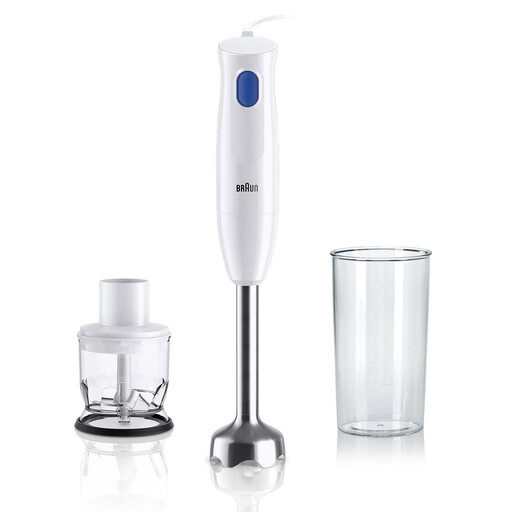
Why it suits this type of user: The single-speed control is straightforward for anyone who mainly makes smoothies, sauces and desserts without needing lots of settings.
The product specifications state that it has 450 watts of power, a 600 ml beaker and a 350 ml chopper. This makes it clear which basic functions you’re getting.
450 watts, an EasyTwist attachment system and BPA-free parts that come into contact with food, according to the product information.
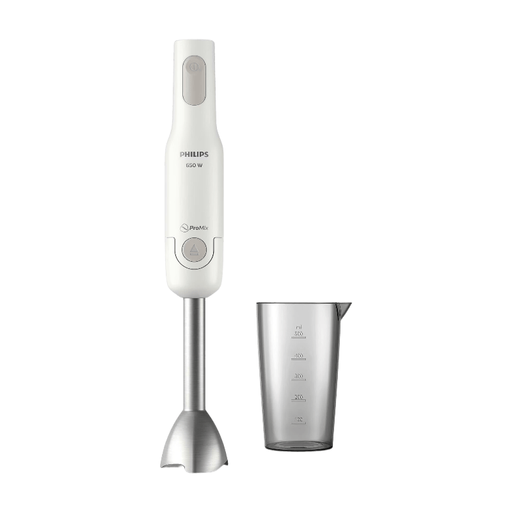
Why it suits this type of user: A good choice for everyday cooking if a metal blending foot, ergonomic grip and simple controls are important to you.
The specifications list 650 watts, a 1.2-metre cable, one speed and an included measuring beaker. This gives you a clearer idea of what it can do than a general claim about versatility.
ProMix blending foot, splash guard and one-click release, according to the product description.

Why it suits this type of user: If you want one appliance for blending, chopping, mixing and whisking, this model comes with several attachments, each with a different capacity.
The set lists a rated power of 1000 watts, a maximum of 1200 watts and a recommended cycle of one minute running followed by one minute resting. This helps you match how hard you use it to the instructions.
700 ml beaker, 500 ml chopper, whisk and stepless speed control, according to the product information.

Why it suits this type of user: This mini blender is designed for making smoothies and shakes at work, on the go or after a workout, with no need for a plug socket while blending.
The cordless blender has a capacity of 0.48 litres, a USB-C connection and a to-go lid. This makes it clear what it’s designed for.
17,000 revolutions per minute and, according to the product information, more than 15 uses per charge.
We’ve put together a complete, up-to-date list of products that meet these strict selection criteria and the applicable European safety regulations.
Always follow the manufacturer’s safety instructions when using a hand blender. Pay particular attention to the following:
If you mainly make soup and sauces, a classic hand blender is usually the best choice. For smoothies on the go, a mini blender is more convenient. A model with a whisk and chopper is better suited to households that want one appliance to handle several kitchen tasks.
Look for a metal blending foot, a splash guard and a beaker large enough for your portions. Multiple speed settings are useful for everyday use, but one speed may be enough for simple smoothies and smooth soups. Always check the instructions for your chosen model before using it with hot soup.
It depends on the ingredients. For soft vegetables, fruit, sauces and baby food, 300 to 450 watts may be enough. For thicker mixtures or more frequent use, 500 to 800 watts is a sensible range to consider. Wattage alone won’t predict the overall results; the blade, blending foot, speed and running time all play a part.
A cordless blender gives you more freedom to move around and is practical for travelling or using at work. However, you’ll need to factor in charging, a smaller capacity and restrictions on hot liquids. For larger portions and longer use, a corded model is generally a more practical choice.
