
Vandaag of morgen in huis

Kwaliteit gegarandeerd

Welkomstaanbiedingen ontgrendelen: GRATIS bezorging | Tot 80% korting | Gratis 30 dagen JoyPlus-proefperiode
Download de app
A hand blender might seem simple at first glance: a motor at the top, a blending shaft underneath and a button to get blending. But models vary widely in power, controls, accessories and cleaning. An inexpensive hand blender may be ideal for soup, while a family that regularly chops nuts or whisks batter may benefit from a complete set.
As a Joybuy Product Recommendation Officer, I focus on specifications you can check. That way, you can avoid paying extra just for a high wattage or a long list of accessories.
A 1000W hand blender sounds more powerful than a 600W model, but wattage doesn’t tell you everything about the blade design, drive system or operating time. For soup, sauces and soft vegetables, 300 to 600W is often enough. For larger quantities, firmer ingredients or regular chopping, a powerful hand blender with 800 to 1000W may be more practical.
Check the recommended operating time, too. Some models, for example, can run for a maximum of one minute at a time before they need to cool down. This matters if you’re preparing several portions of soup or mash.
A hand blender with accessories may come with a whisk, chopper, measuring jug or potato masher. That’s useful if you’ll actually use these functions. However, a standalone blending shaft without a chopper may be a better choice if you mainly make soup and smoothies.
Check the chopper’s capacity. A 350 or 500 ml bowl is suitable for small quantities of herbs, onion or vegetables, but not for preparing a large meal. For a family, a 600 to 900 ml measuring jug may be a better fit.
With a dishwasher-safe hand blender, this usually refers to removable accessories or the metal blending foot. The motor unit, plug and cable must not be put in water or the dishwasher. Check the manual to see which parts can be removed and what temperature the plastic accessories can withstand.
A model with one speed is simple to use. Two speeds give you more control. A variable speed dial or turbo setting is especially useful when you want to switch between whisking lightly and blending powerfully.
A stainless steel shaft is generally suitable for hot preparations, but always follow the manufacturer’s temperature limits. Keep the motor unit out of the pan. Fully immerse the blending shaft before you start to help prevent splashes.
A splash guard around the foot can help keep your worktop cleaner. According to product information from various brands, some blade and foot designs are intended to blend ingredients more finely. Treat these as manufacturer claims, and check the specific details too, such as the number of blades and the shape of the blending foot.
A hand blender should feel secure to hold, especially when you’re blending a pan of soup. Consider:
A 25 cm shaft, for example, is useful when you’re blending in a deep pan. For small bowls, a compact model may be easier to manoeuvre.
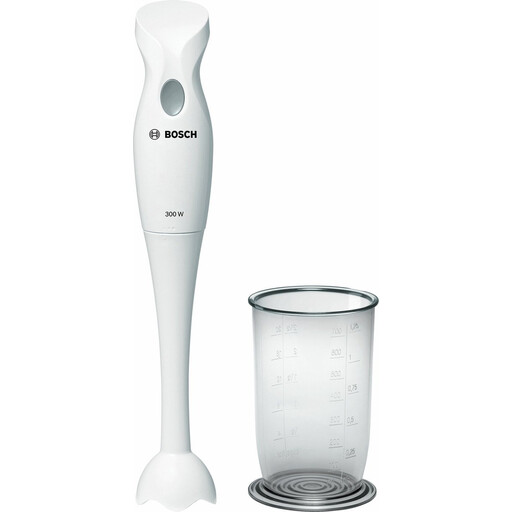
Why it suits this user type: This compact model has 300W, one speed, a turbo function and a measuring jug. It’s well suited to simple preparations such as soup, sauce and mash.
The specifications are clear: no unnecessary accessories and no ambiguity about the number of speeds. According to the product information, the removable parts are dishwasher-safe.
300W power, turbo function, measuring jug and a 1.5-metre cable.
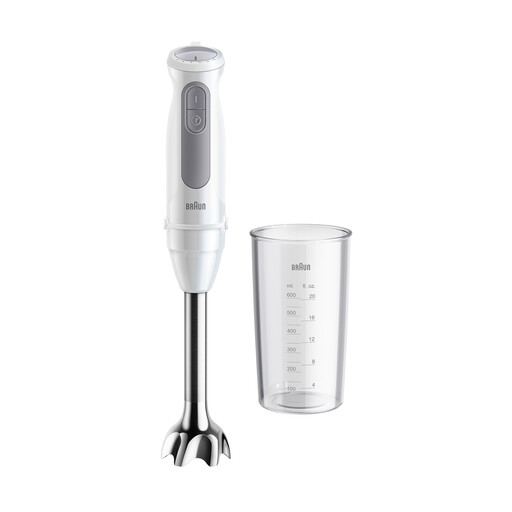
Why it suits this user type: The product information lists a 1000W motor, 21 speeds, a variable speed control and dishwasher-safe parts. That gives you plenty of options for making sauces, smoothies and desserts.
You’re not paying for wattage alone: the speed control and EasyClick Plus system are clearly specified features. Before use, check the manual for the permitted operating time.
1000W, 21 speeds, splash protection and an accessory system.
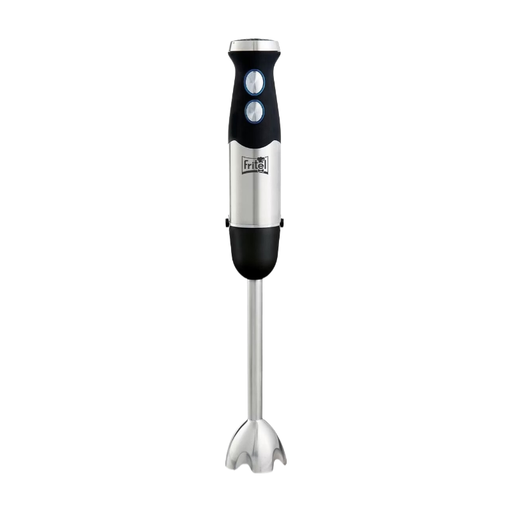
Why it suits this user type: This powerful hand blender has 800W, a 25 cm blending shaft, a stainless steel shaft and a set with a whisk, chopper and measuring jug.
The long shaft and metal construction are clearly specified. The manual states a maximum continuous operating time of 60 seconds, so plan to take breaks when preparing larger quantities.
800W, a 25 cm shaft, six blades and accessories for chopping and whisking.
We’ve put together a complete, up-to-date list of products that meet these strict selection criteria and the applicable European safety regulations.
For most soups, smoothies, sauces and soft vegetables, 600W is generally a practical choice. Check the jug’s capacity and the maximum operating time, too. Frozen or hard ingredients may require a model whose manual explicitly says it can handle them.
A hand blender, also known as an immersion blender, purées ingredients directly in a pan, bowl or jug. A hand mixer usually uses beaters for batter, cream and egg whites. If you need both functions, you could choose a hand blender with a whisk, but check that the accessory is actually included.
Its lifespan depends on how you use it, clean it and the demands you place on it. Don’t run the motor for longer than instructed, don’t force it to handle hard ingredients, and clean the blades straight away. A removable, dishwasher-safe foot can make maintenance easier. Store the hand blender somewhere dry and follow the manufacturer’s safety instructions.
