
Vandaag of morgen in huis

Kwaliteit gegarandeerd

Welkomstaanbiedingen ontgrendelen: GRATIS bezorging | Tot 80% korting | Gratis 30 dagen JoyPlus-proefperiode
Download de app
A hand blender can purée soup, blend smoothies, smooth sauces and, with the right accessories, also chop or whisk. Even so, a purchase can sometimes disappoint. A device may look powerful on the packaging, but prove difficult to clean in practice or not be suitable for the recipes you regularly prepare.
As a Joybuy Product Recommendation Officer, I filter product information based on practical considerations. Below, you’ll find what to look out for, which marketing claims are worth checking and which models suit different usage scenarios.
A higher wattage does not automatically mean that a stick blender is suitable for every task. The shape of the blade guard, the type of blade, the blending cup and the recommended operating time also matter. A compact model is often sufficient for soft vegetables and fruit. For thick soup, nuts or hard ingredients, power, speed and accessories are more important when considered together.
Also pay attention to the difference between rated and maximum power. Some models only state their peak power. Always check the technical specifications and usage restrictions.
A hand mixer works with beaters and dough hooks. This type is designed for cake batter, whipped cream and dough. A hand blender or stick blender uses a blending foot with blades and is intended for puréeing and liquid preparations.
The Braun MultiMix 3 HM3105 and Philips 5000 Series HR3745/00, for example, are hand mixers. They are suitable for baking, but not for puréeing a pan of soup. If you’re looking for a kitchen blender for smoothies or sauces, you need a different appliance.
The term “4-in-1” means little if it is not clear which parts are included in the box. Check whether a whisk, chopper, measuring cup or blending beaker is actually included. Also look at the capacity: a 350 or 500 ml chopper is practical for herbs, nuts or small portions, but less suitable for a large family.
For everyday use, hand blenders are available in a wide range of power classes. Models from 300 to 450 watts are worth considering for simple smoothies, soft vegetables and sauces. A powerful hand blender rated at 600 to 800 watts offers more scope for thicker mixtures, depending on the manufacturer’s instructions.
Multiple speed settings give you greater control over the texture. A low setting helps with gentle blending or frothing, while a higher setting is useful for thick soups and firmer ingredients. A turbo function can provide extra speed temporarily, but only use it as instructed in the manual.
A stainless-steel blending foot is easy to rinse and is often chosen for everyday use. Check whether the foot is detachable. This makes cleaning easier, but the motor unit must not be submerged in water.
Splash protection around the blades helps to reduce splashes. Extra care is needed when working with hot preparations: follow the temperature limit in the manual and keep the blending foot below the surface before starting.
A 600 to 800 ml measuring cup is well suited to smoothies, sauces and small portions of soup. For several people, a larger pan or bowl may be more convenient. With a BPA-free blender, check exactly which parts are BPA-free. The Braun MQ10.201MWH, for example, states that the food-contact parts are BPA-free; always check the latest product specification and manual before use.
Detachable parts that are dishwasher-safe according to the product information can save time. This does not automatically apply to the motor unit. Also check whether accessories are available separately and how much storage space the set requires. A compact appliance is appealing for small kitchens, but an extensive set needs more room to store.
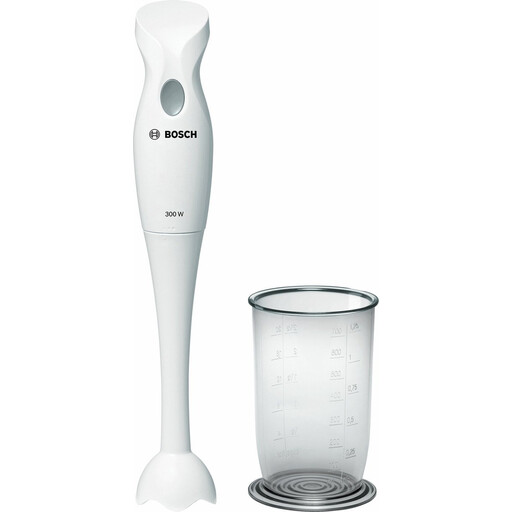
Why it suits this profile: This 300W stick blender is compact and comes with a measuring cup. It is suitable for simple tasks such as blending soft ingredients and puréeing small portions.
The product information specifies 300W, one speed, a turbo function and detachable dishwasher-safe parts. This makes the key features clear.
Compact design, measuring cup and a 1.5-metre cord according to the product specifications.
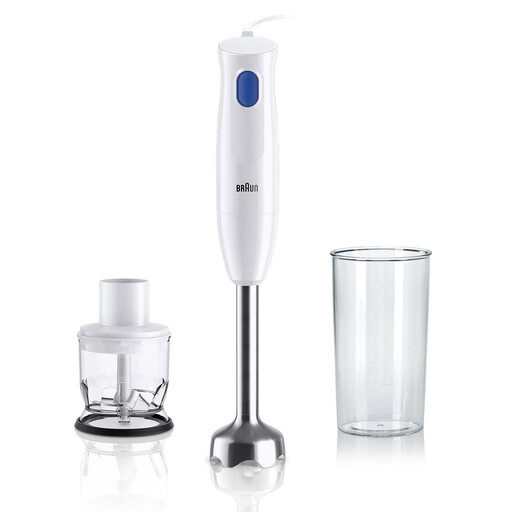
Why it suits this profile: This model combines 450W with a lightweight design, one-button operation and an EasyTwist system for accessories.
The contents of the set are clearly specified: a 600 ml BPA-free measuring cup and, according to the product description, a whisk and 350 ml chopper.
450W motor, EasyTwist changeover system and food-contact parts listed as BPA-free.

Why it suits this profile: If you often make soup, pesto, batter or sauces, 800W, 20 speeds and a turbo setting may be useful, as stated in the product specifications.
The power, 20 speeds and included whisk and chopper are specified. According to the listing, the detachable parts are dishwasher-safe.
800W, variable speed control, turbo function and stainless-steel housing according to the product information.
A stick blender is useful when you want to work directly in a pan, bowl or measuring cup. This is practical for soup and sauces and takes up little storage space. A kitchen blender with a fixed jug is more suitable if you regularly make larger quantities of smoothies or cold drinks.
For keen bakers, a hand mixer with a whisk and dough hooks is the more logical choice. A hand blender with a whisk can mix cream or eggs, but it cannot always replace a hand mixer for heavy dough. So first consider which preparations appear most often on your menu.
We’ve compiled a complete, up-to-date list of products that fully meet these strict selection criteria and the applicable European safety regulations.
That depends on the model and its instructions. Check the permitted temperature and use a suitable pan or cup. Keep the blades fully below the surface to reduce splashing, and allow hot liquid to cool first if the manual requires this.
Its lifespan depends on how it is used, how well it is maintained and whether the maximum operating time is observed. Allow the motor to cool between demanding tasks, avoid overloading it and clean the blades immediately after use. Store sharp parts out of children’s reach.
A hand blender is usually used for a relatively short period at a time. Total consumption is mainly determined by the wattage and operating time. An 800W model uses more electricity per minute than a 300W model, but may be used for less time. Consider your recipes rather than looking at the wattage alone.
