
Vandaag of morgen in huis

Kwaliteit gegarandeerd

Welkomstaanbiedingen ontgrendelen: GRATIS bezorging | Tot 80% korting | Gratis 30 dagen JoyPlus-proefperiode
Download de app
A hand blender seems simple: connect the motor, add the ingredients and start blending. Yet many people buy a model that disappoints them after just a few weeks. The power may be insufficient for hard ingredients, accessories end up unused in a kitchen cupboard, or cleaning takes longer than expected.
When searching for the “best hand blender”, many people look first at wattage or price. These are useful indicators, but they do not tell the whole story. Also consider the controls, choice of materials, jug capacity, cleaning and maximum operating time.
A 1000-watt hand blender or a 1200-watt hand blender has a powerful motor on paper. That does not automatically mean it will process every ingredient equally well. The shape of the blade guard, the number of blades and the way ingredients are directed towards the blade also play a part.
For soup, soft vegetables and smoothies, a lower power rating may be sufficient. For nuts, ice cubes or thick mixtures, a more powerful model with suitable accessories is more practical. Always check what the manufacturer considers suitable according to the product description.
A hand blender with accessories can partly replace a hand mixer, whisk and mini chopper. This is useful if you regularly make batter, whipped cream, pesto, chop herbs or prepare baby food. However, a comprehensive set takes up more space and means more washing up.
So choose carefully. A hand blender with whisk is well suited to baking and light, airy mixtures. A hand blender with chopper is useful for onions, herbs, nuts and small portions. If you mainly make soup and sauce, a separate blending attachment with measuring jug may be all you need.
A detachable blending foot makes cleaning easier. However, check which parts are dishwasher-safe. The motor unit, plug and cord must not be immersed in water.
Also read the operating instructions. Some models may only run for a limited time at once and then need to cool down. This is particularly important when preparing thick mixtures or larger quantities.
The wattage indicates the electrical power input, but it is not a direct guarantee of a particular blending result. For everyday use, models rated at around 600 to 800 watts are often suitable for soup, sauce, fruit and soft vegetables. If you regularly process hard ingredients, you may want to consider a powerful hand blender rated at 1000 or 1200 watts.
Several speed settings give you more control. A low setting is useful for liquid mixtures and reducing splashing. A turbo setting or higher speed can help with thicker preparations. A model with 21 settings, such as the Braun MQ50051M, offers more adjustment options than an appliance with just two speeds.
A stainless-steel blending foot is generally practical for hot soups and intensive kitchen use, provided you follow the safety instructions. Pay attention to the shape of the blade guard. Splash protection can help reduce splashing, but you should still place the foot fully into the mixture before switching the appliance on.
According to Philips’ product description, the HR2683/00 features ProMix technology and a special anti-splash blade guard. According to Braun’s own product information, the MQ50051M and MQ50001 are equipped with PowerBell VPlus technology. These brand claims describe how the products work according to the manufacturer; the final result also depends on the recipe, quantity and how the appliance is used.
A 500 to 700 millilitre measuring jug is suitable for smoothies, dressings and small portions. For larger quantities, a 0.9-litre mixing bowl, such as the one supplied with the Haier HHB5B5/1 011 I-Master Series 5, is more practical. Check whether the stated capacity refers to the maximum fill level rather than just the bowl’s total capacity.
Also consider:
A hand blender is not the same as a hand mixer. A hand mixer is primarily designed for whisking and making batter with two beaters. A hand blender uses a blending foot and is better suited to puréeing, emulsifying and blending in a pan or jug.
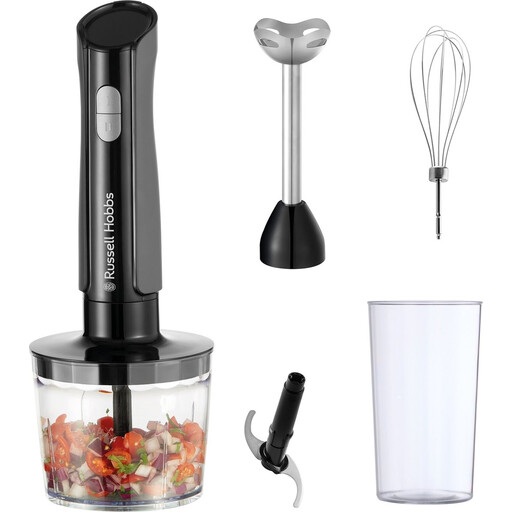
Why it suits this profile: This set combines blending, whisking and chopping without the need for a large kitchen appliance. The blending jug has a capacity of 600 ml and the chopping bowl holds 500 ml.
The specifications list two speeds, detachable parts and dishwasher-safe components. This keeps operation straightforward and cleaning to a minimum.
500 watts, two speeds, whisk and chopping attachments, plus a 1.2-metre cord.
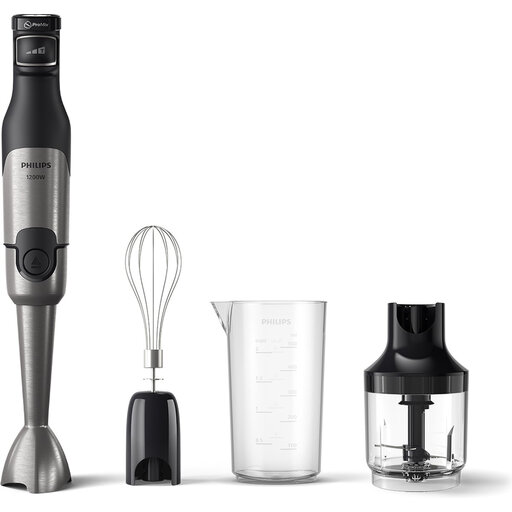
Why it suits this profile: The 1200-watt motor, three speeds and supplied chopper, measuring jug and whisk give you plenty of scope for a wide range of recipes.
The product information explicitly lists three speeds, splash protection and a BPA-free measuring jug. This lets you assess power and control together.
1200 watts, three speeds, 0.5-litre measuring jug and three accessories.
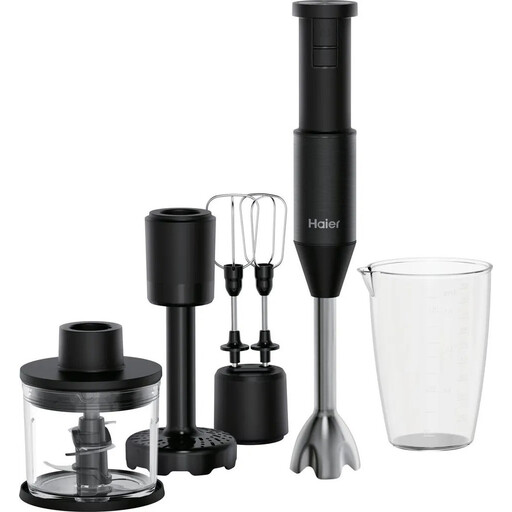
Why it suits this profile: The 0.9-litre blending capacity is practical for families and larger portions of soup, sauce or milkshake.
The product details list a stainless-steel foot, three blades, detachable parts, a whisk, measuring jug and chopper.
0.9-litre capacity, three blades, ergonomic handle and several detachable accessories.
We have put together a complete, up-to-date list of products that fully meet these strict selection criteria and the applicable European safety regulations.
This depends on the instructions and the model’s temperature limit. Only use the hand blender for this purpose if the manufacturer permits it. Keep the blending foot fully submerged to reduce splashing, and avoid switching it on in an almost empty pan.
Its lifespan depends on how often it is used, the ingredients processed, cleaning and whether the maximum operating time is observed. A model that regularly processes hard ingredients is placed under greater strain than one used only for soft soup and smoothies. Store accessories dry and prevent the motor unit from getting wet.
A hand blender usually runs for only a short time, so total electricity consumption per preparation remains limited. The wattage indicates the power used during operation, not automatically the consumption for each recipe. A higher wattage can be useful for demanding tasks, but it is not necessary for every user.
