
Vandaag of morgen in huis

Kwaliteit gegarandeerd

Welkomstaanbiedingen ontgrendelen: GRATIS bezorging | Tot 80% korting | Gratis 30 dagen JoyPlus-proefperiode
Download de app
A hand blender, also known as a stick blender, is handy for making soup, smoothies, sauces, dips and baby food. However, not every model is suitable for the same tasks. A low price might seem appealing, but a weak motor, awkward accessories or parts that are difficult to clean can quickly make using it a frustrating experience.
That's why you should look beyond just the wattage or the number of accessories. The right choice depends on what you'll be preparing, the quantities you usually make, and how much control you want while blending.
A powerful hand blender sounds appealing, but wattage doesn't tell the whole story. It indicates the maximum electrical power the motor uses, not necessarily how efficiently the appliance processes ingredients. The shape of the blending wand, the blades, the speed control and the maximum continuous running time also play a part.
A 450-watt model can be sufficient for smoothies and sauces. For thicker soups, nuts or hard vegetables, a hand blender with more power and multiple speeds is often more practical.
A hand blender with accessories might include a whisk, a measuring beaker and a chopper attachment. These are handy if you regularly whip cream, chop herbs or prepare batter. If you'll rarely use the extra parts, they'll mostly just take up cupboard space.
Also, check the capacity. A 350 ml or 500 ml chopper is suitable for smaller portions. For a family, a 700 ml or 800 ml blending beaker might be more convenient, but never fill it past the maximum fill line.
Food residue can easily get stuck around the blades or in the connections. Therefore, check if the blending wand and accessories are detachable and whether the manual says they are dishwasher-safe. The motor housing must not be submerged in water.
An "easy-to-clean hand blender" doesn't mean that every part is dishwasher-safe. Check the product information and the permitted temperature for each individual part.
For light tasks like making milkshakes, blending soft vegetables and preparing sauces, a power output of around 300 to 450 watts can be suitable. If you often process thick soups, pesto or nuts, you might want to look for a model with 600 to 1,000 watts. Higher wattage is no guarantee of a smoother result, but it generally provides more leeway for tougher jobs.
A hand blender with multiple speeds offers more control:
Always check the manual. For example, some models can only run continuously for one minute before they need to cool down.
A stainless steel hand blender often has a stainless steel blending wand or blades. Stainless steel is resistant to corrosion and suitable for food contact, provided the part is maintained according to the instructions. Furthermore, a metal blending wand can be more practical for hot preparations than some plastic versions.
Pay attention to the safety instructions for hot liquids. According to the product information for some models, hot ingredients must be left to cool first. Never use a stick blender in boiling liquid unless the manual explicitly states that it is safe to do so. A splash guard around the blending wand can help to reduce mess.
A 4-in-1 hand blender usually combines a blending wand with a whisk, a chopper and a measuring beaker. Check that the product name accurately reflects what's included in the box. A hand blender with a whisk is a great choice for cream, eggs and light baking tasks. A hand blender with a chopper is especially practical for herbs, nuts, onions and small portions of vegetables.
Also, pay attention to:
A hand mixer, such as the Cuisinart HM7E, is designed for whipping, mixing and kneading with beaters and dough hooks. This is not the same as a stick blender for soups and smoothies. So, always check the product type before you order.
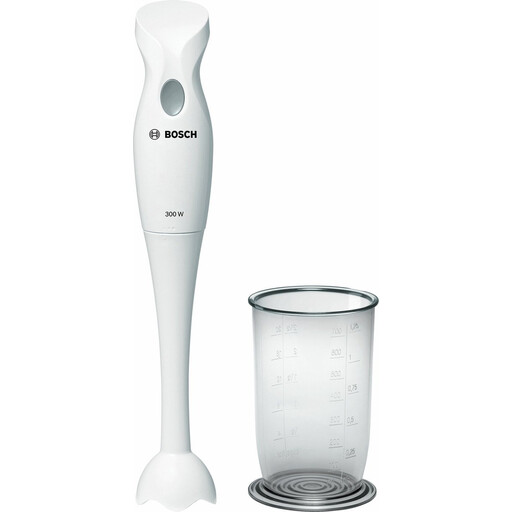
Why it's a good match: This model has a straightforward design with 300 watts of power, one speed, a turbo function and an included measuring beaker. This makes it ideal for simple, everyday tasks.
The specifications make it clear that this is a basic hand blender. This means you're not paying for accessories you might not need.
300 watts, turbo function, detachable parts that are dishwasher-safe according to the product information, and a 1.5-metre cord.

Why it's a good match: The combination of 1,000 watts, 25 speeds, a turbo function and a chopper attachment gives experienced home cooks plenty of settings to play with.
The number of speeds and the accessories are clearly described. This allows you to base your choice on texture and preparation method, rather than on vague marketing claims.
25 speeds, turbo function, splash-control wand, three texture settings in the chopper, and dishwasher-safe parts according to the product description.

Why it's a good match: For those who want a single appliance for soups, sauces, smoothies, whipping and chopping, this set offers multiple functions and large-capacity beakers.
The set separately lists the 700 ml blending beaker and the 500 ml chopper. It also specifies a usage limit of one minute of operation followed by one minute of rest.
Up to 1,200 watts, 15,000 rpm according to the product information, variable speed control, stainless steel blade and whisk, with overheat protection.
We have compiled a complete, up-to-date list of products that fully meet these strict selection criteria and comply with current European safety regulations.
A statutory warranty of at least two years applies to many electrical kitchen appliances in the European Union. An additional manufacturer's warranty may have extra conditions. Therefore, keep your proof of purchase and check what is covered by the warranty.
Yes, many models are designed for soups, smoothies, sauces and purées. However, you should always check the power, the shape of the blending wand and the instructions for hot liquids. For large quantities, a jug blender may be more practical than a stick blender.
That depends on how you plan to use it. Around 300 to 450 watts is often enough for soft ingredients and simple preparations. For thicker mixtures and regular chopping, you might want to look at models from around 600 watts upwards. Always compare the speeds, accessories and maximum continuous running time as well.
The lifespan depends on usage, maintenance and how much strain it's put under. An appliance that isn't overloaded, is allowed to cool down between uses and is cleaned correctly will generally last longer. Follow the manual and choose a model with parts that click securely into place and are replaceable if necessary.
