
Soup maker with limited cupboard space
You want to blend soup straight in the pan and store as few parts as possible. The Dutch Consumers' Association (Consumentenbond) lists blending in the pan as a practical way to use a hand blender.


For cooked beetroot that you want to blend straight in the pan, a hand blender is a practical choice. The Dutch Consumers' Association (Consumentenbond) lists blending in the pan as a useful way to use this type of blender. Choose a simple model if you want to keep storage to a minimum and mainly make soup, or look for speed settings and attachments if you’ll use those extra features too. Before buying, check the specifications and safety information for the exact model.
You want to blend soup straight in the pan and store as few parts as possible. The Dutch Consumers' Association (Consumentenbond) lists blending in the pan as a practical way to use a hand blender.
You make soup in a compact kitchen and pay attention to the controls, the design of the blending shaft and how you blend. The Dutch Consumers' Association advises placing the blending shaft in the pan before switching the blender on.
You want to chop or whisk ingredients as well as make soup, and weigh up the extra features against the space needed to store the attachments.
Start with the task you do most often. For soup, blending straight in the pan matters most, while speed settings and extra attachments are mainly useful if you’ll use them for other recipes too.
| What to consider | What to look for | Who is this important for? |
|---|---|---|
| Blending beetroot soup | Check whether the model is designed for soup and how you control the speed. Cook hard vegetables until tender first. | I want to blend cooked beetroot straight in the pan and adjust the mix if needed; around 36% of consumers prioritise blending performance. |
| Storage in a small kitchen | Check the dimensions of the exact model, what’s included in the set and where you can store the motor unit and blending shaft. | If I have limited cupboard space, I mainly want room for the blender and its parts without having to clear an extra space; around 29% of consumers prioritise storage space. |
| Minimising splashes and cleaning | Look for a removable blending shaft and check the cleaning instructions for the specific model. Place the shaft in the pan before switching it on. | I want to blend in a controlled way and clean the blending shaft easily afterwards; around 21% of consumers prioritise clean, controlled blending. |
| Other recipes | Check exactly which attachments are included in the set; a chopper or whisk means extra parts to store. | If I regularly want to chop or whisk ingredients as well as make soup, a set with those attachments could suit me; around 14% of consumers prioritise versatility. |
A chopper and whisk are designed for other tasks; the blending function is all you need for soup.
Choose attachments to suit what you actually want to make, and check what’s included in the exact set.
Extra attachments take up storage and cleaning space.
The stated motor power alone doesn’t tell you how finely or evenly a hand blender will blend soup. The Dutch Consumers' Association considers fineness and evenness when assessing blending results.
Compare the controls and, where available, independent blending results for the exact model.
Names such as AntiSplash and SplashControl are manufacturers’ claims and don’t guarantee that hot soup won’t splash. The position of the blending shaft and when you switch the blender on also make a difference.
Keep the shaft in the pan when switching on and follow the model’s instructions.
Splashes can mean extra cleaning.
The ErgoMixx MSM66110 is an example of a hand blender with a removable metal blending shaft and two speed settings, designed for blending.
Braun presents the MultiQuick 1 MQ 100 Curry as a compact model with simple controls and few parts to store.
Philips presents the 3000 Series HR2521/40 as a lightweight hand blender for soup and other uses.
According to Tefal, the Quickchef HB659838 combines a hand blender with a measuring jug and chopper. These extra features are mainly useful if you plan to use them.
These hand blenders are suited to blending soup, with options for speed control and sets that include extra attachments.
 Image unavailable
Suitable if you want to blend soup and adjust the speed. The product description lists 20 speeds, a turbo function, a splash-protective design and removable parts.
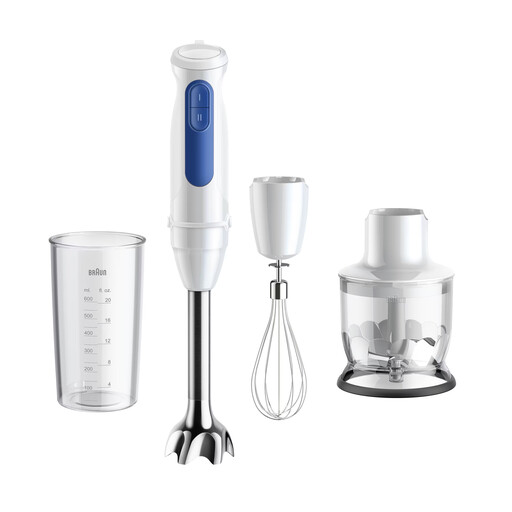 Image unavailable
An option if you want to blend soup and choose between two speeds. The product description lists a removable blending shaft, SplashControl and dishwasher-safe parts.
 Image unavailable
This set is suitable if you want to blend soup and use a chopper or whisk too. The product description lists a removable stainless steel blending shaft, a turbo function and dishwasher-safe accessories; the extra parts need storage space.
 Image unavailable
Suitable if you want to blend soup, adjust the speed and use a chopper as well. The product description lists 25 speeds, SplashControl and dishwasher-safe parts; according to the description, don’t use this model with boiling liquids.
 Image unavailable
A set for anyone who wants to blend soup and use a chopper or whisk too; the extra parts take up storage space. The product name lists up to 1200 W, 15,000 rpm, a 700 ml measuring jug and a 500 ml chopper. The stated operating cycle is up to 1 minute of continuous use, followed by 1 minute of rest.
Yes. Cook hard vegetables until tender first; cooked vegetables are easier to blend. Add liquid if needed and check whether the soup is smooth enough.
Put the blending shaft in the pan first, then switch the blender on. Unplug it before detaching and cleaning any parts. Check your model’s manual to see which parts are dishwasher-safe.
Electrical equipment covered by the relevant rules must carry a CE mark. The Netherlands Food and Consumer Product Safety Authority describes the low-voltage rules for equipment with a nominal AC voltage of 50 V to 1000 V inclusive. Check the marking and safety information for the specific mains-powered model; a CE logo is not an independent quality mark.
Not necessarily. According to the Dutch government, consumers in the Netherlands have the right to a product that works properly, with no fixed statutory guarantee period, and should contact the retailer if there’s a problem. Check whether paid-for extra cover actually adds anything to your rights.