
Vandaag of morgen in huis

Kwaliteit gegarandeerd

Welkomstaanbiedingen ontgrendelen: GRATIS bezorging | Tot 80% korting | Gratis 30 dagen JoyPlus-proefperiode
Download de app
Loose shoes in the hallway can quickly take up more space than you expect. A shoe rack, shoe cabinet or shoe organiser can restore order, but not every model suits every home. A narrow hallway calls for different dimensions than a spacious walk-in wardrobe. Capacity, ventilation and assembly also determine whether your purchase remains practical in everyday use.
Pay particular attention to these three common pitfalls:
For a hallway shoe rack, depth is particularly important. A model measuring around 24 to 30 cm can fit along a wall more easily than a wide shoe cabinet. Also check that doors can open fully and that enough space remains for putting your shoes on and taking them off.
A narrow shoe rack is not automatically suitable for every hallway. A tall rack makes good use of vertical space, but it can be visually imposing. A compact model is more suitable for a low cupboard or beneath a coat rack.
Do not compare only the stated number of pairs. Also check:
A shoe rack for 30 pairs is practical for a large household, but may be unnecessarily large if you mainly want to store a few everyday pairs. For an extensive collection, stackable shoe boxes can offer more control: you can organise the shoes by pair and quickly see what is inside through the transparent doors.
A metal shoe rack generally has an open construction, allowing air to circulate between the shoes. This makes it suitable for everyday use, although the shoes remain visible. Polypropylene and other plastic components are lightweight and easy to wipe clean. A closed shoe cabinet keeps shoes out of sight, but check that the design has sufficient ventilation openings.
Also consider maintenance. Clean metal with a soft, slightly damp cloth. Wood-effect panels should not be left wet for extended periods. With a hanging shoe organiser, it is wise to check that the door, rail or cabinet structure can support the additional weight.
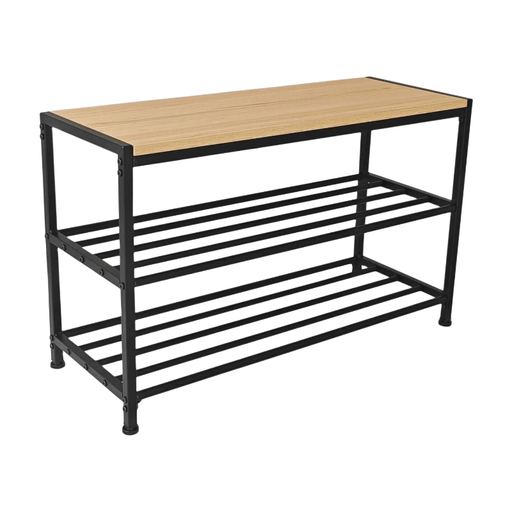
Why it suits this profile: This compact model holds up to 6 pairs and has a top shelf for small accessories. Measuring approximately 80 x 30 x 49,2 cm, it fits in a hallway, bedroom or corridor where space is limited.
The dimensions and capacity are clearly stated, so you can check in advance whether 6 pairs will be enough. The open construction prevents your shoes from disappearing into an untidy pile.
Black powder-coated metal, a wooden top shelf, open ventilation and a freestanding design.
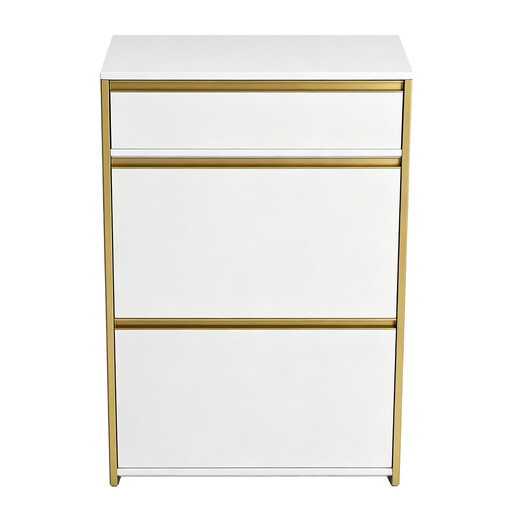
Why it suits this profile: This shoe storage cabinet combines enclosed storage with a drawer, a top surface and adjustable or removable shelves. Measuring 60 x 24 x 104,5 cm, it is designed for narrow hallways and multifunctional use.
The adjustable layout prevents every compartment from having the same height. However, you should compare the stated capacity of up to 12 pairs with the shape and size of your own shoes.
Two doors, four adjustable shelves, a drawer and an anti-tip feature for wall mounting.

Why it suits this profile: This tall freestanding rack is designed to hold up to 30 pairs and measures 65,5 x 24,5 x 138 cm. It is suitable when you want to store lots of shoes vertically without installing a deep shoe cabinet.
The product information lists the capacity and external dimensions separately. Check the available height in advance and place the rack on a level surface; wall mounting is recommended where there is a risk of tipping.
Metal construction, space for 30 pairs, a white finish and a relatively shallow depth of 24,5 cm.
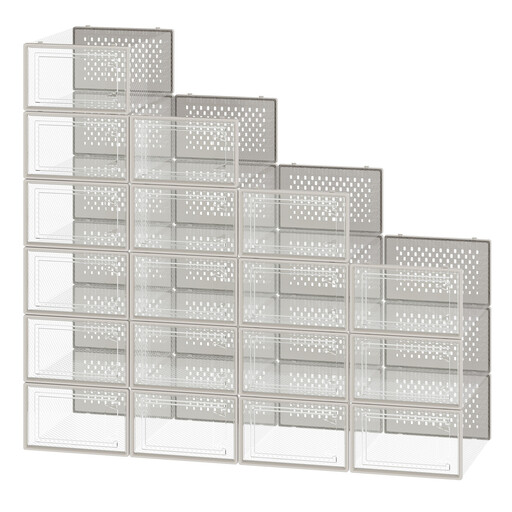
Why it suits this profile: The 18 individual boxes are stackable and have transparent doors. According to the product description, the internal dimensions are 31,2 x 22,5 x 13,5 cm and they accommodate shoes up to UK size 11.
You can check the space available for each pair rather than relying solely on the total capacity. Measure wide trainers and high-top shoes beforehand, as the boxes have fixed internal dimensions.
18 transparent boxes, stackable connectors, ventilation openings and a plastic construction.
We have put together a complete, up-to-date list of products that fully meet these strict selection criteria and the applicable European safety regulations.
Before assembly, check that all parts are included and read the instructions. Place a freestanding shoe rack on a level floor. A tall or heavily loaded model may require additional stability. Do not use a shoe rack as seating unless it has been specifically designed as a shoe bench.
When loading the rack, place the heaviest shoes at the bottom. Keep the pairs you wear every day at eye level and use higher compartments for seasonal footwear. Transparent boxes keep everything easy to see, while a closed shoe cabinet gives the hallway a tidier appearance.
This depends on the available wall space and the number of shoes. First measure the clear width and depth, including skirting boards and doors. A narrow model around 24 to 30 cm deep can be suitable for a corridor, provided enough walking space remains.
Place the rack on a level surface, distribute heavier shoes towards the bottom and do not exceed the stated load capacity. A tall model, or a household with children, may benefit from being secured to the wall for extra stability. Always follow the manufacturer's assembly instructions.
A shoe cabinet keeps shoes out of sight and can reduce dust. An open rack provides better ventilation and direct access. The right choice depends on the space available, the number of pairs and whether you want to air and retrieve your shoes every day.
