
Vandaag of morgen in huis

Kwaliteit gegarandeerd

Welkomstaanbiedingen ontgrendelen: GRATIS bezorging | Tot 80% korting | Gratis 30 dagen JoyPlus-proefperiode
Download de app
A hair dryer may seem simple, but models can differ considerably. Wattage doesn’t tell you everything about drying time, an ionic function won’t necessarily prevent frizz, and a long list of attachments can prove impractical in everyday use. If you focus only on price or marketing claims, you could end up paying for features you barely use.
This buying guide helps you compare hair dryers using specifications you can check. Find a model to suit straight, wavy or curly hair, everyday use, more intensive styling or travel.
A powerful hair dryer often has a higher wattage, but wattage isn’t the same as airflow. The motor design, air outlet and selected speed also affect how quickly your hair dries. So, as well as checking the wattage, look at the number of speed and temperature settings and any stated airflow figures.
An ionic hair dryer is often promoted as a solution for static or frizzy hair. According to information from the brands concerned, the ionic function is designed to help reduce static or frizz. However, results vary depending on your hair type, drying technique and the products you use. Think of ionic technology as an extra feature, not a guaranteed result.
A hair dryer with a diffuser is handy for curls and volume, while a hair dryer with a concentrator nozzle directs airflow towards a brush. Check that the attachments fit securely and that you’ll actually use them. A diffuser you never use mainly takes up storage space and adds to the cost.
For everyday use at home, many models have a stated wattage of around 1,800 to 2,300 watts. A fast-drying hair dryer can be useful for thick or long hair, but higher wattage also means more electricity used if you run the appliance for longer.
Some models state a specific airflow figure. For example, the Remington D6077 has a stated airflow of 120 km/u. This gives you a better point of comparison than a general term such as ‘high speed’. Also consider the weight. A lightweight hair dryer is particularly practical if you spend a long time blow-drying or often use a round brush.
Where possible, choose a model with several combinations of heat and speed. A hair dryer with temperature control gives you more control when styling fine or thick hair, or using a brush. A low setting is often suitable for gentle drying or using a diffuser; a higher setting can save time when your hair is towel-dried.
A hair dryer with cool air has a cool-shot function to finish your style. Cool air doesn’t replace good technique: keep the appliance moving and don’t direct hot air at one spot for too long.
A diffuser distributes the airflow and can be a good match for a hair dryer for curly hair. Use it on a lower speed if you want to preserve your curls’ or waves’ natural shape. For straight hair and blow-drying with a brush, a narrow concentrator nozzle is more practical.
Check the filter too. A removable filter is easier to clean and helps prevent dust and hair from blocking the air inlet. A swivel cord, hanging loop and sufficient cord length make everyday use more comfortable. For a travel hair dryer, a folding handle, low weight and, where relevant, dual voltage are useful features. When travelling outside Europe, always check the mains voltage and plug type.

Why it suits this user: This model offers a straightforward set of features for home use, with 1,800 watts, three speeds, three temperature settings and an ionic function.
The three temperature and speed settings mean you aren’t limited to simply switching between on and off. Check that the concentrator nozzle you want is included.
1,800 watts, three speeds, three temperature settings, plus hot and cool air.
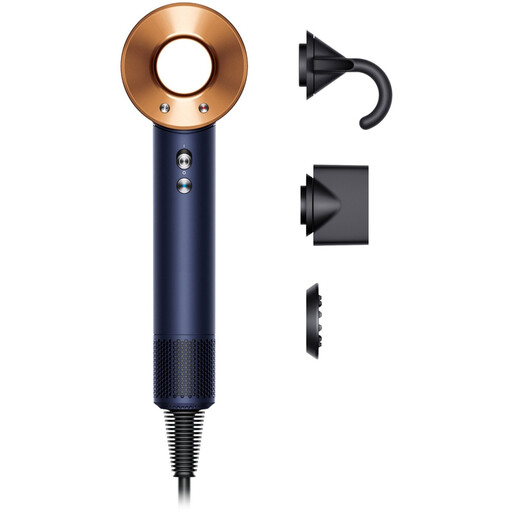
Why it suits this user: The stated specifications focus on controlled airflow, several heat settings and temperature monitoring during use.
Temperature control gives you more choice than one fixed hot setting. The product information lists three speeds, four temperatures and a cool-shot function.
Dyson V9 motor, three speeds, four temperature settings and a styling concentrator, according to the product description.
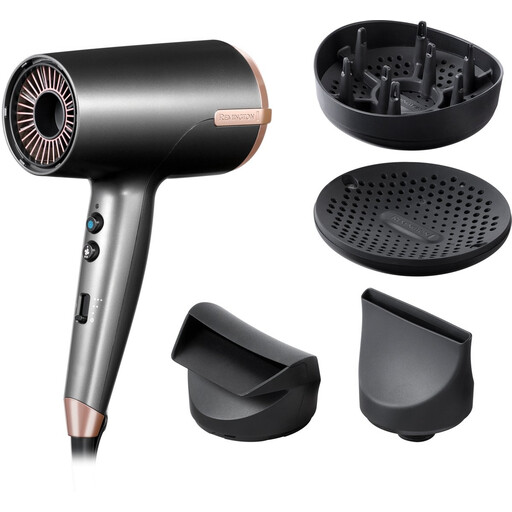
Why it suits this user: This is a practical choice if you regularly create different styles and want to use several attachments.
The eight heat and speed combinations reduce the need to rely on the same hot airflow every time. The model also has a filter and several attachments for directing the airflow.
2,000 watts, stated airflow of 120 km/u, four styling attachments and a cool-shot setting.

Why it suits this user: The folding handle and stated weight of 330 grams make this model suitable for short trips and small storage spaces.
Its compact design means you don’t have to take a bulky appliance with you when travelling. The listed contents include both a diffuser and a concentrator nozzle.
1,800 watts, folding design, stated weight of 330 grams, two speeds and three temperature settings.
We’ve put together a complete, up-to-date list of products that meet these strict selection criteria and the applicable European safety requirements.
Start with towel-dried hair and choose a medium temperature setting. Hold the hair dryer about 15 to 20 centimetres away, keep it moving and work in sections if needed. Use a diffuser for curls and a concentrator nozzle for straight or wavy hair. Let attachments cool before removing them.
Clean the filter regularly and keep the air inlet clear. Don’t use an electrical appliance near a bath, shower or washbasin. Check the cord and casing for damage, and unplug the appliance after use. Products in the Netherlands and the EU are generally covered by statutory conformity rights; check the seller’s warranty information for full details.
For everyday use at home, around 1,800 to 2,300 watts is a common choice. Also consider the airflow, temperature control and weight. High wattage isn’t essential for fine or short hair.
It can be, but the result depends on your hair and technique. For curls, use a suitable diffuser, a lower speed and a moderate heat setting. Brands promote ionic technology as a way to help reduce static or frizz, but the results aren’t guaranteed.
Its lifespan depends on how you use and maintain it, as well as the quality of the motor, cord and casing. Keeping the filter clean, the air inlet clear and the appliance stored carefully can help reduce wear. Stop using it if the cord is damaged, you notice a burning smell or sparks, or it repeatedly overheats.
