
Vandaag of morgen in huis

Kwaliteit gegarandeerd

Welkomstaanbiedingen ontgrendelen: GRATIS bezorging | Tot 80% korting | Gratis 30 dagen JoyPlus-proefperiode
Download de app
Choosing a new hair dryer may seem straightforward, but product pages are often packed with terms such as “high-speed”, “plasma ions” and “professional power”. These figures do not always tell the whole story. A model with a high wattage does not automatically dry hair faster, and an ionic function will not suit every user in the same way.
Pay particular attention to the combination of motor, airflow, temperature control, weight and accessories. This helps you avoid paying for features you will barely use.
A power rating of 1800 or 2300 watts sounds impressive, but it does not directly tell you how much air the hair dryer moves. A high motor speed, such as 110,000 RPM, should also be considered alongside the airflow speed, air outlet design and temperature control.
For everyday use, an airflow that is easy to adjust is often more practical than a high wattage alone. A fast hair dryer should dry your hair quickly without relying solely on extremely hot air.
According to brands’ own product information, negative ions may help reduce static electricity and frizz. This does not guarantee the same result for every hair type. An ionic hair dryer may leave fine or straight hair feeling smoother, while users with curly hair should mainly look for a suitable diffuser and a low heat setting.
Also note the difference between an ionic function and broader claims about “repair”, “health” or “protection”. Such claims cannot automatically be verified from a product page.
A concentrator nozzle is useful for targeted drying and smoothing. A diffuser distributes the airflow more widely and is relevant for curly hair or extra volume. If the right accessory is not included, you may need to buy it separately.
For travel, weight, a folding handle, dual voltage and overall size are also more important than a highly powerful motor. A heavy professional hair dryer may be comfortable to use at home but awkward to pack in a suitcase.
Do not compare wattage alone. Also look at:
A high-speed hair dryer with a brushless motor can be compact while still delivering powerful airflow. The promised drying time will still depend on hair length, thickness, moisture and styling technique. Towel-dry your hair first and keep the hair dryer moving continuously.
A hair dryer with temperature control gives you more control than a model with just one warm setting. At least two heat settings are useful for different hair types. Three or four temperatures provide extra flexibility for fine, thick, long or curly hair.
A hair dryer with cool air is useful for briefly finishing a style. Check whether it has a genuine cool-air button or simply a lower temperature. According to the product description, intelligent temperature control may monitor the air temperature, but this does not mean the appliance can be used without any risk of excessive heat.
A lightweight hair dryer weighing around 300 to 600 grams is generally more comfortable during longer drying sessions. For professional or intensive use, cable length, grip and filter cleaning are also important.
When assessing noise claims, check the stated measurement and conditions. A specified noise level, such as less than 65 dB, is mainly useful for comparisons within the same product category. In practice, the distance and setting can affect how loud the appliance seems.
Finally, check that the plug is suitable for Dutch sockets. For use outside Europe, multivoltage is important. A standard EU hair dryer will not automatically be safe to use with every mains voltage.
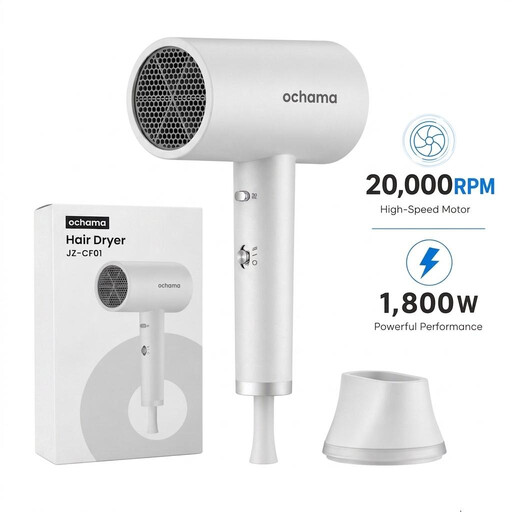
Why it suits this profile: A practical choice for home, a student room or everyday use without complicated controls.
The specifications state both 1600–1800 watts and an approximate weight of 480 grams, along with a concentrator nozzle. This tells you exactly what you are getting, rather than relying on a marketing term such as “fast”.
1800W motor, ionic function according to the product information, approximately 480g and a styling nozzle.
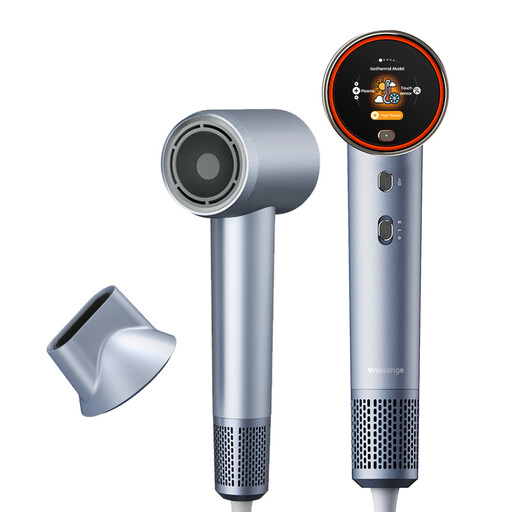
Why it suits this profile: For anyone who values extensive controls, a display and a powerful high-speed motor.
The five smart settings and HD LCD display make the controls visible. The claim of faster drying comes from Uniorange’s product information and depends on your hair type.
110,000 RPM brushless motor according to the specification, stated airflow of 25 m/s and a concentrator nozzle.

Why it suits this profile: Designed for long, thick or curly hair and users who want several styling options at home.
You are not limited to one hot, powerful setting: according to the product description, this model has three speeds, four temperatures and a cool-air setting.
Diffuser plus two concentrators, 1900W power, approximately 570g and a stated noise level below 65 dB.

Why it suits this profile: With its folding handle, weight of 257 grams and multivoltage, this is a sensible hair dryer for travelling.
The compact design is clearly described. Here, you are deliberately choosing portability rather than a large number of settings or a diffuser.
1200W, two temperature settings, styling nozzle, folding handle and multivoltage.
We have put together a complete, up-to-date list of products that fully meet these strict selection criteria and the applicable European safety regulations.
Its lifespan depends on the motor, frequency of use, maintenance and storage. Clean the air filter regularly, keep the air intake clear and only put the appliance away once it has cooled down completely. Automatic shut-off in the event of overheating is a safety feature, not a reason to ignore blockages in the airflow.
It can be, but an ionic function alone is not the deciding factor. For curls, a diffuser, several heat settings and low airflow are generally more important. According to brands’ own product information, ions may help reduce static electricity and frizz; the end result varies depending on hair structure and styling method.
Energy consumption is mainly determined by the power rating and how long the appliance is used. A 1800-watt appliance theoretically uses 1.8 kWh in one hour, although you will usually use a hair dryer for much less time. A model that dries hair faster may therefore run for less time per use, but always compare the stated power, settings and your own usage.
