
Vandaag of morgen in huis

Kwaliteit gegarandeerd

Welkomstaanbiedingen ontgrendelen: GRATIS bezorging | Tot 80% korting | Gratis 30 dagen JoyPlus-proefperiode
Download de app
Want to replace standard halogen bulbs with H7 LED headlight bulbs? At first glance, many models look identical. However, differences in the fitting, beam pattern, cooling and vehicle compatibility can determine whether your purchase performs properly. A high lumen rating alone says little about whether a bulb is suitable for your car.
In this buying guide, the Joybuy Product Recommendation Officer explains what to look for in H7 LED car bulbs, which claims to assess critically and which type is right for your needs.
Searches such as H7 LED bulbs 20,000 lumens are common. Manufacturers sometimes quote 13,000, 20,000 or even 25,000 lumens. However, this does not automatically mean better visibility on the road. The light distribution, position of the LED chip and headlight adjustment are at least as important.
A bulb with an incorrect beam pattern can create dark areas or dazzle oncoming drivers. According to ENdureLite’s own product information, several models are designed with a 1:1 beam pattern compared with a halogen bulb. Even so, check your headlight alignment after installation.
A plug-and-play H7 LED bulb generally uses the existing H7 fitting and does not require a separate adapter. That does not mean it will work without problems in every car. Some vehicles monitor the bulb’s power consumption. This can result in a dashboard warning, flickering or radio interference.
An integrated driver or H7 LED CANbus support can reduce this risk, but is no guarantee of compatibility with every vehicle. According to ENdureLite’s own product information, the integrated driver is designed for broad compatibility; however, sensitive European vehicles may still require an additional CANbus decoder.
LED bulbs produce less heat at the front than halogen bulbs, but the electronics and LED chip still need to be cooled. Models with a fan can be noisy in a cramped headlight housing or may not have enough room.
A rating such as IP68 means that, according to the product specifications, the housing provides protection against dust and water. Also consider the construction: the aluminium housing, fan and available space behind the bulb are all practical points to check. ‘Waterproof’ is therefore no reason to ignore the fit and sealing of the headlight.
H7 is a fitting type, not a universal bulb for every headlight function. In some cars, H7 is used for H7 LED dipped beam, while in others it is used for the main beam. Therefore, check:
Do not use an H7 bulb if your car requires H1, H4, H11, H18 or 9012/HIR2. A product title listing several fitting names may be useful for a range of variants, but you must select the exact version.
H7 LED headlight bulbs 6000K produce a cool white appearance that is closer to daylight than standard halogen. The colour looks modern, but a higher Kelvin rating does not automatically mean more light. In rain, fog or on wet tarmac, very cool white light may be perceived differently from warmer white light.
For H7 LED main beam and dipped beam, an even beam pattern is particularly important. Only use an H7 bulb if the headlight housing and vehicle application are suitable for it. H7 LED fog lights require extra attention to light distribution: a bright beam that is not properly shielded can be distracting for other road users.
Product listings for the selected ENdureLite models include an aluminium housing, an integrated fan running at 10,000 rpm, IP68 protection and a stated lifespan of 50,000 hours. These figures come from the manufacturer’s product information and are not an independent guarantee for every usage situation.
A fan must be able to rotate freely. Check that there is enough space behind the headlight and that the original dust cap still closes correctly. A passively cooled model may be quieter, while an actively cooled model is described in the product information as being designed to dissipate more heat.
Not every LED retrofit bulb is automatically approved for use on public roads in the Netherlands. Before buying, check the approval, vehicle list, light function and installation conditions for the specific model. If in doubt, a suitable halogen bulb or an officially approved LED retrofit is a safer starting point.
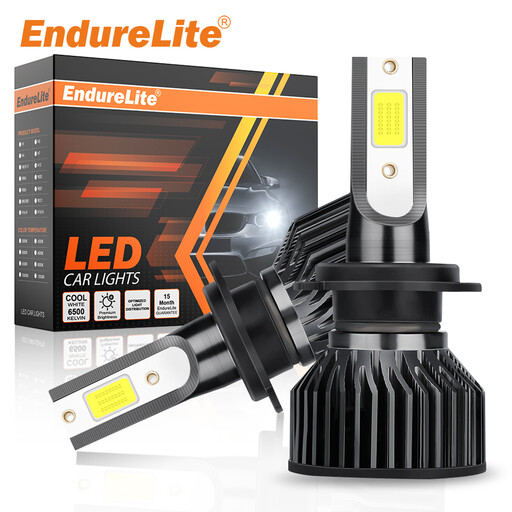
Why it suits this profile: A straightforward H7 set for motorists looking for cool white light and an easy replacement without additional wiring.
The product description specifies an H7 fitting, plug-and-play installation and integrated cooling. However, check vehicle compatibility yourself.
6000K cool white light, CSP LED chips, a stated 13,000 lumens and a set of two bulbs.
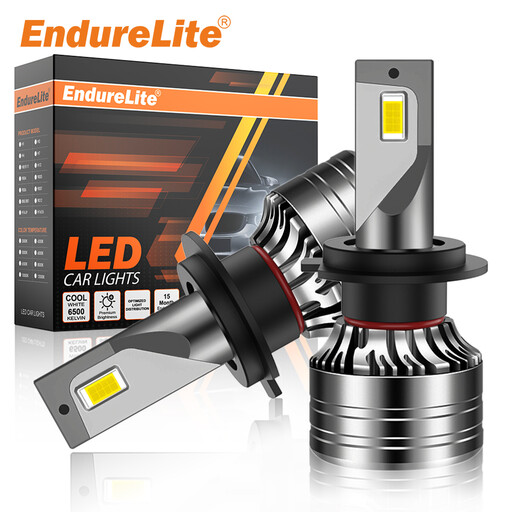
Why it suits this profile: Designed for those who want to combine several technical features: cool white light, active cooling and a design without a separate adapter, according to the product information.
The listed IP68 housing and fan address moisture and heat. The CANbus-ready designation may reduce faults, but a compatibility check is still necessary.
20,000 lumens according to the product listing, 6000K light, an aluminium housing and a stated lifespan of 50,000 hours.
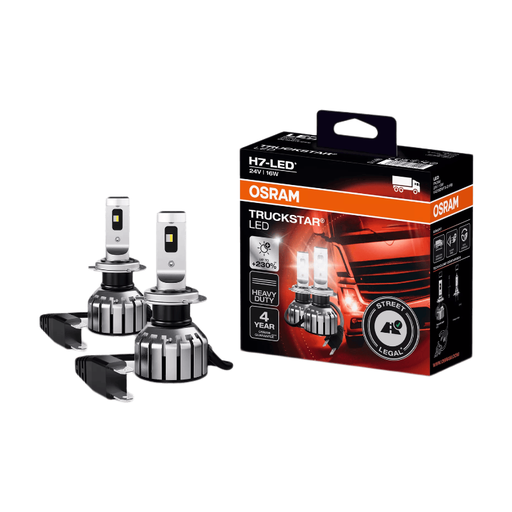
Why it suits this profile: A targeted choice for lorries, buses, tractors and other vehicles with a 24V system.
The product information explicitly specifies 24V use. This helps prevent you from ordering a lorry bulb for a standard 12V passenger car.
6000K light, a 24V specification and a manufacturer’s statement that it is suitable for heavy vehicles. Check the official vehicle list before installation.
We have compiled a complete, up-to-date list of products that fully meet these strict selection criteria and the applicable European safety regulations.
Replacing an H7 LED bulb is often straightforward, but take these steps seriously:
Do not touch the LED chip or other sensitive components with your bare fingers. With a fan-cooled model, also check that the fan does not catch on the dust cap.
No. Your car must use an H7 fitting, and the headlight housing must be suitable for the chosen light source. Also check CANbus compatibility, the available space and the applicable approval for your vehicle and light function.
Many product listings state a lifespan of 50,000 hours. This is a stated manufacturer’s figure and may be affected in practice by heat, moisture, usage time, voltage and the quality of the headlight housing. Good heat dissipation remains important.
LED technology can use less power than a standard halogen bulb for comparable light output. Do not look only at marketing claims: compare the stated wattage and check that the vehicle does not display an error message. A CANbus module may require additional power and may need to be purchased separately.
