
Vandaag of morgen in huis

Kwaliteit gegarandeerd

Welkomstaanbiedingen ontgrendelen: GRATIS bezorging | Tot 80% korting | Gratis 30 dagen JoyPlus-proefperiode
Download de app
Driving at night with dim, yellowish halogen bulbs can feel unsafe. Poor road visibility, delayed recognition of traffic signs, and an outdated look for your car are common frustrations. Upgrading to a modern H4 LED headlight can solve these issues by providing brighter, whiter light and a longer lifespan.
As a Joybuy Product Recommendation Officer, I'm here to help you see past the specs and marketing claims. This article provides practical tips and presents a selection of popular H4 LED bulbs, so you can make an informed choice for your vehicle.
Before making a choice, it's helpful to understand a few key points. This will help you better evaluate the specifications of different LED headlights for your car.
A bulb's brightness is expressed in lumens (lm). Generally, more lumens mean more light. The colour of the light is measured in Kelvin (K). Standard halogen bulbs have a yellowish tint of around 3200K. Bright white headlights have a colour temperature of 6000K to 6500K, which approximates daylight. This provides better contrast and visibility on the road.
No one wants a complicated installation. Many modern H4 LED bulbs feature a 1:1 design, meaning they have the same dimensions and connector as the original halogen bulb. This makes the process of replacing an H4 bulb a simple 'plug-and-play' task that you can often do yourself in minutes, without special tools.
LED chips produce heat. An effective cooling system, such as a built-in fan or an aluminium housing, is crucial for performance and lifespan. Proper cooling prevents the bulbs from overheating and losing their brightness. A bulb with a solid cooling system can achieve a lifespan of tens of thousands of hours, which is much longer than a traditional H4 car bulb.
Based on product specifications and popular features, we've selected H4 LED bulbs that offer an upgrade for both low beam and high beam LEDs.
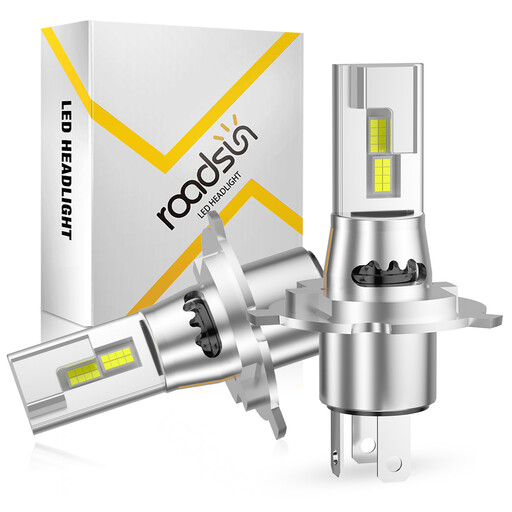
Why it stands out: According to the manufacturer, Roadsun, this bulb delivers 500% more brightness than a standard halogen bulb. The combination of high light output with a powerful cooling fan makes this an interesting option for those seeking maximum performance.
Pros:
Who is it for? For the driver looking for a very bright and durable lighting upgrade that can withstand all weather conditions.
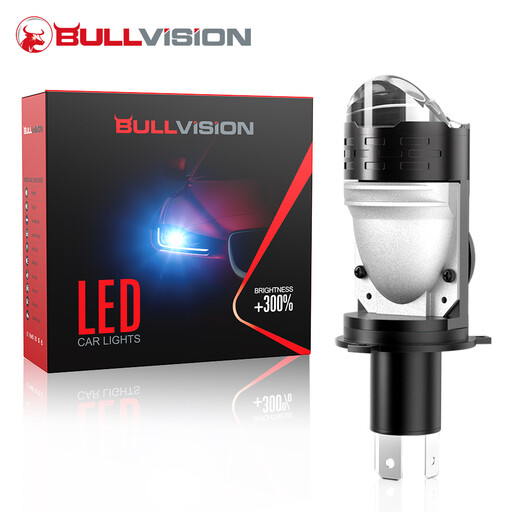
Why it stands out: Bullvision emphasizes a perfect beam pattern that mimics the original halogen beam. This is designed to minimise glare for oncoming drivers while providing a wider and farther field of vision.
Pros:
Who is it for? For the driver who wants a bright upgrade but places equal importance on a correct beam pattern to avoid disturbing other road users.

Why it stands out: This version from Bullvision offers a solid balance between performance and functionality. With a claim of 300% more brightness than halogen and an efficient cooling system, it's a reliable choice for a noticeable improvement.
Pros:
Who is it for? For the practical driver seeking a clear and reliable upgrade for daily use, without necessarily chasing the absolute highest specifications.
The H4 fitting is one of the most common, but many other types exist. For example, if your car uses a different fitting, such as a D4S bulb, you can browse our wider range of car lighting for more options.
Regulations for retrofitting LED lighting into headlights originally designed for halogen are complex. For use on public roads, a bulb must have an E-mark certification that is specifically valid for your vehicle model. Many aftermarket LED kits are officially intended for off-road or track use only. Always check your local laws and the product's certification before purchasing and installing.
The main difference is their function. An H4 LED headlight is a dual-filament bulb that combines both low beam and high beam in a single unit. An H7 bulb has only one filament and is used for either the low beam or the high beam. Therefore, cars with H7 bulbs require two separate bulbs per headlight unit for these functions.
Yes, in most cases, replacing an H4 bulb is a relatively simple job. The 'plug-and-play' models recommended here are designed to fit directly into the existing socket. It's usually a matter of twisting out the old bulb, inserting the new one, and connecting the plug. For peace of mind, always consult your car's owner's manual.
