Who is this for?

Fans of leafy green juice

You mainly want to make juice with ingredients such as leafy greens for your guests, so you’re choosing a machine based on how well it handles them. The Dutch Consumers’ Association generally considers slow juicers better suited to a wider range of ingredients, including leafy greens.

If you want to serve several glasses quickly

You’re looking at the feed chute, collection jug and how often you’ll need to stop while juicing. The Dutch Consumers’ Association describes centrifugal juicers as often being faster; also check the collection capacity of the specific model.

If you want less tidying up after your guests leave

You don’t make juice often and want to know in advance how many separate parts you’ll need to clean. Check each machine’s sieve, pulp container and any cleaning instructions.

What should you look for when choosing?

Slow juicer

A good fit if: leafy greens make up a significant part of your recipe.

Trade-off: according to the Dutch Consumers’ Association, this type of juicer often requires more preparation and cleaning.

Centrifugal juicer

A good fit if: you mainly use hard or juicy fruit and vegetables and want to serve juice quickly.

Trade-off: according to the Dutch Consumers’ Association, this type of juicer is generally less suited to leafy greens.

Blender as an alternative

A good fit if: you’d rather serve a thicker drink containing the ingredients than clear juice.

Trade-off: a smoothie has a different texture and, according to the Netherlands Nutrition Centre, is no substitute for eating vegetables and fruit.

What to consider What should you look for? Who is this important for?
Leafy greens Check which leafy greens the manufacturer mentions and look at the design of the feed chute and sieve. I mainly want to juice leafy greens, so I first check that the technology suits my recipe. Around 36% of consumers prioritise suitability for leafy greens.
Several glasses Compare the capacity of the juice jug with the number of glasses you want to serve; don’t confuse it with the capacity of the feed chute. If I want to serve several guests one after another, I look at the collection capacity and how often I’ll need to stop. Around 29% of consumers prioritise serving continuously.
Cleaning Check which parts can be removed, whether the sieve needs a brush and which parts the manufacturer says are dishwasher-safe. After hosting guests, I don’t want to be surprised by lots of separate parts to clean. Around 21% of consumers put ease of cleaning first.
Matching your purchase to how you’ll use it Consider how often you’ll use the machine and which features you need for your recipes. I only make juice for guests occasionally and want the features to suit that kind of use. Around 14% of consumers prioritise this consideration.

Common pitfalls

  • Confusing a large feed chute with a large amount of juice

    The feed chute holds ingredients; the juice jug collects the extracted juice. So the capacity of one doesn’t tell you how much juice will be ready to pour.

    Compare the two capacity figures separately and plan how many glasses you can serve based on the juice container, without assuming a fixed yield.

  • Choosing a slow juicer based on a general promise about vitamins

    The Dutch Consumers’ Association says that a slow juicer doesn’t automatically produce more nutrients or juice than a centrifugal juicer. A general claim is no substitute for choosing based on your ingredients and how you’ll use the machine.

    Choose according to your recipes and check how much preparation and cleaning the model requires. Treat manufacturers’ statements about nutrient retention as claims about their product, not as a general benefit of slow juicers.

  • Assuming all parts have the same warranty

    The manufacturer’s warranty may differ from one part to another. It is separate from your statutory rights against the retailer if a product is faulty.

    Read the warranty terms for each part and keep your proof of purchase. If something goes wrong and the product doesn’t meet expectations, contact the retailer.

Brands to consider

Bosch

The MES4000 is a centrifugal juicer worth comparing if a collection jug and fast juicing matter for the way you’ll use it.

  • Bosch lists two speed settings, a large feed tube and a hole-free ceramic blade for the MES4000. The manufacturer specifies a 1500 ml juice container.
  • These are model specifications, not an independent performance assessment. Check separately how to clean the sieve and pulp container.

Hurom

The H320N is a slow juicer to consider if leafy greens are important and you want to prepare your ingredients in advance.

  • Hurom lists a 2 l feed hopper and a 15-year warranty claim covering the motor and parts.
  • The hopper capacity isn’t the amount of juice collected. Hurom’s statements about vitamin retention are manufacturer claims, not a generally proven benefit of slow juicers.

Magimix

According to Magimix, the Juice Expert 3 combines a juice filter with an Extra Press and citrus press, making it an option if you want to prepare different things.

  • For this model, Magimix lists an XL feed tube, dishwasher-safe parts and spare parts availability for 30 years.
  • Before use, check which parts are dishwasher-safe and whether you need the extra functions.

Kuvings

The REVO830 is a slow juicer worth comparing if you process ingredients in different shapes.

  • Kuvings describes the REVO830 as having two feed openings and an automatic cutting function.
  • Kuvings lists a 15-year warranty on the motor and a 2-year warranty on other parts. Juice yield claims are made by the manufacturer and aren’t a general performance comparison.

Philips

The HR1922/21 shows that you can also consider your preferred juice texture when choosing a centrifugal juicer.

  • Philips lists FiberBoost for this model, which the manufacturer says lets you choose your preferred texture.
  • Being able to adjust the texture doesn’t mean the juice contains the same fibre as whole vegetables.

Slow juicers for green juice when guests come over

These Joybuy products are slow juicers for anyone who wants to include leafy greens in juice for guests. Compare each model’s feed opening, collection capacity and any usage limitations.
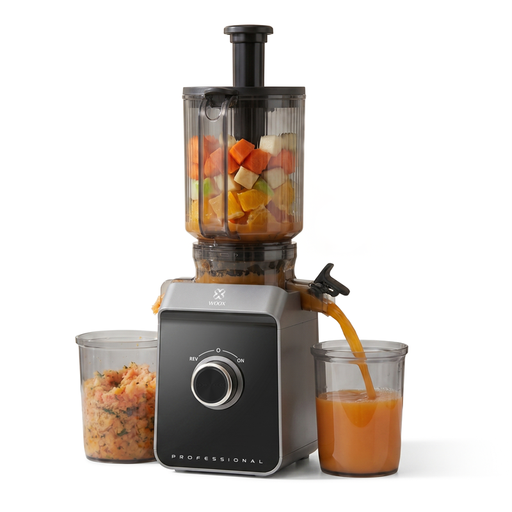
WOOX MX0289 slow juicer

WOOX MX0289 slow juicer

A slow juicer to compare if you want to use leafy greens for green juice.

Power: 150 W. Feed opening: 130 mm. Juice jug: 600 ml. Pulp container: 836 ml.

According to the product information, use for a maximum of 10 minutes at a time, followed by a 20-minute rest.

View at Joybuy
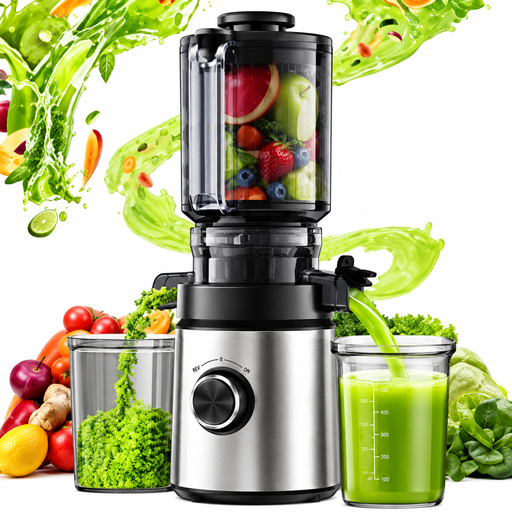
Slow juicer for fruit and vegetables with an XL feed opening

Slow juicer with a 130 mm XL feed opening

A slow juicer to compare if you want to juice fruit and vegetables and are interested in the size of the feed opening.

Feed opening: 130 mm, described as XL. The product title mentions two glasses.

View at Joybuy

Frequently asked questions

Does green juice mean I’ll get more vitamins from a slow juicer?

No, you can’t tell that from the name of the machine. The Dutch Consumers’ Association says that, in the comparison study it cited, juice from a slow juicer didn’t contain more vitamin C, iron, calcium or magnesium than juice from a centrifugal juicer. Choose mainly according to your ingredients and how easy the machine is to use. Juice also contains less fibre than whole vegetables.

How can I tell whether a juicer will make enough juice for my guests?

Compare the number of glasses you want to serve with the stated capacity of the juice container, not the feed hopper. Bosch lists a 1500 ml juice container for the MES4000; Hurom lists a 2 l feed hopper for the H320N. These capacity figures don’t tell you how much juice your ingredients will yield.

How should I prepare raw ingredients for my guests?

The Netherlands Nutrition Centre recommends washing fruit and vegetables under running water and using clean kitchen utensils. Wash produce even if you’re going to peel it; don’t use soap or bleach to wash fruit and vegetables.

What if the machine becomes faulty or I change my mind?

If a product is faulty, you have statutory rights against the retailer as well as any manufacturer’s warranty. What you could reasonably expect from the product is taken into account. For a standard online purchase, you generally have a legal cooling-off period of up to 14 days after delivery, subject to applicable exceptions. ACM ConsuWijzer explains these consumer rights.

What rules apply to an electric juicer in the Netherlands?

According to the Netherlands Food and Consumer Product Safety Authority, electrical products must carry the CE marking. Parts that come into contact with food must also comply with the applicable EU rules on food contact materials, including Regulation (EC) No 1935/2004. A brand name or product listing alone doesn’t prove that a specific item meets all the requirements.
