
For leafy greens
MediaMarkt describes slow juicers as suitable for leafy greens, among other ingredients. Check the instructions for each model to see which greens you can use.


For juice with plenty of leafy greens, a slow juicer is the more obvious choice; a centrifugal juicer is better suited to a short break and juicy ingredients. If you’d rather not separate the pulp, consider a blender too. The Dutch Nutrition Centre does not include juice or smoothies in its Wheel of Five guidelines, so don’t assume they replace whole vegetables. The NVWA states that electrical appliances are subject to CE marking requirements; this alone does not confirm whether a specific model meets the relevant requirements.
MediaMarkt describes slow juicers as suitable for leafy greens, among other ingredients. Check the instructions for each model to see which greens you can use.
If you make juice during a short break, consider both preparation and cleaning time. Bosch says that some parts of the MES25A0 are dishwasher-safe; check exactly which parts these are.
The Consumentenbond explains that juicers and blenders work differently and produce different results. Compare filtered juice with a thicker, blended drink.
First decide whether you want filtered juice or a blended drink. Then compare the ingredients each model can handle, along with the full preparation and cleaning process.
A good choice when: leafy greens are a key ingredient and you can follow the model’s instructions for using them.
Consider: preparation and cleaning are also part of the time it takes to make a glass.
A good choice when: you mainly want to juice juicy ingredients such as cucumber or apple during a short break.
Consider: it may be less suitable for recipes made mostly with leafy greens; check the instructions.
A good choice when: you’d rather drink blended ingredients than separate the pulp from the juice.
Consider: a blended drink has a different texture from filtered juice; they are made in different ways.
| What to consider | What to look for | Who is this important to? |
|---|---|---|
| Suitable for leafy greens | Check which leafy greens and stems the exact model can process, according to its instructions, and how much preparation they need. | If leafy greens are my main ingredient, I want to know whether the appliance can handle them and whether I need to chop them. Around 31% of consumers prioritise suitability for leafy greens. |
| Total break time | Compare the time needed to prepare the ingredients, feed them into the appliance and clear everything away for one glass. | When my break is short, it’s not just the juicing that counts, but also getting everything ready and tidying up. Around 25% of consumers prioritise the total time. |
| Cleaning effort | Count the parts you need to wash and check which of them are dishwasher-safe. | If I often make a single serving, I don’t want more washing-up than necessary. Around 25% of consumers make cleaning their top priority. |
| Type of drink | Decide whether you want filtered juice or a thicker, blended drink before comparing appliances. | If you’d rather have a blended drink than juice with the pulp separated, a blender is also worth considering. Around 19% of consumers place the most importance on their preferred drink texture. |
A different juicing method does not prove that the result replaces whole vegetables or is healthier for you. The Dutch Nutrition Centre does not include juices or smoothies in its Wheel of Five guidelines.
Choose based on the ingredients, the drink you want and ease of use, not on unproven health claims.
When you’re making one glass during a short break, chopping and cleaning can make a difference to the total time the appliance takes.
Compare the entire process for the exact model, including which ingredients it can handle and how to clean it.
Remember to allow time for chopping, washing up and cleaning the filter.
Kuvings lists a 3,000 ml feed hopper and dimensions of 207 × 254 × 459 mm for the AUTO10S. A roomy hopper does not automatically mean the appliance takes up little space.
Measure the worktop and storage space available, and consider whether you usually make one glass or a larger batch.
Slow juicers for anyone looking for a compact juicing model; the H310A is one specific model to compare.
The MES25A0 is a centrifugal juicer to consider if you want a large feed tube and several speed settings for suitable ingredients.
The HR1922/21 centrifugal juicer is worth considering if the texture of the juice you want is part of your decision.
The AUTO10S is a slow juicer with a large automatic feed hopper, designed for anyone who wants to add several ingredients at once.
These Joybuy products are slow juicers for fruit and vegetable juice. Before buying, check that the exact version has the required CE marking, as stipulated by the NVWA.
 No image available
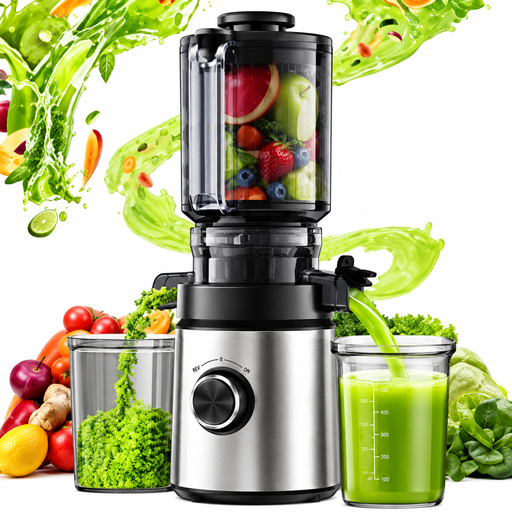
A slow juicer for making fruit and vegetable juice; check the instructions to see whether it’s suitable for the leafy greens you want to use.
Capacity: 2 l. Feed opening: 130 mm. The product name also mentions 2 glasses.
 No image available
A slow juicer for anyone looking to make green juice; allow for extra chopping when using fibrous vegetables.
Power: 150 W. Juice jug: 600 ml. Pulp container: 836 ml. The user information says fibrous vegetables should be cut into 3–4 cm pieces.
Yes. Wash the fruit and vegetables you’re using under running water, as advised by the Dutch Nutrition Centre. Check the packaging for pre-washed, packaged vegetables; washing does not guarantee that all pathogens will be removed.
Don’t use the storage time for orange juice as a general guide for homemade green juice. The Dutch Nutrition Centre says fresh orange juice can be kept in the fridge for 1–2 days after opening; this does not necessarily apply to a homemade green juice blend. Make it just before your break if you don’t have suitable storage advice for your ingredients.
Don’t assume that it does. The Dutch Nutrition Centre does not include juices or smoothies in its Wheel of Five guidelines; choosing a slow juicer does not prove that it offers health benefits over other preparation methods either.
No. According to the Dutch government, the Netherlands has no fixed statutory guarantee period: you’re entitled to a product that works properly, and you should contact the seller if there’s a problem. A manufacturer’s guarantee may come with additional terms.
The NVWA states that CE marking is compulsory for the relevant electrical consumer products. This general requirement alone does not confirm that a specific appliance on sale meets the applicable requirements; check the information for the exact version.