
Anyone preparing a large cheese meal
You want to freeze a large amount of grated cheese in portions in advance. The amount you can freeze in a day and the space available are important considerations.


If your existing freezer has enough room to freeze the cheese in small portions at -18 °C or below, you may not need an extra chest freezer for a single community meal. If you need more space, compare the amount of cheese you want to freeze in 24 hours with the stated freezing capacity. Then check the capacity, dimensions, permitted ambient temperature and annual energy consumption. A larger freezer gives you more storage space, but also takes up more floor space and may be less useful after the meal.
You want to freeze a large amount of grated cheese in portions in advance. The amount you can freeze in a day and the space available are important considerations.
You need extra freezer space, but may be considering a garage or shed. Before placing a freezer there, check that the model is suitable for the ambient temperature.
You want to weigh up whether an extra appliance is worth buying compared with using your existing freezer space, and whether the freezer will still be useful after the community meal.
First, check whether the cheese will fit in your existing freezer. Only then consider an extra chest freezer, based on the size of the batch and where you plan to put it.
Choose this if: the portions you have measured out will fit and your freezer can maintain -18 °C or below.
Bear in mind: the cheese will share the available space with other food, and a large amount may need to be frozen in several batches.
Choose this if: you need extra space, but the batch size and available floor space are limited.
Bear in mind: the limited capacity may mean you have to freeze the cheese in several batches.
Choose this if: you need room for other food as well as the cheese, or want to freeze a larger amount in a short time.
Bear in mind: greater capacity and a higher stated freezing capacity usually mean the freezer takes up more space, too. Compare the specifications of the models you are considering.
| Consideration | What to look for | Who is this important for? |
|---|---|---|
| Space for portions | Work out how many portions you need and their packed dimensions, then compare them with the net capacity and external dimensions. | If I want all the prepared portions to fit, I focus on usable capacity and the space available. Around 33% of consumers prioritise storage space for portions. |
| Freezing capacity per day | Weigh the fresh cheese going into the freezer over 24 hours and compare the amount with the stated freezing capacity in kg/24 hours. | If a large batch needs to be ready on time, I want to know how much the appliance can freeze per day according to its specifications. Around 27% of consumers prioritise freezing speed. |
| Where you’ll put it | Check the lowest and highest ambient temperatures in that location and compare them with the permitted temperatures for the exact model. | If the chest freezer is going in a garage or shed, the model needs to suit the temperatures there and be practical to install. This is the main concern for around 20% of consumers. |
| Using it after the event | Check the stated annual energy consumption in kWh and consider whether you’ll continue using the extra capacity later. | If I might only need an appliance for one community meal, I want to know in advance whether the extra space will still be useful afterwards. Around 20% of consumers prioritise costs and use after the event. |
The Netherlands Nutrition Centre recommends setting your freezer to -18 °C or below, freezing food in small portions and not adding too much at once. A chest freezer is therefore not automatically the answer when you have a large batch to freeze in one day: match the amount you freeze at a time to the stated freezing capacity.
Capacity and freezing capacity are different specifications. A freezer may have enough room, but you should separately check its capacity in kg/24 hours to make sure it can freeze the amount of fresh cheese you want to add at once.
Weigh the batch you plan to freeze each day, compare it with the specification and divide the cheese into small portions. If the amount exceeds the stated capacity, plan to freeze it in several batches.
Freezing in several batches may take extra preparation time.
The permitted ambient temperature varies between models. Having space in an unheated room doesn’t, by itself, mean a chest freezer is suitable for that location.
Check the permitted temperature for the exact model and compare it with the conditions in the place you have in mind.
A chest freezer continues to use electricity while it is switched on, even if you make little use of the extra space after the event.
First check how much space you already have and, when comparing models, look at the stated annual energy consumption in kWh. Also consider how you plan to use the freezer after the community meal.
If you keep using it, it will continue to use electricity.
The CF100EWN is a compact option for anyone looking for extra freezer space.
The TCF1981W is an example of a chest freezer for anyone wanting to store more food at once.
The VK1422W is a large model for anyone who plans to make use of the extra capacity after the community meal, too.
The CFd 2085 Plus is an example for anyone considering product features relating to frost build-up and cold locations.
This selection of products at Joybuy focuses on freestanding chest freezers for extra storage, from compact to larger models.
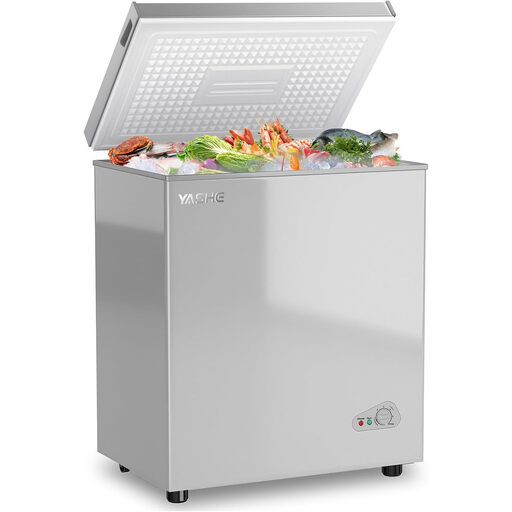 Image unavailable
An option for extra freezer space. Check that the stated capacity and available location suit your portions.
The product title lists two removable baskets, six temperature settings and a noise level of 45 dB.
Before use, check that the model can maintain the required temperature of -18 °C or below and that the ambient temperature in your chosen location is within the permitted range.
 Image unavailable
A compact option if you’re looking for extra space. Check that the convertible function and capacity suit the way you plan to use it.
The product title lists energy class E, a seven-level thermostat, a removable basket and a defrost drain.
Check that the temperature range and operating conditions of the exact model are suitable for freezing at -18 °C or below and for your chosen location.
 Image unavailable
A larger option if you want to store other food as well as the cheese. Measure the space where the freezer will go before you buy.
The product title lists energy class E, five-level digital temperature control, a removable basket and LED lighting.
Check that the exact model can maintain the temperature required for the cheese and is suitable for the ambient temperature in your chosen location.
 Image unavailable
An option to consider if you’re comparing extra freezer space with the space available and the amount of cheese you want to store.
The product title lists a storage basket, counterbalanced lid, adjustable temperature control, adjustable feet and energy class E.
Check that the model can maintain the required temperature of -18 °C or below and is suitable for the temperature where you plan to put it.
 Image unavailable
A compact option if you only need a little extra space. Compare the capacity with the number of portions you’ll be storing.
The product title lists an inverter compressor, a removable basket, LED lighting and a noise level of 38 dB.
Check the operating conditions for the exact model and make sure it can freeze the cheese at -18 °C or below where you plan to put it.
For opened grated cheese, the Netherlands Nutrition Centre recommends keeping it in the freezer for 2–4 months; its quality may deteriorate after that. For an unopened pack, follow the storage advice and date on the packaging.
Set your freezer to -18 °C or below and avoid freezing too much at once. Divide the cheese into small portions and match the amount you freeze each day to the model’s stated freezing capacity.
To compare energy use, check the annual kWh figure on the energy label for the exact model. According to the manufacturer, Low Frost can reduce frost build-up, but it doesn’t rule out defrosting. For a consumer purchase, any manufacturer’s warranty is separate from your statutory rights; the retailer is responsible for dealing with those rights.
Among other things, this depends on whether food is being sold. The Netherlands Food and Consumer Product Safety Authority (NVWA) says food safety rules also apply to individuals selling food at events. For anyone who prepares and sells food several times a year, the NVWA specifies that a HACCP food safety plan is required. Businesses offering food to consumers must provide information about allergens present, including milk.