
Scriptwriters with scene notes
You want to read dialogue or stage directions while referring to a scene outline or reference text. How you arrange your windows and the readability of the text should therefore inform your choice.


A 27-inch QHD monitor can be a good starting point for viewing a script alongside scene notes. Choose an ultrawide if you often use several wide windows, or a 3:2 screen if you mainly want more vertical space for documents. Also check text scaling, adjustability and compatibility with your computer. Window-snapping keyboard shortcuts come from your operating system, not your monitor.
You want to read dialogue or stage directions while referring to a scene outline or reference text. How you arrange your windows and the readability of the text should therefore inform your choice.
You often switch between typing and reading, and want to be able to position the screen comfortably. Employees may be covered by screen-work rules in certain circumstances; these do not automatically apply to every freelance writer. Arboportaal explains the relevant conditions.
You connect a laptop and keyboard and want to check that the monitor supports the video connection you need, hub features and, if required, laptop charging.
Start with the window layout you actually use when writing, then compare text readability, screen positioning and connections.
| What to consider | What should you check? | Who is this important for? |
|---|---|---|
| Script and notes side by side | Try both windows at your usual text scaling. Dell describes the P2725D as a 27-inch QHD monitor; LG lists a 21:9 screen with 3440 × 1440 pixels for the 34WR50QC-B. | If I want to read my script and scene notes at the same time, the text needs to remain comfortable to read at my chosen scaling. Around 31% of consumers prioritise space for these windows. |
| Readability and positioning | Check the range of adjustment, text scaling and whether you can position the screen, desk and keyboard comfortably together. Dell lists height adjustment for the P2725D; LG says the supplied stand for the 34WR50QC-B only tilts. | During long writing sessions, I want to position the screen so that reading and typing work well at my desk. Around 25% of consumers prioritise readability and positioning. |
| Laptop and peripherals | Check your laptop's video output, the monitor input, the cable and the charging power required. BenQ lists 65 W power delivery over USB-C for the GW2790QT; this does not prove that it can charge every laptop model. | If I want to connect my laptop and keyboard to the monitor, the ports and charging power need to suit my equipment. Around 19% of consumers start by considering the laptop connection. |
| Vertical script view | Compare how many lines are comfortably visible at your chosen text scaling, and measure the space needed for the screen and stand. BenQ lists a 3:2 screen with 3840 × 2560 pixels for the RD280UA. | When I read long scenes, I want to see more of the page without making wide windows side by side my main priority. Around 13% of consumers choose with vertical script space in mind. |
| Visual references | Test a representative page using your own sketches or reference images. LG lists 3440 × 1440 pixels for the 34WR50QC-B; Philips lists 3840 × 2160 pixels for the 27E1N1900AE/00. | If I refer to sketches or panel references while writing, I want to see how much room they take up alongside my script. Around 12% of consumers prioritise viewing references. |
According to LG, the LG 34WR50QC-B has more horizontal pixels than the 27-inch QHD monitors mentioned here, but its supplied stand only tilts. Extra width alone doesn't determine whether your text layout will be comfortable to use.
Measure your desk and try your preferred window layout at your usual text scaling. Then check the adjustability of the exact model.
Dell distinguishes the P2725D from the P2725DE, which is sold as a USB-C hub monitor.
Check the full model code and the ports you need before buying.
Philips lists the 27E1N1600AE/00 at 120 Hz, while the Joybuy listing says 100 Hz.
For any specification that matters to you, compare the details for the exact model and don't assume the discrepancy has been resolved.
ACM ConsuWijzer distinguishes statutory rights from an additional manufacturer's or seller's warranty.
If a product doesn't meet reasonable expectations, ask the seller for a solution based on your statutory rights. Don't assume there is one fixed statutory warranty period for every monitor.
The P2725D and P2725DE are 27-inch QHD models; Dell specifically describes the P2725DE as a USB-C hub monitor.
The LG 34WR50QC-B is a 34-inch ultrawide for anyone considering a wide window layout.
The models reviewed offer different approaches: the GW2790QT for QHD with USB-C, and the RD280UA for a 3:2 document view.
The 1000 series models reviewed include the 27-inch QHD monitor 27E1N1600AE/00 and the 27-inch 4K monitor 27E1N1900AE/00.
These Joybuy monitors are options to compare for script text, notes and visual references.
 No image available
A 27-inch 4K monitor for viewing text and notes on one screen.
Resolution: 3840 × 2160 pixels. The description lists an anti-glare screen and a height-adjustable stand.
 No image available
A 4K monitor for viewing your script, notes and other windows side by side.
Resolution: 3840 × 2160 pixels. The description lists PiP/PbP and Thunderbolt 4 with up to 140 W Power Delivery. Check that the connections and charging power suit your laptop.
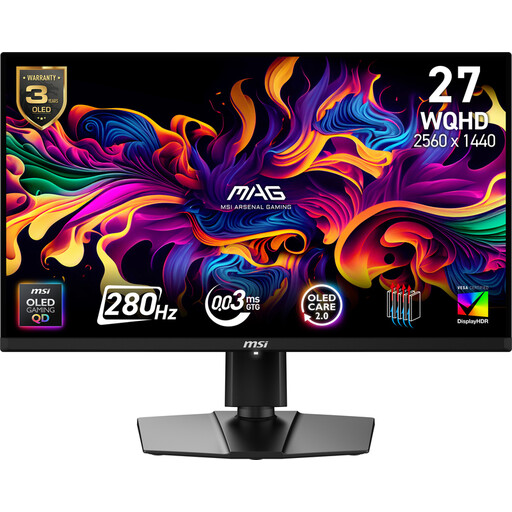 No image available
A 27-inch screen for trying out a script and notes side by side.
Resolution: 2560 × 1440 pixels. The description lists a QD-OLED panel and a stand adjustable for height, tilt, swivel and pivot.
 No image available
A 27-inch 4K monitor for viewing text and notes on one screen.
Resolution: 3840 × 2160 pixels. The product name lists HDMI, DisplayPort and a height-adjustable stand.
 No image available
A 27-inch 4K monitor for a workspace with a script and several video sources.
Resolution: 3840 × 2160 pixels. The description lists USB-C with 98 W Power Delivery, PiP/PbP, a KVM function and a height-adjustable stand. Check that your laptop and peripherals support the features you need.
No. Keyboard shortcuts for arranging windows are features of your operating system. Microsoft explains that in Windows, Windows key + Left arrow or Right arrow snaps a window to one half of the screen; Alt + Tab switches between open applications. Your monitor determines how much space those windows have. Check the shortcuts for your system and writing software.
Adjust the screen position, text size and lighting to suit your workspace, and break up prolonged screen work. Arboportaal outlines the health risks of screen work and requirements for certain employee situations, including adjustability and limiting reflections. A monitor alone can't make your entire workspace ergonomic.
No. Check whether your laptop's USB-C port supports video, whether the monitor and cable provide the features you need, and whether the charging power is sufficient. For example, BenQ lists 65 W power delivery for the GW2790QT; that figure doesn't prove compatibility with every laptop.
According to ACM ConsuWijzer, for a standard online consumer purchase you generally have 14 days from delivery to change your mind, subject to applicable exceptions. You also have statutory rights if the product doesn't meet what you could reasonably expect under normal use; the seller is responsible. A manufacturer's warranty doesn't replace those statutory rights.
No, it doesn't apply to everyone. Arboportaal outlines requirements for certain employee workspaces where screen work exceeds 2 hours a day, including a height-adjustable screen, as well as circumstances in which requirements may be waived. This doesn't create a general product requirement for freelance writers.