If you have coeliac disease, first choose granola clearly labelled gluten-free; a sugar claim does not make a product gluten-free. If by ‘sugar-free’ you mean no added sugar, Holie’s Granola Glutenfree Buckwheat & Nuts could be an option, provided its allergens are suitable for you: according to Albert Heijn, this granola contains 1.9 g of sugars per 100 g and 0% added sugar. That is not the same as ‘sugar-free’, for which the Voedingscentrum sets a maximum of 0.5 g of sugars per 100 g.
Who is this distinction important for?
People with coeliac disease who want to avoid added sugar
You’re looking for granola that’s clearly labelled gluten-free, and then want to check whether any sugar has been added. The gluten-free label is the first thing to look for; next, check the ingredients, nutritional information and allergens on the packaging.
People who mean literally sugar-free
You’re looking for granola with no more than 0.5 g of sugars per 100 g, the limit the Voedingscentrum gives for ‘sugar-free’. Check ‘of which sugars’ in the nutrition table: 0% added sugar does not mean the product contains no sugars.
People who also need to check for nuts or oats
As well as the gluten-free label, you’ll need to check the ingredients and allergen warnings. The Dutch Coeliac Society says most people with coeliac disease can tolerate pure, gluten-free oats, but not everyone can. If you react to oats, discuss this with your healthcare professional or a dietitian who specialises in coeliac disease.
What should you look for when choosing?
If you have coeliac disease, start by checking for a gluten-free label. Then decide whether you simply want to avoid added sugar or need a product that also meets the ‘sugar-free’ limit.
| What to look for |
What to check when buying |
Who it matters most to |
| Gluten-free label |
Look for ‘gluten-free’ or a suitable gluten-free certification mark on the current packaging. A sugar claim is no substitute for this check. |
I’m buying granola for someone with coeliac disease and want to confirm it’s gluten-free first, even if it contains little sugar. Around 45% of consumers put this check first. |
| What ‘sugar-free’ means |
If you mean literally sugar-free, compare ‘of which sugars’ per 100 g with the 0.5 g limit; check separately whether sugar has been added. The Voedingscentrum distinguishes between these claims. |
If I’m looking for something genuinely sugar-free, 0% added sugar isn’t enough: I also want to know the total amount of sugars. Around 36% of consumers say this distinction is their main priority. |
| Ingredients and allergens |
Read the ingredients and ‘contains’ and ‘may contain’ statements, especially for oats, nuts, peanuts and soya. |
As well as coeliac disease, I need to consider an allergen or a personal reaction to oats. For around 19% of consumers, this additional check gets the most attention. |
Common mistakes
-
Reading ‘no added sugar’ as ‘sugar-free’
Granola can contain no added sugar and still have naturally occurring sugars. According to Albert Heijn, Holie’s Granola Glutenfree Buckwheat & Nuts contains 1.9 g of sugars per 100 g; the Voedingscentrum sets the limit for ‘sugar-free’ at 0.5 g per 100 g.
Check which of the two claims you’re looking for, and read the ‘of which sugars’ figure per 100 g in the nutritional information.
-
Assuming ordinary oat granola is suitable for coeliac disease
Oats can come into contact with gluten-containing cereals during processing. A claim about added sugar says nothing about this potential contamination.
If you’re buying oat granola, check that the current packaging explicitly says it’s gluten-free.
-
Ignoring a warning about gluten-containing cereals
According to the Dutch Coeliac Society, ‘may contain gluten-containing cereals’ indicates a real risk that a product contains more than 20 mg of gluten per kg. A low sugar content does not remove this risk.
Don’t use a sugar claim as a substitute for a gluten-free label, and check cross-contamination warnings separately.
-
Stopping your allergen checks once you’ve seen the gluten-free claim
Gluten-free says nothing about other allergens. The Holie’s Granola Glutenfree Buckwheat & Nuts described by Albert Heijn contains almonds and hazelnuts, and may also contain peanuts and soya, among other things.
Check the ingredients and allergen information on the specific packaging every time you buy it.
Brands and shops to explore
Holie’s
According to product information from Albert Heijn and Holie’s, Holie’s Granola Glutenfree Buckwheat & Nuts combines a gluten-free label with 0% added sugar.
- This particular granola suits consumers who mainly want to avoid added sugar.
- At 1.9 g of sugars per 100 g, this variety does not meet the ‘sugar-free’ limit. It contains almonds and hazelnuts, and may also contain cashews, pecans, peanuts and soya, among other things.
Albert Heijn
Two AH granolas show why a gluten-free label and 0% added sugar need to be assessed separately.
- According to Albert Heijn, AH Gluten-Free Granola is produced in a completely gluten-free environment.
- According to Albert Heijn, this variety contains 11 g of added sugars per 100 g. AH Granola Nuts 0% Added Sugar contains barley and spelt, so it is not suitable for this coeliac-related question.
Quaker Cruesli
The checked Zero Sugar Added Naturel variety is an example of granola where ‘no added sugar’ does not mean sugar-free or gluten-free.
- Quaker Netherlands states that this variety contains 3.2 g of sugars per 100 g, so you can compare its sugar information with your own requirements.
- Jumbo states that this variety may contain barley and wheat. Don’t choose it as a gluten-free option just because its name includes Zero Sugar Added.
Jumbo
Jumbo’s online granola range includes products labelled gluten-free, as well as other granolas with different sugar claims.
- Product names can help you find a specific variety and check its packaging.
- A claim such as Zero Sugar Added does not confirm that a product is gluten-free. Check the current product and packaging information for each variety.
Lidl
Lidl offers granola varieties called Super Berry and Super Nutty; the shop or product category alone tells you nothing about whether a product is suitable for coeliac disease.
- You can assess a specific variety by checking the claims and nutritional information on its packaging.
- For this purchase, only choose a variety after checking the gluten-free label, sugar information and relevant allergens on that specific packaging.
Joybuy products to consider
This selection includes Holie's Granola Glutenfree Peanut Chocolate as a single pack and as a multipack. Both names include Glutenfree; before choosing, also check the packaging for information about added sugar, ‘of which sugars’ per 100 g and allergens.
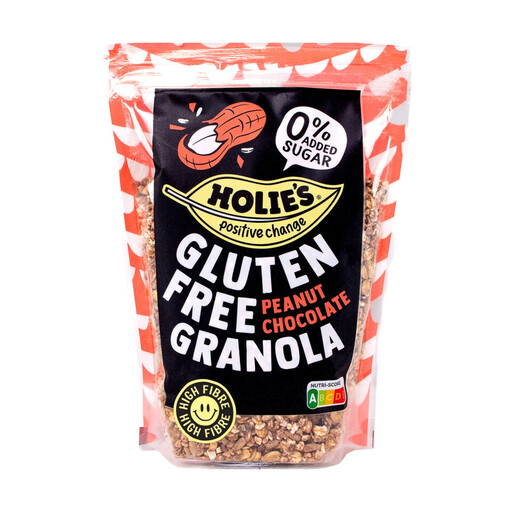 Image unavailable
Holie's Granola Glutenfree Peanut Chocolate, 330 g
A single pack to consider if you’re looking for granola labelled gluten-free. Also check the sugar information and allergens on the packaging.
Pack size: 330 g.
View at Joybuy
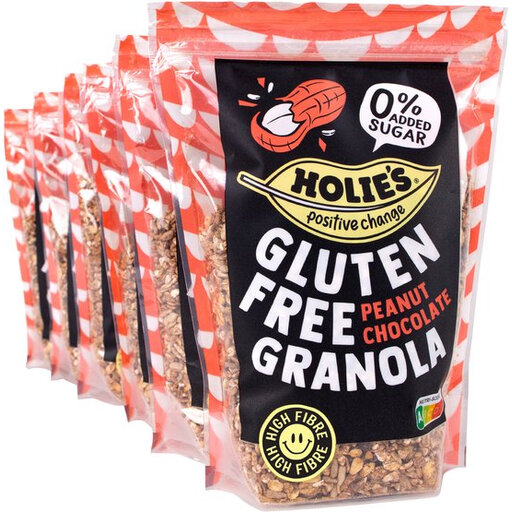 Image unavailable
Holie's Granola Glutenfree Peanut Chocolate, 6 × 330 g
A multipack of the same granola for anyone looking to buy several packs. Be sure to check the current gluten-free label, sugar information and allergens here too.
Multipack: 6 × 330 g packs.
View at Joybuy
Frequently asked questions
Does 0% added sugar mean the same as sugar-free?
No. According to the Voedingscentrum, ‘sugar-free’ means no more than 0.5 g of sugars per 100 g, while a product with no added sugar may still contain naturally occurring sugars. For example, Albert Heijn states that Holie’s Granola Glutenfree Buckwheat & Nuts contains 1.9 g of sugars per 100 g.
Is ordinary oat granola suitable for coeliac disease?
Don’t assume it is without checking: choose oat granola that’s explicitly labelled gluten-free. The European Commission allows the claim ‘gluten-free’ when a food contains no more than 20 mg of gluten per kg; with oats, it’s also important to prevent contamination with wheat, rye and barley.
What does ‘may contain gluten-containing cereals’ mean on granola?
According to the Dutch Coeliac Society, this warning indicates a real risk that the product contains more than 20 mg of gluten per kg. So don’t assess the warning based on the sugar information. Check separately whether the specific granola is clearly labelled gluten-free.
Should I check for nuts and soya in gluten-free granola too?
Yes, if those allergens are relevant to you: ‘gluten-free’ says nothing about nuts, peanuts or soya. The Holie’s Granola Glutenfree Buckwheat & Nuts described by Albert Heijn contains almonds and hazelnuts, and may also contain peanuts and soya; always read the allergen information for the variety you’re buying.


