
Vandaag of morgen in huis

Kwaliteit gegarandeerd

Welkomstaanbiedingen ontgrendelen: GRATIS bezorging | Tot 80% korting | Gratis 30 dagen JoyPlus-proefperiode
Download de app
Looking for grain-free dog food for an adult dog, puppy or senior? You will quickly come across terms such as “natural”, “high in animal protein” and “for sensitive digestion”. These descriptions may sound clear, but they do not always reveal enough about the ingredients, portion size or suitability for your dog.
As a Joybuy Product Recommendation Officer, I filter the most important product information based on verifiable specifications. This allows you to compare grain-free dog food not just by packaging or marketing claims, but by life stage, breed size, protein source and nutritional values.
Grain-free means that the recipe contains no grains such as wheat, corn, rice or barley. That does not automatically make the product suitable for every dog, nor does it necessarily make it more nutritious. Grain-free recipes often contain other sources of carbohydrates, such as peas, chickpeas, potato, sweet potato or quinoa.
Always check the complete ingredients list and confirm whether the food is labelled as complete nutrition. If symptoms persist or you suspect a food intolerance, consulting a veterinarian is wiser than removing ingredients yourself over an extended period.
A high crude protein content may sound appealing, but the percentage does not indicate the proportion of animal protein alone. Plant-based protein sources can also contribute to the total. Check where meat, fish or poultry appear in the ingredients list and whether the manufacturer specifies the proportion of animal protein.
According to the product information for several Farmina N&D recipes, more than 90% or 96% of the protein comes from animal sources. This is a manufacturer claim; always compare it with the listed ingredients and analytical constituents.
Grain-free puppy food is formulated differently from food for adult dogs. Puppies need food designed to support growth. Seniors may benefit from a modified energy content and a different kibble size. Likewise, medium-sized and large dogs do not always need the same portion size or kibble structure as small dogs.
Look for details such as:
Choose a product that clearly states it provides complete nutrition. This means it is intended to serve as a daily main food, in accordance with the product information and feeding guidelines on the packaging.
For puppies, nutritional guidelines for growth are particularly important. According to the product description, Farmina N&D Pumpkin Lamb Puppy is intended for puppies of medium and large breeds. Eukanuba Grain Free Puppy Ocean Fish is described by the manufacturer as suitable for small and medium-sized puppies aged 1 to 12 months. Always check the age range on the label, as the transition to adult food may vary by breed.
Looking for dog food containing duck, lamb or fish? Check whether the selected protein source is clearly listed in the ingredients. Also pay attention to other animal-based ingredients. For example, a duck recipe may also contain fish oil, chicken fat or other animal-derived ingredients.
For dogs with a known food intolerance, “grain-free” therefore does not mean “allergen-free”. Eukanuba Grain Free Adult Venison, for example, lists venison as an important protein source, while other ingredients and fats also contribute to the overall composition.
The fat percentage helps you compare energy-dense recipes with more moderate formulas. Farmina N&D Quinoa Weight Management Adult Medi/Maxi, for example, lists 8% crude fat and 8.2% crude fibre. Farmina N&D Pumpkin Duck Adult Medi/Maxi, by contrast, lists 18% crude fat and 32% crude protein.
This difference does not automatically make a recipe suitable or unsuitable. An active dog may have different energy needs from a dog with a low activity level. Use the feeding table as a starting point and adjust the portion according to body condition, activity level and individual metabolism.
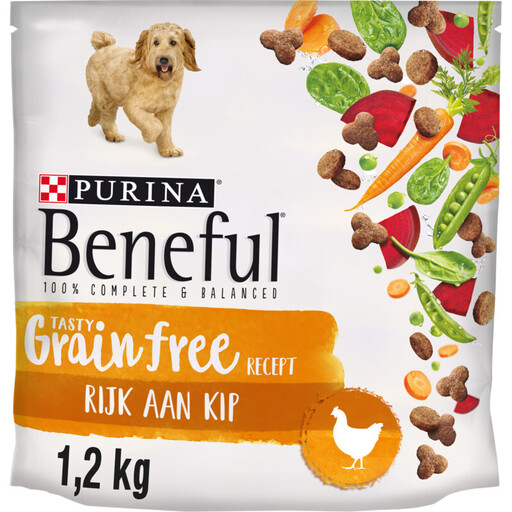
Why it’s a good fit: A smaller pack is practical if you want to try grain-free food first or have a small dog.
You do not have to buy a large bag before knowing whether your dog accepts the kibble.
Complete nutrition for adult dogs; the product information lists 25.5% crude protein and 13.5% fat.
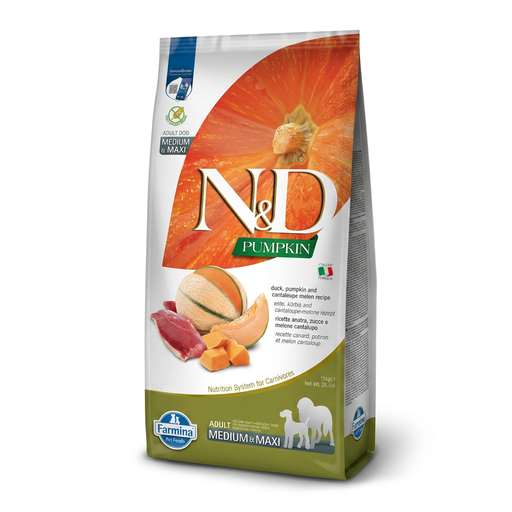
Why it’s a good fit: Designed for medium-sized and large adult dogs, with duck and a higher protein content at the centre of the formula.
The product page identifies both the protein source and the analytical values, helping you look beyond the “grain-free” label.
12 kg pack, fresh and dried duck in the recipe, and 32% crude protein according to the product information.
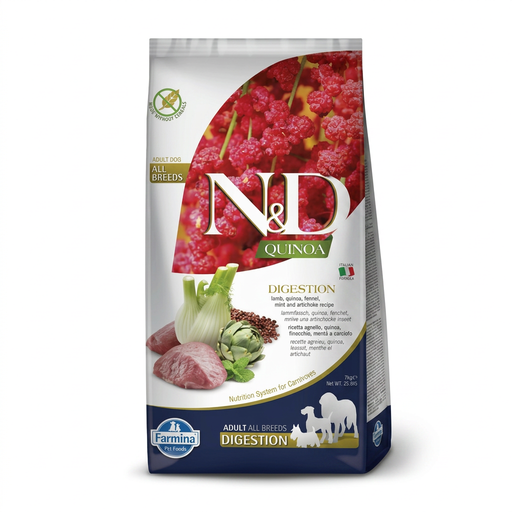
Why it’s a good fit: For medium-sized and large adult dogs whose daily diet may benefit from lamb, quinoa and a fibre-focused formula.
The formula lists ingredients including lamb, quinoa, inulin, fructo-oligosaccharides and psyllium; its effects are not guaranteed for every dog.
25% crude protein, 12% fat and 1.9% crude fibre according to the listed analytical constituents.
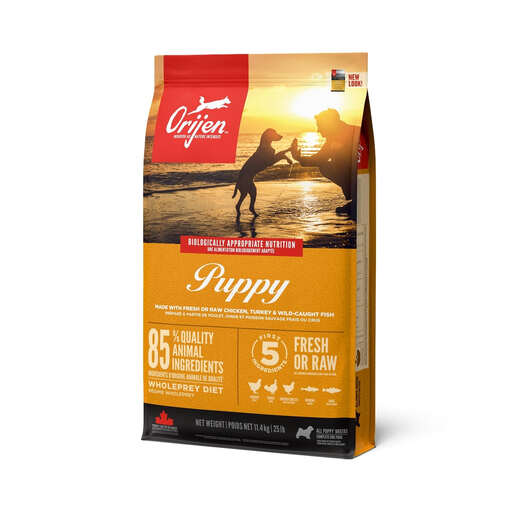
Why it’s a good fit: A large pack for puppies of different breeds or households where dry food is used regularly.
The product information specifies age, feeding frequency and a gradual transition over 7 to 10 days.
The stated analysis lists at least 38% crude protein and 18% fat; feed according to age, weight and breed size.
Browse our current selection of natural grain-free dog food and compare life stage, protein source, pack size and nutritional values.
Mix the new food gradually with the old food, usually over 7 to 10 days. Start with a small proportion of the new kibble and increase it step by step. Monitor your dog’s stools, appetite and body condition. Do not stop prescribed food without guidance, and consult a veterinarian if symptoms persist.
Store an opened bag in a cool, dry place, tightly sealed and away from direct sunlight. Always provide fresh drinking water. A large bag may be more economical per kilogram, but only if your dog accepts the food well and you can use it within the recommended period.
No. Some dogs do well on grain-free dog food, but avoiding grains is not a universal requirement. Consider complete nutritional value, life stage and individual tolerance. If you suspect an allergy or digestive problems, professional advice is important.
There is no guarantee that one recipe will work for every dog. Look for a clear, limited ingredients list, a suitable protein source and a gradual food transition. Farmina N&D Quinoa Digestion lists lamb, quinoa and prebiotic ingredients, among others, but every dog may respond differently.
That depends on the price per kilogram, daily portion and energy density. Do not compare only the pack price; also consider the pack weight, recommended serving size and storage period. A larger pack can be practical for medium-sized and large dogs, while a smaller bag helps limit the risk of waste.
