What should you look for when choosing?
Start by checking that it’s labelled gluten-free and can be prepared without bread crumbs. Then consider how well it travels and whether the ingredients and nutritional information are right for the pupil.
| What to consider |
What to check when buying |
Who should pay particular attention? |
| Gluten-free status and cross-contamination |
Look for the gluten-free label on the product you’ve chosen and use clean equipment when preparing it. |
If I have coeliac disease, my lunch must remain gluten-free after spreading and packing, too. This safety consideration comes first for around 45% of consumers. |
| Portability and portioning |
Check the portion packaging and protect fragile toast pieces from getting crushed in the bag; pack moist toppings separately if needed. |
A dry lunch needs to be easy to take to school and ready to eat when you arrive. Around 33% of consumers give this practical convenience top priority. |
| Other allergens and nutritional information |
Read the ingredients and allergen information; compare the salt content per 100 g and for the portion you’re packing. |
If I need to avoid an allergen as well as gluten, or regularly eat the same toast, I want to know what’s in my portion. For around 22% of consumers, this is the first consideration once gluten-free status has been confirmed. |
Brands to consider
Always compare the specific product: items from the same brand can have different ingredients, allergens and nutritional values.
Gluten Free Bakery Holland
Jumbo lists its 100 g Italian Seasoned Toasts as a gluten-free toast option.
- Jumbo lists 5.3 g of fibre per 100 g for this product.
- The stated salt content of 6.6 g per 100 g makes the portion you plan to eat worth comparing. Check the current label before use.
Schär
Jumbo offers gluten-free Schär Crackers, among other products, in a pack of 6 × 35 g.
- The individual packs can be handy when portioning out a dry lunch.
- Check the ingredients, allergens and nutritional values for each Schär product; they’re not the same across the range.
Laurieri
Albert Heijn lists gluten-free Laurieri Scrocchi in flavours including sea salt, rosemary and garlic and parsley.
- For the sea salt flavour, Albert Heijn lists soya and chickpea flour, making it easy to check for these ingredients specifically.
- The soya variety isn’t suitable if soya needs to be avoided. Check the packaging for the flavour you’ve chosen.
Products for different types of lunch
These products suit two different types of lunch: rice toast for anyone who wants to take toast pieces along, and a mini baguette for anyone who’d prefer a bread-like base. For both, check the gluten-free label on the packaging and take care to avoid cross-contamination when preparing them.
 No image available
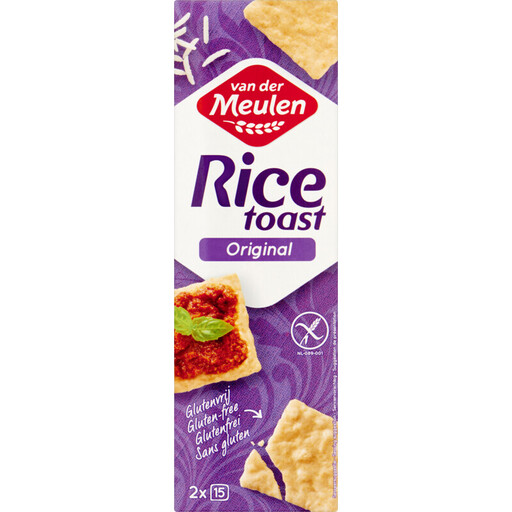
Van Der Meulen Rice Toast Natural, 65 g
A toast option for a dry school lunch; pack toppings separately if you want the toast to stay crisp.
The product name states 65 g. Before buying, check the allergen information on the exact packaging, especially if soya or sesame needs to be avoided, and protect the toast pieces from getting crushed in the bag.
View at Joybuy
 No image available
Gv Baguette Mini, 7 pieces
A bread-like base for a pupil who’d rather not take individual toast pieces or crackers.
The product name states 7 pieces. Before buying, check the exact product format and preparation instructions, the gluten-free label and the allergen information on the packaging; also look out for soya, lupin and mustard.
View at Joybuy
Frequently asked questions
When can toast be labelled gluten-free?
Under Commission Implementing Regulation (EU) No 828/2014, published on EUR-Lex, a food may be labelled gluten-free if it contains no more than 20 mg/kg of gluten for the final consumer. If you have coeliac disease, don’t rely solely on a name such as rice toast or wheat-free; look for the gluten-free label on the packaging.
Do I need to watch out for cross-contamination at home, too?
Yes. Gluten can get onto a gluten-free lunch while you’re preparing it. The Dutch Coeliac Society calls this cross-contamination. Use a clean knife, worktop and lunchbox, and keep ordinary bread and crumbs away.
Is gluten-free toast suitable for someone with a soya allergy?
Not necessarily. Albert Heijn lists soya in the ingredients of Laurieri Scrocchi Sea Salt Gluten-Free. If you have a soya allergy, read the allergen information on the exact pack you’re planning to buy; a gluten-free label doesn’t tell you whether it contains soya.
Does a gluten-free bread substitute always contain iodine from baker’s salt?
No, you can’t assume that. According to the Netherlands Nutrition Centre, bakers aren’t required to use baker’s salt. Check the packaging or ask the manufacturer or baker which salt was used in the bread substitute you’ve chosen if this matters for the pupil.


