What should you look for when choosing?
First check for a gluten-free statement and any other allergens. Then choose based on flavour and ingredients, and check that the product is available shortly before you shop.
| What to consider |
What to check when buying |
Who it matters to |
| Gluten-free statement |
Look for ‘gluten-free’ on the current packaging. If the muesli contains oats, check what type of oats are listed too. |
If I have coeliac disease, I don’t want to assume muesli is suitable based on the type of grain alone; demonstrable gluten-free suitability is the top priority for around 36% of consumers. |
| Other allergens |
Read the ingredients list and check both ‘contains’ and ‘may contain’ in the allergen information. |
If I also have another food allergy or am buying for a guest, the whole pack needs to suit their needs. These additional ingredients and allergens matter most to around 29% of consumers. |
| Ingredients and flavour |
Compare sugars and fibre per 100 g, and decide whether you’d like a plain, fruit or crunchy variety. |
For my Sunday breakfast, it makes a difference whether I add my own fruit or choose a mix with dried fruit; ingredients and flavour are the main focus for around 21% of consumers. |
| Availability |
Check current in-store or delivery availability. If you choose an alternative, check its gluten-free statement and allergen information again. |
When I’m sorting out the Sunday food shop, I want to know whether my chosen variety is available. For around 14% of consumers, being able to buy the product is the main priority. |
Brands and product ranges compared
The product varieties mentioned show differences in ingredients, nutritional information and allergens. A previous product listing doesn’t mean a variety is available now.
AH Glutenvrij
Albert Heijn lists a gluten-free basic muesli made with oat, soya and buckwheat flakes, raisins and sunflower seeds.
- Albert Heijn’s product information lists 13 g of fibre and 18 g of protein per 100 g.
- The variety contains soya and oats and may contain nuts. The listing checked said ‘in store only’; check current availability.
Consenza
Jumbo lists a gluten-free organic fruit muesli from Consenza, made with gluten-free oats, cornflakes and dried fruit.
- The fruit variety offers a different mix of ingredients from a plain base, and Jumbo describes it as having ‘no added sugars’.
- Jumbo also lists oats and 15,0 g of sugars per 100 g; the statement about added sugars doesn’t describe the total sugar content.
Zonnatura
An organic apple and cinnamon muesli from Zonnatura listed by Albert Heijn contained gluten-free wholegrain oats, rice, buckwheat, linseed and apple, among other ingredients.
- Albert Heijn listed 9,9 g of fibre and 3,1 g of sugars per 100 g for this variety.
- The product listing said this variety had been discontinued. Don’t use the information as an indication that it’s available to buy now.
Eat Natural
Jumbo listed toasted gluten-free breakfast options from Eat Natural, including a buckwheat mix and another mix with gluten-free oats, buckwheat, amaranth, quinoa and chia.
- The buckwheat variety included seeds in its ingredients.
- For this variety, Jumbo warned that it may contain milk, nuts, peanuts, sesame and soya. The varieties checked were no longer available online.
Leev
Jumbo listed an organic gluten-free fruit flakes muesli from Leev, made with dried fruit, maize, rice, seeds and pseudocereals, among other ingredients.
- The product listing stated that it contained 43% fruit, which is useful when comparing it with other fruit mueslis.
- Jumbo listed 30,3 g of sugars per 100 g and said that the product was no longer available online.
Granola for Sunday breakfast at Joybuy
This product selection is granola, not muesli. Consider it as another breakfast cereal option for Sunday, and if you have coeliac disease, check the gluten-free statement on the packaging.
 No image available
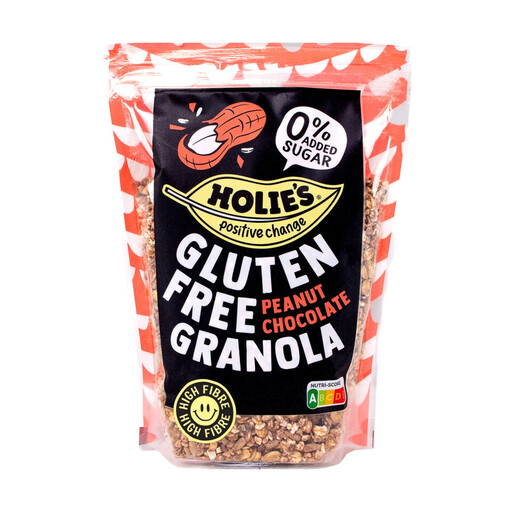
Holie's Granola Glutenfree Peanut Chocolate, 330 g
A granola option if you’d prefer a peanut and chocolate variety to muesli for Sunday breakfast.
The product name includes ‘Glutenfree’ and the pack size is 330 g. Check the gluten-free statement and the current ingredients and allergen information on the packaging, especially if peanuts, nuts or soya are relevant to you.
View at Joybuy
Frequently asked questions
When can muesli be labelled ‘gluten-free’?
Under Implementing Regulation (EU) No 828/2014, the statement ‘gluten-free’ may be used in the Netherlands when the food sold to consumers contains no more than 20 mg/kg of gluten. When choosing, look for the statement on the finished product’s packaging.
Is gluten-free muesli with oats suitable for people with coeliac disease?
Muesli with oats can carry a gluten-free statement, provided the oats have been specially produced, prepared or processed in accordance with EU rules to avoid contamination with wheat, rye and barley. The Dutch Coeliac Association points out that a small number of people with coeliac disease also react to pure oats; discuss any previous reactions with your doctor or specialist dietitian.
Is the allergen information on a product page enough?
Use the online information to help you choose, but check the current packaging before eating the muesli too. Albert Heijn points out that ingredients and allergen information can change. A gluten-free statement also doesn’t rule out other allergens.
Is fruit muesli with no added sugars low in sugars?
Not necessarily: the Consenza fruit muesli listed by Jumbo carries the statement ‘no added sugars’, but its nutritional information lists 15,0 g of sugars per 100 g. So compare the total sugar content per 100 g and check which ingredients the mix contains.
How should I store muesli after opening?
Follow the storage advice on the packaging you’ve chosen and seal it well after use. Albert Heijn advises storing its gluten-free muesli in a cool, dark and dry place; other varieties may have different storage instructions.


