What should you look for when choosing?
If you have coeliac disease, first check for a gluten-free label and any warnings about cereals containing gluten. Size, other allergens and nutritional information should only be considered after that.
| What to consider |
What to check when buying |
Who it matters to |
| Gluten-free labelling and cross-contamination |
Look for ‘gluten-free’ on the current packaging and read any warnings about cereals containing gluten. Under Commission Implementing Regulation (EU) No 828/2014, ‘gluten-free’ may only be used when the finished product contains no more than 20 mg of gluten per kg. |
If I have coeliac disease, I want to know what the label says about gluten and cross-contamination before I take a biscuit with me. This would be the main concern when buying for around 33% of consumers. |
| Size and portion for taking with you |
Compare the pack size and number of biscuits per pack; also consider how you’ll carry an opened pack. |
For a short lunch break, I want to take a portion with me without having to keep a large pack open. Portability would be the main consideration for around 27% of consumers. |
| Other allergens and oats |
Read the ingredients, allergen information and any ‘may contain’ wording. For oat biscuits, also check for an explicit gluten-free label. |
As well as gluten, I may need to consider ingredients such as soya, milk or oats; the specific product variant will determine my choice. Additional allergens would be the main concern for around 20% of consumers. |
| Portion and nutritional information |
Compare portion sizes and nutritional information, including sugars and fibre, on a like-for-like basis: per 100 g or per portion. |
I want to know how many biscuits I’m having with lunch and what the nutritional information means for that portion. Portion size and nutritional information would be the most important criteria for around 20% of consumers. |
An oat biscuit at Joybuy
This product selection features a Verkade oat biscuit with milk chocolate for a lunchtime treat. Check whether the current packaging meets your requirements for gluten and other allergens.
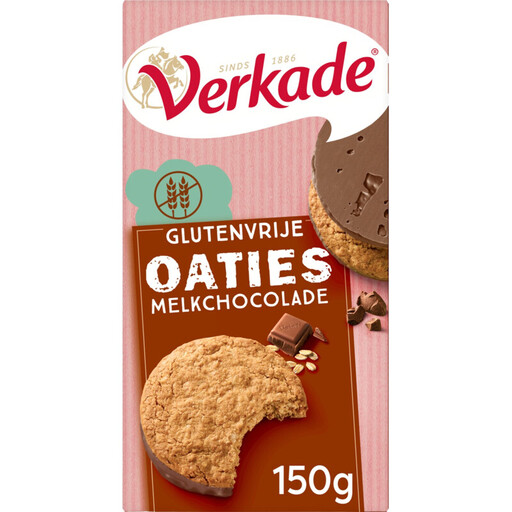 Image unavailable
Verkade Gv Oaties Milk Chocolate, 150 g
If you’d like to take an oat biscuit with you for lunch, the product description labels this variant gluten-free. Check that label on the current packaging.
150 g pack. According to the product information, the biscuit contains milk, oats and soya, and may contain nuts. Check the pack itself if you need individually wrapped portions.
View at Joybuy
Frequently asked questions
What does ‘gluten-free’ mean on a biscuit pack?
In the EU, under Commission Implementing Regulation (EU) No 828/2014, a food may only be labelled ‘gluten-free’ if the product sold to the final consumer contains no more than 20 mg of gluten per kg. If you have coeliac disease, read the rest of the information on the current packaging, too.
What should I do if a pack says ‘may contain cereals containing gluten’?
For this selection aimed at people with coeliac disease, don’t choose a biscuit with that warning. The Dutch Coeliac Association considers ‘may contain cereals containing gluten’ and ‘not suitable for people with coeliac disease’ equivalent warnings for this assessment.
Is every oat biscuit suitable for people with coeliac disease?
No. Don’t choose a biscuit based on oats alone. Check that it is explicitly labelled ‘gluten-free’ and read the warnings on the packaging; also consider oats separately if that ingredient is relevant to you.
Can I take Lotus Biscoff Original as a gluten-free biscuit?
No. Lotus Bakeries lists wheat flour as an ingredient in Biscoff Original and gluten as a present allergen. Even a small pocket-sized pack doesn’t make this variant gluten-free.
How should I store gluten-free biscuits in a shared lunch area?
Keep the biscuits well wrapped and separate from food containing gluten. The Dutch Coeliac Association recommends storing gluten-free products separately and well wrapped to prevent contact with products containing gluten.


