
Host welcoming a guest with coeliac disease
You’re looking for toast labelled gluten-free and want to prevent crumbs, shared toppings or utensils coming into contact with it. The Dutch Coeliac Society advises preparing gluten-free food separately.


For a guest with coeliac disease, choose toast whose current packaging or product information explicitly states ‘gluten-free’. Plain rice toast lets the toppings take centre stage, while seasoned toast adds flavour of its own; check both for other allergens too. At your Vlaggetjesdag drinks party, keep the gluten-free toast, toppings and utensils separate from food containing gluten, as advised by the Dutch Coeliac Society.
You’re looking for toast labelled gluten-free and want to prevent crumbs, shared toppings or utensils coming into contact with it. The Dutch Coeliac Society advises preparing gluten-free food separately.
As well as gluten, eggs, oats, nuts, sesame or soya may be a concern. Which allergens need to be avoided depends on your guests and the label on the product you choose.
You’re choosing between plain rice toast and Italian herb toast. Compare the size and allergens too before picking a variety for your get-together.
Start by checking that the specific product is labelled gluten-free, then work out how you can serve it separately. Next, compare the flavour, size and other allergens with your guests’ needs.
| What to consider | What to check before buying | Who is this most important for? |
|---|---|---|
| Gluten-free labelling | Check the current packaging of the specific toast for the words ‘gluten-free’ or a recognised gluten-free symbol. | If someone with coeliac disease is joining us, I want to see that the product I’ve chosen is labelled gluten-free. For around 50% of consumers, this labelling is their main concern when buying. |
| Serving separately | Use a clean surface and clean utensils, and keep the toast and toppings separate from food containing gluten. | When serving regular toast too, I want to prevent crumbs or shared knives from reaching the gluten-free snacks. Serving food separately is the top priority for around 30% of consumers. |
| Flavour and other allergens | Compare plain and seasoned toast; check the ingredients and any listed allergens or possible traces for each product. | When catering for several guests, I’m looking for a flavour that suits the toppings without overlooking their other allergies. Around 20% of consumers give this consideration the highest priority. |
Rice as an ingredient doesn’t, by itself, tell you whether the finished product can be labelled gluten-free. Under Implementing Regulation (EU) No 828/2014, ‘gluten-free’ may be used when the food contains no more than 20 mg/kg of gluten for the final consumer.
Check the gluten-free labelling on the specific product again whenever you buy a different pack or a newly updated one.
The Dutch Coeliac Society warns that crumbs and shared kitchen utensils can lead to cross-contamination, even when the toast itself is labelled gluten-free.
Use clean utensils and a clean surface, set the gluten-free snacks aside, and don’t use the same knife for different toppings.
Jumbo’s product information lists egg and oats, as well as possible traces of various nuts and sesame, for Gluten Free Bakery Holland Toastjes Italiaans Gekruid. For Van Der Meulen Rice Toast Original, Jumbo lists possible traces of sesame and soya.
Ask which other allergies your guests have, and check the current packaging of the toast you buy.
Baker’s salt contains iodine, but the Netherlands Nutrition Centre says bakers aren’t required to use it. The ‘gluten-free’ label doesn’t tell you which salt has been used.
If iodine content matters when choosing a product, check the toast’s label to see whether ‘iodised salt’, for example, appears in the ingredients.
Plain rice toast to pair with a variety of toppings.
Seasoned toast for anyone who wants the toast itself to add flavour.
A range to compare with crackers, crispbread or other alternatives to toast for a drinks party.
A bread alternative for guests who would rather have bread than small pieces of toast with their drinks.
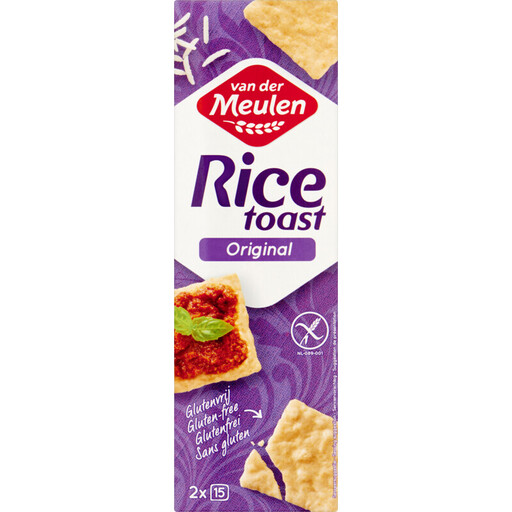
This Van Der Meulen rice toast suits a get-together where you’re looking for a plain base for toppings. If you’re serving a guest with coeliac disease, check the current gluten-free labelling and keep the toast separate while preparing and serving it.
 No image available
Plain rice toast to pair with savoury toppings. The product information labels this variety gluten-free; check the current packaging to confirm.
Pack size: 65 g. If you have an allergy to sesame or soya, check the current label carefully and ask for further product information if needed, as the available allergen information is not consistent.
Keep the toast separate from products containing gluten when serving it, and use clean utensils.
Choose toast whose current packaging or product information explicitly states ‘gluten-free’. Under Implementing Regulation (EU) No 828/2014, food for the final consumer must contain no more than 20 mg/kg of gluten to use this label. A recognised gluten-free symbol can help you check the packaging.
It needs to be prepared and served separately: crumbs from regular toast and shared knives or toppings can contaminate gluten-free snacks. Use clean kitchen utensils, set the toast aside, and make sure guests don’t use the same knife for both types, as advised by the Dutch Coeliac Society.
It varies by product. For Gluten Free Bakery Holland Toastjes Italiaans Gekruid, Jumbo lists egg and oats, as well as possible traces of various nuts and sesame. For Van Der Meulen Rice Toast Original, Jumbo lists possible traces of sesame and soya. Ask which allergies your guests have and always check the label on the pack you choose.
No, that isn’t guaranteed by the ‘gluten-free’ label. The Netherlands Nutrition Centre explains that baker’s salt contains iodine, but bakers aren’t required to use it. For a specific toast, check the ingredients list for ‘iodised salt’, for example.
Yes, check the current gluten-free and allergen information every time you buy it, especially if the packaging says the product has been updated. The Dutch Coeliac Society points out that an updated product may have a different composition.