
Student with coeliac disease
You’re looking for a crispy base for dinner, but need a product labelled gluten-free. In a shared kitchen, watch out for crumbs from ordinary bread too.


If you have coeliac disease, choose only toast or a bread alternative labelled ‘gluten-free’ on the packaging for a student dinner; ordinary toast or Melba toast is not a suitable alternative unless it carries that label. Then decide whether small, crispy portions or bread for toppings would work better with your meal, and check for other allergens and possible cross-contamination too.
You’re looking for a crispy base for dinner, but need a product labelled gluten-free. In a shared kitchen, watch out for crumbs from ordinary bread too.
You compare toast bites and crackers by pack size and the number of portions you’ll use, without assuming that ordinary toast is gluten-free.
You want to choose a practical base for dinner. According to the Netherlands Nutrition Centre, not everyone needs to eat gluten-free; if you do, check the label on every product.
First, decide whether you need a gluten-free product. Then choose the type and quantity that suit your dinner.
| What to consider | What to check when buying | Who it matters to |
|---|---|---|
| Gluten-free status and cross-contamination | Look for the ‘gluten-free’ label on the packaging and read the allergen information. At home, avoid contact with crumbs from ordinary bread. | If I have coeliac disease, I want to be sure my toast is gluten-free and hasn’t come into contact with ordinary bread. For around 42% of consumers, this dietary check comes first. |
| Quantity per meal | Compare the pack size with the portions you need for one or more dinners. | On a limited student budget, I want to use a pack without having lots left over. Around 33% of consumers put this question of portion sizes first. |
| Type of meal | Choose small toast bites for snacks, or check whether bread, rolls or crispbread would work better with your toppings. | For a topped evening meal, I’m looking for a base with a suitable portion size, not just individual snacks. For around 25% of consumers, the type of meal is the biggest consideration. |
A brand name, shop or shelf won’t tell you whether a specific product is gluten-free. For someone with coeliac disease, crumbs from ordinary bread matter too.
Check the gluten-free label on the packaging of the product you’re buying, and keep it separate from ordinary bread when preparing food.
Jumbo lists egg and oats as allergens in Gluten Free Bakery Holland Italian Herb Toast Bites. The product may also contain almonds, hazelnuts, other nuts and sesame.
If you have another allergy, check the current ingredients and allergen information for that exact product variant too.
The Netherlands Food and Consumer Product Safety Authority explains that iodine compounds may be present in bread, bread substitutes and other bakery products because baker’s salt is added. This doesn’t tell you whether a particular toast product contains iodine.
If iodine is relevant to your choice, check the information on the packaging or ask the manufacturer.
An option to consider if you’re looking for small, seasoned gluten-free toast bites for dinner.
A cracker option if you’re looking for something other than small toast bites.
A range to consider if you’d rather have bread or crispbread than toast bites with a meal topped with your favourite ingredients.
For small, crispy portions, you could consider rice toast; there’s also a bread-like option for a meal with toppings. If you have coeliac disease, check the gluten-free label on the current packaging of both products.
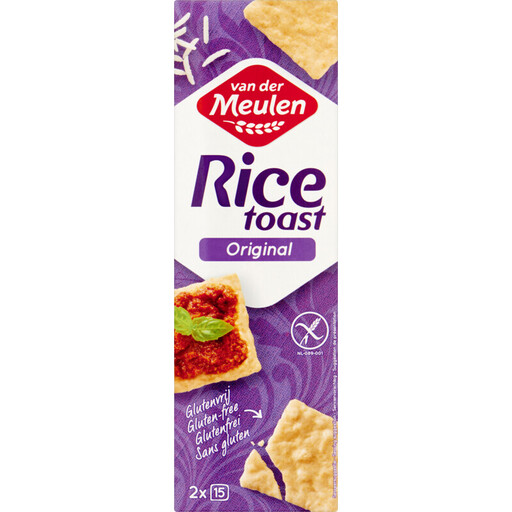 Image unavailable
Rice toast to consider if you’d like a small, crispy accompaniment to dinner; the product name states that it’s 65 g.
If you have coeliac disease, check the gluten-free label on the current packaging. If you’re allergic to sesame or soya, read the label too.
 Image unavailable
A bread-like option to consider if you’d like to serve toppings on something other than toast.
Before buying, check what this variant contains and how to prepare it. If you have coeliac disease, look for the gluten-free label on the packaging; if you’re allergic to soya, lupin or mustard, check the current label.
Look for ‘gluten-free’ or the Crossed Grain symbol on the packaging of the specific product, and avoid cross-contamination when preparing food. Under Regulation (EU) No 828/2014, a food may only be labelled ‘gluten-free’ if the gluten content of the finished product is no more than 20 mg/kg.
Not unless that specific Melba toast is labelled gluten-free. The product name or the shop where you buy it doesn’t tell you whether it contains gluten.
Use clean utensils and a clean work surface, and keep gluten-free products away from crumbs from ordinary bread. The Netherlands Nutrition Centre points out that even a stray bread crumb can matter if you have coeliac disease.
No. The Netherlands Food and Consumer Product Safety Authority explains that iodine compounds may be present in bread, bread substitutes and other bakery products because baker’s salt is added, with a maximum of 65 mg of iodine per kg of salt. Check each product to find out whether this applies to a particular type of toast.
Follow the storage instructions for the product you’ve bought. For Gluten Free Bakery Holland Italian Herb Toast Bites, Jumbo says to store in a cool, dry place in a sealed pack.