What should you look for when choosing?
Start with the gluten-free label and other allergens. Then compare the nutritional information and choose a shape that works for eating at home or taking with you.
| What to consider |
What to check when buying |
Who is this most important for? |
| Choose gluten-free and serve separately |
Look for ‘gluten-free’ on the packaging. If taking it with you, agree how the toast will be prepared and served without contact with ordinary crumbs. |
If my child has coeliac disease, I want to avoid contact with gluten during preparation and serving too. Around 36% of consumers put gluten-free assurance first. |
| Other allergens |
Read the ingredients and allergen warnings for the exact variety; check again if you switch flavours. |
If another allergen needs to be avoided as well as gluten, the ‘gluten-free’ label alone isn’t enough. Around 29% of consumers put other allergens first. |
| Nutritional value |
Compare fibre and salt per 100 g and per portion eaten. If your child eats less regular bread, consider how iodine fits into their overall diet. |
If this snack is served regularly, I want to know how it fits in with the rest of what my child eats. Around 21% of consumers give nutritional balance the highest priority. |
| Shape and portion |
Choose between a plain toast for your own toppings, a seasoned variety or individually wrapped crackers. |
For taking with me or a small snack, I want to be able to take an amount that suits the occasion. Portion size and convenience come first for around 14% of consumers. |
Rice toast at Joybuy
This plain rice toast is a good fit for a small snack with toppings of your choice. Check the current packaging before serving, and if your child has coeliac disease, prepare it separately from food containing gluten.
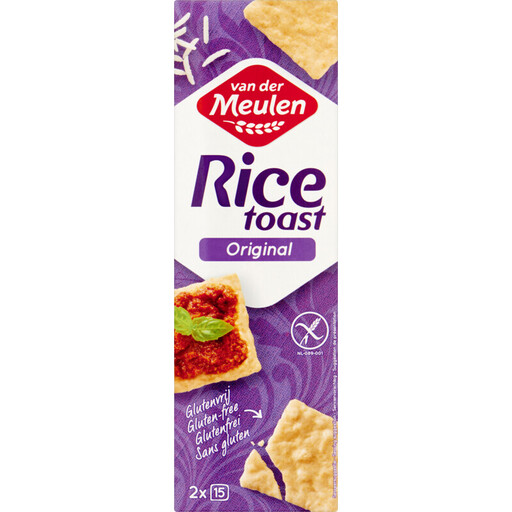 Image unavailable
Van der Meulen Natural Rice Toast 65 g
A plain rice toast for a small snack with toppings of your choice; Albert Heijn describes Natural Rice Toast as 100% gluten-free.
Two trays totalling 65 g. The listed nutritional values are 2,1 g of fibre and 1,5 g of salt per 100 g.
If you have another allergy to consider, check the current packaging for information about sesame and soya. If your child has coeliac disease, prepare the toast using clean utensils.
View at Joybuy
Frequently asked questions
What does ‘gluten-free’ mean on a pack of toast?
Under Commission Implementing Regulation (EU) No 828/2014, a food may be labelled ‘gluten-free’ for the final consumer if it contains no more than 20 mg/kg of gluten. If you’re choosing food for a child with coeliac disease, check the label on the exact product rather than relying on a brief description that only says ‘wheat-free’.
Are gluten-free toasts also free from other allergens?
No, the label tells you nothing about other allergens. For example, the product information for the varieties discussed lists egg or soya, or warns that they may contain sesame or nuts. So check the label for the flavour you’re actually buying.
How do I prepare gluten-free toast for a child with coeliac disease?
Keep the toast separate from ordinary bread and crackers, and use clean hands, a clean plate and a clean knife. The Netherlands Nutrition Centre warns that even a stray bread crumb can cause symptoms in someone with coeliac disease.
Can I send gluten-free toast to school or an after-school club without making arrangements?
Talk to the school or after-school club in advance about how the food will be stored, prepared and served, and what arrangements apply to the group. The Dutch Food Allergy Foundation advises parents to agree arrangements with the school for food and hygiene.
Can gluten-free toast replace ordinary bread in a child’s diet?
Not automatically: a snack toast does not necessarily have the same nutritional value as the bread a child would otherwise eat. The Netherlands Nutrition Centre describes bread made with iodised baker’s salt as an important source of iodine in the Netherlands. If your child eats less of this bread, consider their overall diet and, if needed, discuss questions about a strict gluten-free diet with a specialist dietitian.


