Who is this choice relevant to?

Anyone with coeliac disease looking for party toast

You want to choose toast slices or crackers for your first food shop. The ‘gluten-free’ label on the current packaging and the ingredients matter more than how closely they resemble ordinary Melba toast.

Anyone who also needs to check for other allergens

As well as gluten, you may need to check for egg, oats, soya, sesame or nuts. A gluten-free label does not mean a product is free from these other allergens or warnings about possible traces.

Anyone putting together their first gluten-free food shop

Alongside party toast, you may also be looking for bread and crackers for other occasions. If this means you eat less ordinary bread, it is worth considering your sources of iodine as part of your wider diet, as explained by the Netherlands Nutrition Centre (Voedingscentrum).

What should you look for when choosing?

Start with the ‘gluten-free’ label and check for any allergens that matter to you. Then choose the type of product you want and compare the nutritional information that is relevant to you.

What to check What to look for when buying Who should pay particular attention?
‘Gluten-free’ label Look for an explicit label on the current packaging; ‘wheat-free’ alone does not mean the same thing. If I have coeliac disease, I want to know whether a product is labelled gluten-free before considering its taste or shape. This check comes first for around 42% of consumers.
Other allergens Read the allergen declaration and any warnings about possible traces, even on a gluten-free product. If I have an additional allergy, I need to be able to see whether, for example, egg, soya or sesame is involved. Around 25% of consumers give this second check the highest priority.
Shape and use Choose between small toast slices, crackers and Scrocchi; also check the pack size. For a drinks party, I might look for toast slices, while crackers may be a better fit for other occasions. The occasion is the main factor in the choice for around 17% of consumers.
Salt and iodine Compare the salt per 100 g and the amount you eat; consider your sources of iodine as part of your overall diet. If you buy less bread, you may want to take the salt content of toast into account without overlooking your other sources of iodine. This is the main consideration for around 16% of consumers.

Common mistakes

  • Relying on ‘wheat-free’ or the shape of ordinary toast

    ‘Wheat-free’ does not mean the same thing as ‘gluten-free’. Under Commission Implementing Regulation (EU) No 828/2014, ‘gluten-free’ may be used when the gluten content is no more than 20 mg/kg in the food as sold to the final consumer.

    Check for the ‘gluten-free’ label on the current packaging before choosing based on taste or size.

  • Assuming gluten-free also means free from other allergens

    Jumbo lists egg and oats for Gluten Free Bakery Holland Toastjes Italiaans Gekruid, as well as the possible presence of various nuts and sesame. The Schär crackers and Laurieri Scrocchi described here contain soya.

    Check the full allergen information for each product against the allergens you need to avoid.

  • Seeing toast as a direct replacement for bread

    According to the Netherlands Nutrition Centre (Voedingscentrum), bread made with iodised baker’s salt is a source of iodine. Bakers do not have to use this salt, so toast or crackers alone tell you nothing about your total iodine intake.

    Consider your iodine sources as part of your overall diet if you eat little bread. If needed, discuss any personal dietary questions with a dietitian or doctor.

  • Ignoring the salt because the toast slices are small

    Jumbo lists 6.6 g of salt per 100 g for Gluten Free Bakery Holland Toastjes Italiaans Gekruid. The amount you actually eat matters as well as the figure per 100 g.

    Compare the nutritional information per 100 g and consider how many toast slices you serve or eat.

Brands and product ranges to consider

Gluten Free Bakery Holland

The Toastjes Italiaans Gekruid at Jumbo are an option if you are specifically looking for small, savoury, herb-seasoned gluten-free toast slices.

  • Jumbo lists gluten-free oat flour, egg and teff flour in these toast slices.
  • Jumbo also mentions the possible presence of almonds, hazelnuts, nuts, sesame and walnuts, and 6.6 g of salt per 100 g.

Schär

The crackers described here are an alternative to toast slices if you would prefer crackers in smaller packs.

  • Jumbo describes these crackers as specially made for people with gluten intolerance and lists six 35 g packs.
  • According to the product information, these crackers contain soya; wheat-free and lactose-free do not mean soya-free.

Laurieri

The sea salt Scrocchi at Albert Heijn are a gluten-free cracker alternative if you are also looking for products without milk or eggs.

  • Albert Heijn describes these Scrocchi as gluten-free and free from milk and eggs.
  • The Scrocchi contain soya; Albert Heijn also lists 3% sea salt in the ingredients.

AH Glutenvrij

This product range may be useful if you are looking at bread and crackers as well as toast for your first food shop.

  • Albert Heijn’s range includes gluten-free crackers and bread products.
  • Check the current ingredients, allergens and packaging for each item individually.

Rice toast on Joybuy

This rice toast is a suitable product type to consider for your first shop if you are looking for something to serve as toast. If you have coeliac disease, check for the ‘gluten-free’ label on the current packaging before buying and read the allergen information, especially if you also need to avoid soya or sesame.
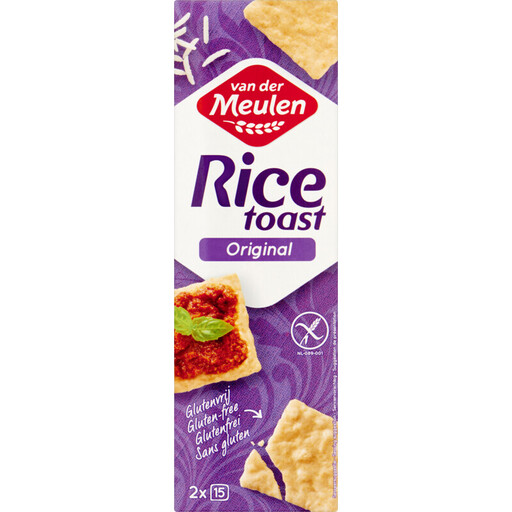
Van Der Meulen Rice Toast Natural, 65 g pack

Van Der Meulen Rice Toast Natural 65 g

Rice toast to consider if you are looking for toast for your first food shop; check the current packaging for the ‘gluten-free’ label and allergen information.

Pack size: 65 g. If you have a soya or sesame allergy, pay particular attention to the ingredients and any warnings about possible traces.

View on Joybuy

Frequently asked questions

Does ‘wheat-free’ mean the same as ‘gluten-free’ for coeliac disease?

No. For this choice, look specifically for the ‘gluten-free’ label on the current packaging. Commission Implementing Regulation (EU) No 828/2014 sets a maximum gluten content of 20 mg/kg for this label in products as sold to the final consumer.

Are gluten-free toast slices also free from egg, soya and nuts?

Not necessarily. Jumbo lists egg and oats for Gluten Free Bakery Holland Toastjes Italiaans Gekruid and warns of the possible presence of various nuts and sesame; the Schär crackers and Laurieri Scrocchi described here contain soya. So, check the allergen information for the product you buy.

Can gluten-free toast replace bread as a source of iodine?

Do not assume so. According to the Netherlands Nutrition Centre (Voedingscentrum), bread made with iodised baker’s salt provides iodine, but bakers are not required to use this salt. If you eat less bread, consider your sources of iodine as part of your overall diet.

How should I store toast or crackers after opening?

Follow the instructions on the packaging of the product you choose. The products described should be stored in a cool, dry place; keep an opened pack tightly closed in line with the product instructions.

Is the online allergen information enough when I’m buying a product?

Use it to compare products, but also read the packaging of the item you actually buy. Albert Heijn points out that ingredients, nutritional information and allergen information can change when products are updated.
