
Parents of children with coeliac disease
A gluten-free label is their starting point. The Dutch Coeliac Association also advises taking care when preparing and packing food, so the snack doesn’t come into contact with ordinary bread crumbs.


For a child with coeliac disease, start by checking that the packaging clearly states that the toast or crackers are gluten-free, or carries the Crossed Grain symbol. Don’t rely on the product name alone. Then check for other allergens and choose a format that’s easy to take with you. Keep the snack away from ordinary bread crumbs when preparing and packing it.
A gluten-free label is their starting point. The Dutch Coeliac Association also advises taking care when preparing and packing food, so the snack doesn’t come into contact with ordinary bread crumbs.
As well as gluten, ingredients such as egg, soya, oats, sesame or nuts may be a concern. Which ones matter varies from child to child and from product to product.
Individual pieces of toast and crackers work well in different ways. If you’re packing a snack to take with you, portion size and clean, sealed packaging matter too.
If your child has coeliac disease, check the gluten-free label first. Then decide which toast or crackers are suitable by checking the allergens, packaging and nutritional information.
| What to consider | What should you check? | Who is this most important for? |
|---|---|---|
| Choosing gluten-free | Check the current packaging for a gluten-free label or the Crossed Grain symbol. Keep the snack separate from ordinary bread products while preparing it. | If my child has coeliac disease, I don’t want to rely on the word ‘toast’ or a wheat-free recipe alone. For around 42% of consumers, choosing gluten-free is the top priority. |
| Other allergens | Check the ingredients and allergen information again when you buy the product. Look out for anything your child needs to avoid. | If my child also needs to avoid egg or soya, a gluten-free label alone isn’t enough. Other allergens are the main concern for an estimated 25% of consumers. |
| Packing and serving | Compare the format and portion packaging. Use clean cutlery and a sealed container for a snack with toppings. | I want to be able to pack an after-school snack quickly and serve it appropriately, without it coming into contact with bread crumbs. For around 17% of consumers, practical use comes first. |
| Nutritional information | Compare things such as salt and fibre per 100 g and per portion. If the snack is regularly replacing bread, consider how it fits into the overall diet. | If toast often replaces bread, I want to look beyond a single snack. For an estimated 16% of consumers, nutritional considerations are the top priority. |
Ordinary toast and crackers may contain ingredients that contain gluten. For a child with coeliac disease, contact with bread crumbs can also be a concern.
Check for a gluten-free label or the Crossed Grain symbol, and read the ingredients again if the packaging or recipe changes.
A gluten-free product may also contain ingredients such as egg, soya or oats, or carry a warning that it may contain nuts or sesame.
Before packing a snack for school or childcare, compare the current allergen information with the ingredients your child needs to avoid.
A gluten-free cracker can come into contact with crumbs while you’re preparing it, through a breadboard, knife or shared spread.
Use clean utensils, keep gluten-free products separate and store the prepared snack in a sealed container.
According to the Netherlands Nutrition Centre, bread made with iodised baker’s salt is an important source of iodine in the Netherlands. Using this salt isn’t compulsory, so you can’t tell how much a piece of toast contributes to the overall diet by looking at the toast alone.
Use the nutritional information to help choose a portion. If bread is regularly being replaced, consider the overall diet rather than just the snack.
Schär Gluten-Free Crackers are an alternative for an after-school snack, but they’re not small pieces of toast.
These Italian-herb gluten-free toast pieces are small enough to enjoy on their own or with toppings.
Bolletje Sesame Bagel Crackers show why ordinary crackers aren’t automatically a gluten-free alternative.
This rice toast is worth considering if you’re looking for a toast-style snack. For a child with coeliac disease, check the gluten-free label on the current packaging and avoid contact with crumbs when serving.
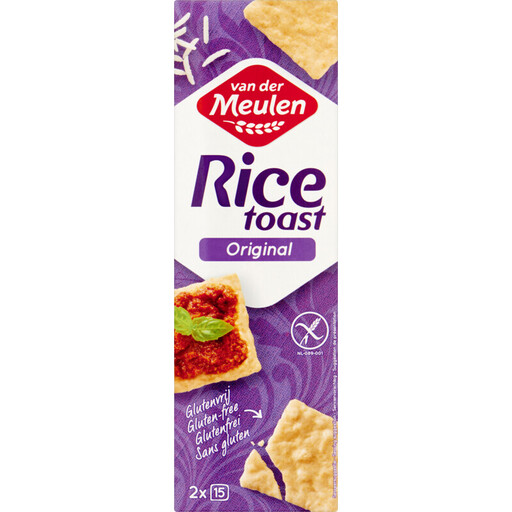 Image unavailable
Rice toast for anyone looking for a toast-style snack. The product description states that it’s gluten-free; if you have coeliac disease, check the current packaging. If you need to avoid other allergens, also check the information about sesame and soya, and use clean cutlery when adding toppings.
No. The name doesn’t tell you whether a product is gluten-free. If you have coeliac disease, check for a gluten-free label or the Crossed Grain symbol and read the current ingredients. For example, Bolletje Sesame Bagel Crackers contain wheat flour and barley malt extract.
Pack the toast separately and keep it away from ordinary bread crumbs. Use clean cutlery and a clean, sealed container. Take care with shared spreads, and check the allergy policy at your child’s school or childcare setting in advance.
Yes, if your child also needs to avoid particular allergens. According to Jumbo, Gluten Free Bakery Holland Italian-Seasoned Toast contains egg and oats and may contain nuts and sesame. Schär Gluten-Free Crackers are listed as containing soya. Always check the current packaging.
You can’t tell from the toast alone. According to the Netherlands Nutrition Centre, bread made with iodised baker’s salt is an important source of iodine in the Netherlands, although using this salt isn’t compulsory. If bread is regularly being replaced, consider the overall diet.