
Weekly shopper with coeliac disease
You’re looking for muesli for several breakfasts and want to see an explicit gluten-free label on every pack. An ingredients list with no obvious wheat ingredient isn’t enough.


If you have coeliac disease, choose muesli whose packaging explicitly says ‘gluten-free’, then check the oats and other allergens. When planning your weekly shop, compare the ingredients and pack size: basic muesli, fruit muesli and crunchy varieties can differ on both counts. Granola can be a crunchy alternative breakfast cereal, but it isn’t the same product as muesli.
You’re looking for muesli for several breakfasts and want to see an explicit gluten-free label on every pack. An ingredients list with no obvious wheat ingredient isn’t enough.
You want to compare ingredients and nutritional information, such as fibre, protein and sugars per 100 g, across the gluten-free range before choosing a pack for the week.
You’re looking for variety, but you also check the gluten-free label, oats and other allergens on fruit muesli and crunchy breakfast cereals. A product range’s name alone doesn’t tell you whether it’s suitable.
Start by checking the gluten-free label and allergen information on the pack. Then compare the nutritional information, flavour and quantity you’ll need for several breakfasts.
| What to consider | What to check when buying | Who it matters to |
|---|---|---|
| Gluten-free label | Look for ‘gluten-free’ on the pack, and read the ingredients and allergen information too. If the muesli contains oats, check how they’re labelled. | When I’m buying muesli for someone with coeliac disease, I don’t want to rely on the impression that it’s wheat-free. Around 44% of consumers prioritise a gluten-free label and checking the packaging. |
| Everyday ingredients | Compare fibre, protein and sugars per 100 g, and check the ingredients. ‘No added sugars’ doesn’t tell you how much sugar the product contains overall. | For my everyday breakfast, I want to know how a basic variety compares with fruit muesli. For around 33% of consumers, this is the main question when choosing. |
| Weekly supply and variety | Check the pack weight and choose the flavour you want. If you’re considering a crunchy variety, check separately whether that specific product is gluten-free. | I want to stock up and perhaps try a crunchy flavour, without skipping the label check. Around 23% of consumers prioritise this question of stocking up and adding variety. |
An ingredients list with no wheat doesn’t rule out gluten from other grains or cross-contamination during production. The Dutch Coeliac Society links the ‘gluten-free’ label to a gluten content of less than 20 mg per kg of product.
If you’re buying for someone with coeliac disease, choose a pack that says ‘gluten-free’ and check the label again if you buy the same product another time.
Quaker Netherlands says that Cruesli Zero Sugar Added Apple, Pecan & Cinnamon contains wholegrain wheat flakes and wheat flour. The claim about added sugars doesn’t change that.
For every crunchy variety, check the gluten-free label and ingredients of that specific product.
A larger pack or multipack doesn’t tell you how much you’ll use at each breakfast. For your weekly shop, the quantity you need depends on your usual portions and how many people will be eating.
Once you’ve confirmed the product is suitable, compare the pack weight with how much you typically use in a week.
Gluten-free muesli may contain other ingredients that matter to the person eating it. For AH Glutenvrij Muesli, Albert Heijn lists oats and soya, among other ingredients, and notes that it may contain nuts.
As well as checking the gluten-free label, read the full allergen information on the current pack.
These examples relate to specific product ranges and varieties. A brand name alone doesn’t confirm that all its muesli is gluten-free.
Albert Heijn lists a 450 g gluten-free basic muesli and crunchy varieties in this range.
Jumbo lists an organic gluten-free fruit muesli containing gluten-free oat flakes and dried fruit, among other ingredients.
The gluten-free apple and cinnamon muesli is an organic variety containing gluten-free oats, rice, buckwheat, linseed and apple, among other ingredients.
Cruesli is a range of crunchy breakfast cereals; the name or a flavour claim doesn’t mean a product is gluten-free.
ALDI lists gluten-free breakfast cereals at category level and also describes standard Golden Bridge muesli.
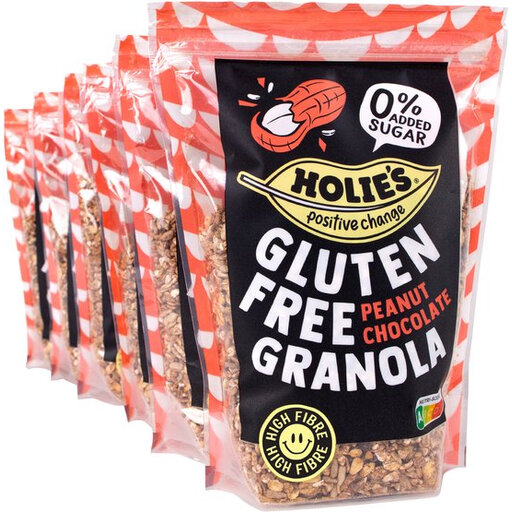
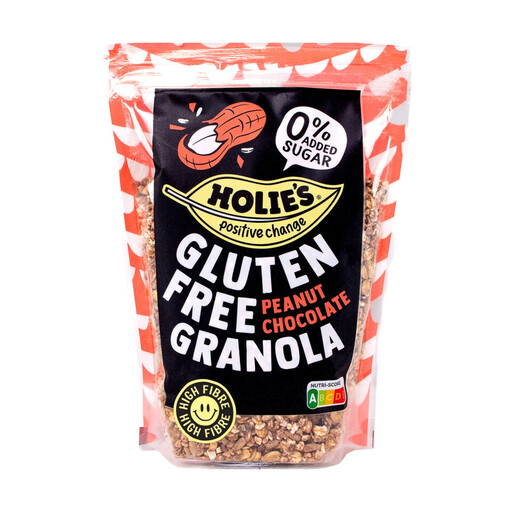
These two packs of Holie's Peanut Chocolate are granola: a crunchy option labelled gluten-free for anyone who wants to look beyond muesli when doing the weekly shop. The difference is that one is a multipack and the other is a single pack. If you’re buying for someone with coeliac disease, check the label and allergen information on the current packaging.
 No image available
For anyone who wants to stock up on several packs of a crunchy breakfast cereal; this granola isn’t muesli.
The product name says Glutenfree and the multipack contains 6 × 330 g. Check the gluten-free label and allergen information on the packaging, paying particular attention to oats and peanuts.
 No image available
For anyone who wants one pack of crunchy granola instead of a multipack; this breakfast cereal isn’t muesli either.
The product name says Glutenfree and 330 g. Check the gluten-free label and allergen information on the packaging, paying particular attention to oats and peanuts.
According to the Dutch Coeliac Society, the ‘gluten-free’ label means a product contains less than 20 mg of gluten per kg. The Netherlands Food and Consumer Product Safety Authority refers to the applicable EU requirements for using this label on packaging. When buying, check that the specific pack is labelled gluten-free.
Not all muesli containing oats is suitable: check whether the product itself is labelled gluten-free. The Dutch Coeliac Society points out that oats can be contaminated with gluten and that a small number of people with coeliac disease also react to pure oats. If you have questions about a reaction to oats, speak to your healthcare professional.
No. Check the ‘of which sugars’ figure in the nutritional information. The gluten-free fruit muesli described by Jumbo has no added sugars, but contains 15 g of sugars per 100 g.
Cruesli Zero Sugar Added Apple, Pecan & Cinnamon isn’t a gluten-free option for someone with coeliac disease: Quaker Netherlands lists wholegrain wheat flakes and wheat flour as ingredients. Check other crunchy varieties individually by reading their own labels.
Follow the storage instructions on the pack you’ve chosen. For AH Glutenvrij Muesli, Albert Heijn advises keeping the pack tightly closed in a cool, dark, dry place. Zonnatura apple and cinnamon muesli should be stored in a dry place in a sealed container.