
People with coeliac disease
If you follow a strict gluten-free diet, the label on the pack matters more than simply seeing no wheat in a short ingredients list. The Dutch Coeliac Society advises paying particular attention to oats.


If you have coeliac disease, choose muesli clearly labelled ‘gluten-free’ – and check this carefully when it contains oats. For a breakfast suitable for diabetes, compare the carbohydrates and sugars per 100 g and in the portion you eat, including any milk, yoghurt or other additions. ‘Gluten-free’ or ‘no added sugar’ does not, by itself, mean a product fits your diet.
If you follow a strict gluten-free diet, the label on the pack matters more than simply seeing no wheat in a short ingredients list. The Dutch Coeliac Society advises paying particular attention to oats.
If you pay attention to what your breakfast contains because of diabetes, compare the carbohydrates and sugars in both the muesli and anything you add to it. Values per 100 g help you compare products, while your own portion shows how much you’ll actually eat.
The flavour or texture won’t tell you whether muesli is gluten-free. For a fruit mix, check the sugars in the nutrition information. For a nut or seed mix, check the ingredients and allergens.
If you need to avoid gluten, start by checking for a gluten-free label. Then compare the nutrition information for the amount you actually eat; a ‘no added sugar’ claim is no substitute for checking the figures.
| What to look for | What should you check? | Who is this most important for? |
|---|---|---|
| Gluten-free labelling and oats | Look for ‘gluten-free’ on the pack. Check for this label on muesli containing oats too; the Dutch Coeliac Society recommends choosing oats with the Crossed Grain symbol where possible. | If I have coeliac disease, I don’t want to guess whether oats are suitable based on the ingredients alone. For around 42% of consumers, certainty that a product is gluten-free comes first. |
| Carbohydrates, sugars and portion size | Compare carbohydrates and of which sugars per 100 g, then work out the values for your own portion. Check the nutrition information for anything you add, too. | When I put my breakfast together, I want to know how many carbohydrates are in my portion, even if the pack says ‘no added sugar’. Around 33% of consumers give this check the highest priority. |
| Fibre, protein and putting a meal together | Check the fibre and protein in the portion you eat, and check the allergens in nut or seed mixes. The Diabetes Fund lists fibre and protein as useful things to consider at breakfast. | I want to be able to combine muesli with, for example, yoghurt or quark, so I look at the meal as a whole. Putting a meal together this way is the most important consideration for around 25% of consumers. |
Oats can come into contact with gluten during production. Muesli with nuts and seeds can also contain gluten-containing grains: Zonnatura lists gluten in its Krokante Muesli Noten & Zaden.
If you need to follow a strict gluten-free diet, check the clear gluten-free label on every new pack, especially when it contains oats.
A product with no added sugar can still contain sugars and carbohydrates. For example, the Schär Müsli Fruit described by Albert Heijn lists 26 g of sugars per 100 g.
When comparing muesli, look at carbohydrates, of which sugars, and the portion you usually eat.
Milk, yoghurt, quark or a plant-based alternative will change the nutritional value of your meal. The figures for the muesli alone therefore don’t tell you about your whole breakfast.
Work out how much muesli you use, then check the nutrition information for anything you add as well.
Ingredients, allergen information and nutritional values can change. A product page also won’t always tell you whether an item is still available from the shop where you buy it.
Before buying, check the current pack and the listing at your chosen shop.
The products below show why gluten-free labelling, nutrition information and ingredients need to be checked separately. A brand name alone doesn’t tell you about every muesli in its range.
Albert Heijn describes AH Glutenvrij Muesli as a 450 g pack containing oats, soya and buckwheat, produced in a gluten-free environment.
The Schär Müsli Fruit described by Albert Heijn is a fruit muesli labelled gluten-free.
Zonnatura’s nut and seed varieties show that standard and crunchy muesli are not automatically gluten-free.
These products are granola, not muesli. If you’re considering a gluten-free breakfast cereal, you can compare the two pack sizes and check the current pack for gluten-free labelling, allergens and nutrition information.
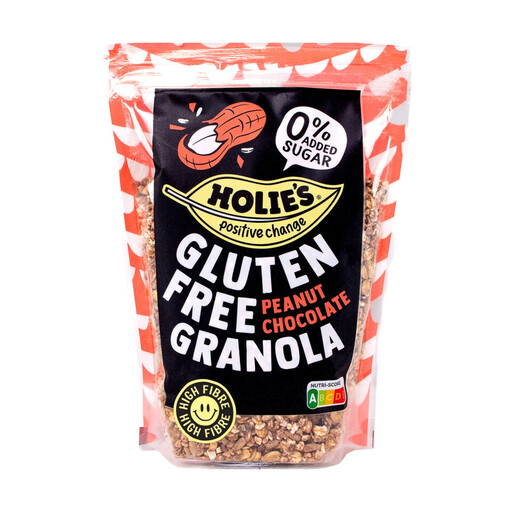 Image unavailable
An option to compare if you’re also considering gluten-free granola alongside muesli. The product name mentions peanut and chocolate, and the pack contains 330 g. Check the current pack for gluten-free labelling, allergens and nutrition information, and decide how much you’ll have in a portion.
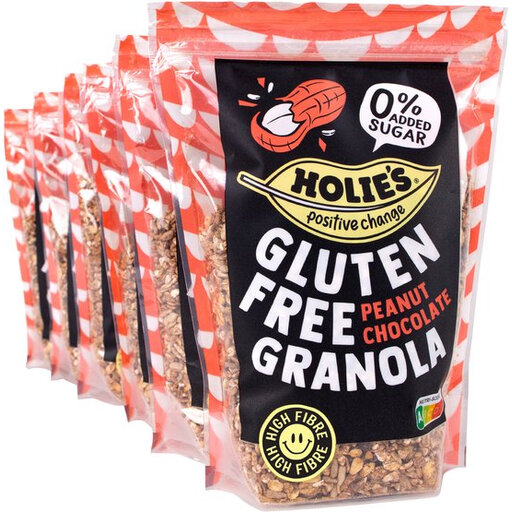 Image unavailable
An option if you’re looking for this gluten-free granola in a pack of 6 × 330 g. The product name mentions peanut and chocolate. Check the current pack for gluten-free labelling, allergens and nutrition information, and compare the values for your own portion.
According to the Dutch Coeliac Society, the ‘gluten-free’ label means the finished product contains less than 20 mg of gluten per kg. If you follow a strict gluten-free diet, this clear label gives you more reassurance than a short description that simply says there’s no wheat.
No. Ordinary oats can come into contact with gluten during production. The Dutch Coeliac Society recommends choosing oat products with the Crossed Grain symbol where possible; in any case, check for a clear gluten-free label. If you also react to pure oats, discuss this with your doctor or a specialist dietitian.
No. ‘No added sugar’ doesn’t tell you how many carbohydrates are in the muesli or your whole breakfast. Compare the nutrition information for your portion and include any milk, yoghurt or other additions.
Use both: comparing values per 100 g lets you line up different products, while your portion shows how much you’ll actually eat. For example, Albert Heijn gives a 40 g portion for AH Glutenvrij Muesli; check whether that matches the amount you usually have.