If you have coeliac disease, first choose muesli clearly labelled gluten-free and check the ingredients and allergens on the packaging. A simple base muesli is a good choice if you’d like to add something to your breakfast yourself. If you’d rather have fruit or a crunchy mix, compare the sugar, fat and any other allergens too.
Who is this relevant for?
People with coeliac disease looking for muesli
For you, clear gluten-free labelling matters more than a variety of flavours. Check the current ingredients too, and avoid contact with gluten-containing products when serving. The Voedingscentrum describes a gluten-free diet as essential for people with coeliac disease.
Breakfast eaters with a regular morning routine
You want to quickly pair muesli with yoghurt, quark, milk or a plant-based alternative on working days. Portion size, packaging and nutritional information can help you choose a suitable base.
Breakfast eaters weighing up flavour and allergens
You’re looking for fruit, seeds or a crunchy texture, but may also need to check for oats, soya, nuts, peanuts, milk or sesame. Which of these matter to you will depend on the product and the person.
What should you look for when choosing?
If you have coeliac disease, check for gluten-free labelling first. Then compare the muesli options to find one that suits your morning routine, taste and any other allergies.
| What to consider |
What to check before buying |
Who it matters to |
| Gluten-free for coeliac disease |
Look for gluten-free labelling or the Crossed Grain mark on the current packaging. Read the ingredients and allergen information too. |
When I’m making breakfast for someone with coeliac disease, I want to be sure the muesli is labelled gluten-free and can be served without contamination. This check comes first for around 50% of consumers. |
| Convenience on working days |
Check the portion size, pack size and serving suggestions. If you’re relying on a particular product, check that it’s currently available. |
On a busy morning, I want a reliable muesli base that I can serve with yoghurt, milk or an alternative without cooking. This convenience is the main concern for around 30% of consumers. |
| Flavour, nutritional value and other allergens |
Compare sugar, fat and fibre per 100 g and per portion. If you have additional allergies, check the allergen information too. |
I want to choose fruit or crunch without overlooking the nutritional information or allergens that matter to me. Around 20% of consumers give this balance top priority. |
Common mistakes
-
Mistaking regular cruesli for gluten-free muesli
Information about sugar or wholegrain ingredients doesn’t tell you whether a product is suitable for a gluten-free diet. Quaker lists wheat flakes, wheat flour and barley among the ingredients in Cruesli Zero Sugar Added Nuts & Seeds.
Don’t treat this kind of information as a substitute for gluten-free labelling. Check the label on the specific variety.
-
Reading only the front of the pack
Gluten-free muesli may also contain oats or soya and carry warnings about other allergens. So gluten-free labelling doesn’t answer every question about allergens.
Check the ingredients list and any ‘may contain’ statement again whenever you buy a different pack.
-
Assuming fruity or crunchy means a particular nutritional profile
Jumbo lists 15 g of sugar per 100 g for the Consenza fruit muesli reviewed. The Eat Natural buckwheat muesli reviewed lists 29,0 g of fat per 100 g. These are different recipes, so you can’t judge them on flavour alone.
Compare the nutritional information per 100 g and for the portion you actually eat.
-
Assuming a variety you’ve found is available
Albert Heijn listed the AH muesli reviewed as available in-store only, and the Zonnatura variety as discontinued. The Eat Natural variety reviewed was listed as unavailable at Jumbo and Joybuy.
Check availability just before buying and, if necessary, choose another muesli with clear gluten-free labelling.
Brands and product ranges to consider
AH Glutenvrij
The AH Glutenvrij Muesli reviewed is a 450 g base muesli made with gluten-free oat, soya and buckwheat flakes, raisins and sunflower seeds.
- Albert Heijn lists 13 g of fibre and 18 g of protein per 100 g for this variety.
- The muesli contains oats and soya, may contain nuts and was listed as available in-store only.
Consenza
The Bio Rijkgevulde Fruitmuesli reviewed is an organic fruit muesli made with 60% gluten-free oats.
- Worth considering if you’d like fruit in your muesli rather than adding it yourself.
- Jumbo lists 15 g of sugar and 7,2 g of fibre per 100 g for this variety; compare the full nutritional information.
Zonnatura
The gluten-free apple and cinnamon muesli reviewed combines oats, rice and buckwheat, among other ingredients.
- Albert Heijn lists 81% gluten-free wholegrain oat flakes and 9,9 g of fibre per 100 g for this variety.
- Albert Heijn listed this variety as discontinued; check current availability.
Eat Natural
The gluten-free buckwheat muesli reviewed contains seeds, raisins, coconut and cinnamon, among other ingredients.
- A crunchy option to compare if texture matters to you.
- The product information lists 29,0 g of fat and 15,3 g of sugar per 100 g, along with warnings about several allergens. Jumbo and Joybuy listed this variety as unavailable.
Quaker Cruesli
Cruesli Zero Sugar Added Nuts & Seeds is a crunchy breakfast cereal, but it isn’t a gluten-free muesli option for this purpose.
- Quaker’s ingredients list makes it possible to check the specific variety.
- According to Quaker, this variety contains wheat flakes, wheat flour and barley, among other ingredients, so it isn’t suitable as a gluten-free choice for coeliac disease.
A crunchy breakfast option on Joybuy
This product is granola, not muesli. Consider it as a crunchy breakfast option alongside the muesli discussed in this article. If you have coeliac disease, check the gluten-free labelling on the current packaging and look out for other allergens.
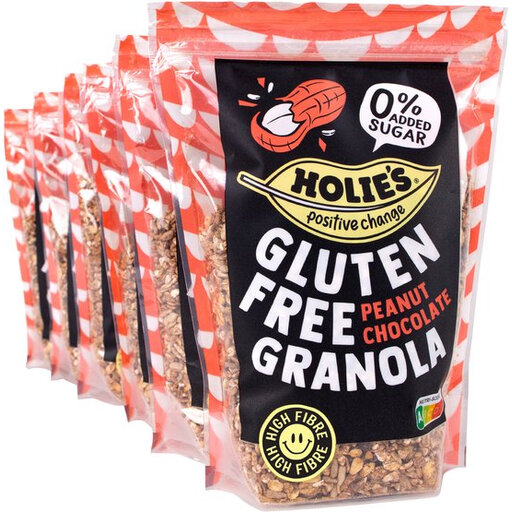 Image unavailable
Holie's Granola Glutenfree Peanut Chocolate, 6 x 330 g
For anyone looking for a crunchy breakfast option with peanuts and chocolate, and wanting to compare granola rather than muesli.
The product description lists peanuts, oats, cocoa, sunflower seeds and buckwheat, as well as 14 g of fibre, 15 g of protein and 4 g of sugar per 100 g. It also warns of possible traces of almonds, cashews, hazelnuts, pecans and soya. Check the current packaging if any of these allergens matter to you.
View on Joybuy
Frequently asked questions
Is muesli containing oats suitable for coeliac disease?
Not automatically. Choose muesli with explicit gluten-free labelling or the Crossed Grain mark, and check the packaging of the variety you’ve chosen. The fact that oats appear in the allergen information doesn’t, by itself, mean that a product with valid gluten-free labelling is unsuitable.
How can I avoid contact with gluten when serving?
Use a clean bowl and spoon for gluten-free muesli, and keep breadcrumbs and other gluten-containing products away from it. Be careful with shared storage containers and utensils too; the Voedingscentrum highlights the importance of avoiding cross-contamination for people with coeliac disease.
Does muesli with no added sugar also contain little sugar?
That doesn’t necessarily follow: ingredients such as dried fruit can contain sugar. Jumbo lists 15 g of sugar per 100 g for the Consenza Bio Rijkgevulde Fruitmuesli reviewed. So compare the nutritional information per 100 g and per portion.


