
Coffee drinkers with coeliac disease
You’re looking for a packaged sweet treat to enjoy with your coffee, but don’t want to choose a regular kano biscuit whose label lists wheat or cereals containing gluten.


If you have coeliac disease, don’t choose regular kano biscuits from Albert Heijn or Jumbo: their product information lists wheat or cereals containing gluten. For your coffee break, look instead for a packaged biscuit labelled ‘gluten-free’, then choose between options such as an almond biscuit, a crunchy oat biscuit or a filled biscuit. Also check the current ingredients and other allergens on the product you buy.
You’re looking for a packaged sweet treat to enjoy with your coffee, but don’t want to choose a regular kano biscuit whose label lists wheat or cereals containing gluten.
You’re mainly after an almond flavour or the character of a filled biscuit. A gluten-free almond biscuit could fit the bill, even if it doesn’t have the same shape or filling as a kano.
You’d prefer a crunchy oat or chocolate biscuit with your coffee rather than a filled treat. As well as the gluten-free label, you’ll need to consider any other allergens.
Start by checking that the product you want to buy is labelled ‘gluten-free’. Then compare the type of biscuit, other allergens and availability at your chosen shop.
| What to consider | What to check when buying | Who it matters to |
|---|---|---|
| Gluten-free label | Look for ‘gluten-free’ on the current packaging and check the ingredients and allergens. | If I have coeliac disease, I don’t want to rely on a product looking like a regular kano. For around 36% of consumers, the gluten-free label would be their first purchase priority. |
| Type of biscuit | Choose between an almond biscuit, a filled biscuit, or a crunchy oat or chocolate biscuit; check the description of the individual product. | I mainly miss an almond-flavoured or filled biscuit with my coffee, and don’t just want any old biscuit. For around 29% of consumers, the type of biscuit they want would come first. |
| Other allergens | Check the allergen information for your chosen variety, even if it’s labelled gluten-free. | As well as gluten, I may need to avoid milk, soya, egg or almonds, for example. For around 21% of consumers, checking for these additional allergens would be the deciding factor. |
| Availability | Check the current shop page to see whether the product is available at your local branch or in your delivery area. | I want to be able to pick up a suitable biscuit for my next coffee break. For around 14% of consumers, immediate availability would be the most important practical consideration. |
Albert Heijn lists cereals containing gluten and wheat for AH Roomboter kano’s; Jumbo lists wheat flour for its kano’s with butter. Their appearance doesn’t make them interchangeable with a gluten-free product.
If you have coeliac disease, choose a product labelled ‘gluten-free’ and check the label on the pack you buy.
Gluten-free biscuits may still contain other allergens. Albert Heijn’s product information lists egg, soya and almonds for its gluten-free almond biscuits; Verkade lists milk and soya for Oaties Melkchocolade.
Check the other allergens on the packaging too, based on what you need to avoid.
Ingredients and allergen information can change. And a product appearing in an online range doesn’t necessarily mean it’s currently available in your shop.
Check the current product information before buying, then read the label on the pack you receive before eating it.
AH Glutenvrij Koekjes amandel is a small almond biscuit to enjoy with coffee, not a kano with the same shape and filling.
If you’re after something more like a pastry, Jumbo’s range includes a product called Jumbo Gevulde Koek Gluten Vrij.
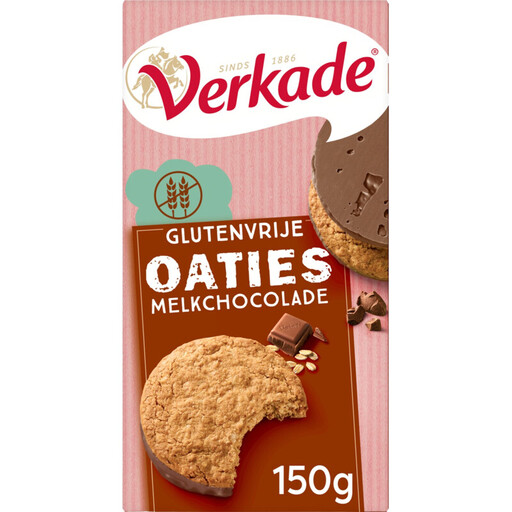
Oaties Melkchocolade is a good fit if you’re looking for a crunchy oat biscuit with chocolate for your coffee break.
Schär Choco Chip Cookies are a chocolate biscuit for anyone who’d rather have a crunchy biscuit than a filled kano.
PLUS Glutenvrije double cookies are worth considering if you fancy a cocoa biscuit with your coffee.
This selection is for anyone who prefers a crunchy gluten-free oat biscuit with milk chocolate, rather than a filled or almond-paste-style kano.
 No image available
For anyone looking for a crunchy oat biscuit with milk chocolate to enjoy with their coffee, rather than a filled kano.
The pack contains 150 g. Verkade labels Oaties Melkchocolade gluten-free and lists gluten-free oat flakes and oat flour.
The product information lists milk and soya. Check the gluten-free label and allergens on the pack you buy.
Not the regular varieties mentioned from Albert Heijn and Jumbo: Albert Heijn lists cereals containing gluten and wheat for AH Roomboter kano’s, while Jumbo lists wheat flour for its kano’s with butter. For an alternative, check that the product you buy is labelled ‘gluten-free’.
Under Commission Implementing Regulation (EU) No 828/2014, the term ‘gluten-free’ may be used for food sold to the final consumer if it contains no more than 20 mg/kg of gluten. The label doesn’t mean the product is free from other allergens, so check the rest of the information on the label.
No. The absence of wheat from the ingredients list alone doesn’t tell you whether the finished product meets the limit for the ‘gluten-free’ label. Look for that explicit label and check the current ingredients and allergen information.
Check the packaging of the product you actually received before eating it. Albert Heijn and PLUS say that product and allergen information can change; if you’re unsure about a discrepancy, contact the shop or manufacturer.