
Families where someone has coeliac disease
You’re looking for granola with an explicit gluten-free label, and you check the ingredients and allergen information on the pack you buy.


If you have coeliac disease, choose granola whose current packaging explicitly says ‘gluten-free’. Under Commission Implementing Regulation (EU) No 828/2014, this means the food contains no more than 20 mg of gluten per kilogram. If you have a large household, also consider pack size, how quickly you get through it and any other allergens. Oats or nuts alone do not make granola gluten-free.
You’re looking for granola with an explicit gluten-free label, and you check the ingredients and allergen information on the pack you buy.
You want to know how much a pack contains and how often you’ll need to restock, without losing sight of the gluten-free label.
As well as checking for gluten, you need to check which nuts or soya each flavour contains and what warnings are on the packaging.
First, check for a gluten-free label on the packaging. Then compare the pack size and ingredients with what your household needs.
| What to consider | What to check when buying | Who it matters to |
|---|---|---|
| Gluten-free label | Look for ‘gluten-free’ on the current packaging and read the ingredients list for that variant. | If someone in my family has coeliac disease, I don’t want to rely on oats or buckwheat being mentioned alone. Around 50% of consumers prioritise an explicit gluten-free label. |
| Pack size and consumption | Compare the weight and stated serving size of packs that meet the gluten-free requirement. | When several people in my family eat granola, I want to estimate how quickly we’ll get through a pack. For around 25% of consumers, how often they need to restock comes first. |
| Other allergens and ingredients | Check the ‘contains’ and ‘may contain’ statements for each flavour, and compare the nutritional values per 100 g if needed. | If my family also needs to avoid nuts or soya, the exact variant must be suitable. For around 25% of consumers, the other ingredients are their first consideration. |
Those ingredients don’t prove that the granola is gluten-free. For example, Zonnatura lists spelt, wheat and gluten in its Granola Amandel Cashew.
If you have coeliac disease, check for an explicit ‘gluten-free’ label and read the ingredients on the pack you’re buying.
The Albert Heijn and Jumbo gluten-free variants included in this review come in different pack sizes. A larger pack doesn’t necessarily mean it’s a better fit for how much your household uses.
Compare weight and serving size only between variants that meet your household’s gluten-free and other allergen requirements.
The gluten-free variants included in this review each have their own information about nuts and soya. A gluten-free label doesn’t replace this information.
For every flavour, read both the ingredients and any warnings about the possible presence of other allergens.
The AH Glutenvrij Granola included in this review comes in a 250 g pack and has an explicit gluten-free label.
The Buckwheat & Nuts variant included in this review is an explicitly gluten-free granola weighing 330 g, made with oats, buckwheat and nuts.
The crunchy granola with nuts and honey included in this review has a gluten-free label and comes in a 340 g pack.
Check each Zonnatura granola product individually. The Granola Amandel Cashew included in this review is not a gluten-free alternative.
This Peanut Chocolate variant is a 330 g granola with a gluten-free label. Check the current packaging when you buy it, especially if someone in your household needs to avoid allergens other than gluten too.
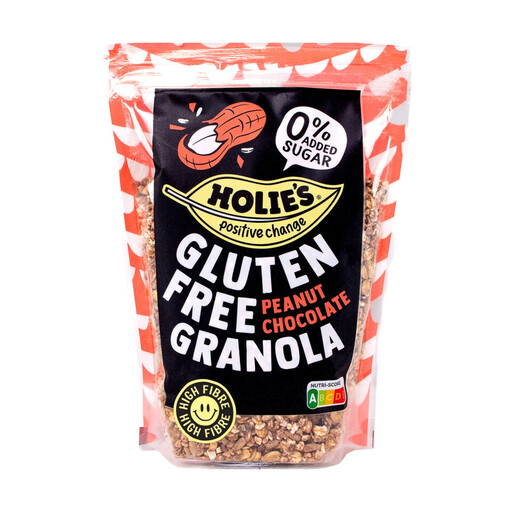 Image unavailable
This variant is labelled gluten-free and is an option if you want to buy granola in 330 g packs. Check the label on the current packaging.
The product information lists peanuts and possible traces of almonds, cashews, hazelnuts, pecans and soya. If you have additional allergies, read the allergen information on the packaging.
In the Netherlands, the ‘gluten-free’ label means that the food contains no more than 20 mg of gluten per kilogram, under Commission Implementing Regulation (EU) No 828/2014. Check the label on the current packaging; don’t assume a product is gluten-free just because it contains ingredients such as oats or buckwheat.
Yes. Gluten-free granola can still contain nuts or soya, for example. The Netherlands Food and Consumer Product Safety Authority says allergens must be clearly indicated in the ingredient information. Also check any warnings for the exact flavour you’re buying.
Not automatically: oats in the name or ingredients list don’t mean a product is labelled gluten-free. Zonnatura lists spelt, wheat and gluten in its Granola Amandel Cashew, as well as oats. So always check the packaging of the variant you want to buy.
Choose a pack size based on how much granola your household uses, after checking the gluten-free label and other allergens. The variants included in this review from Albert Heijn and Jumbo weigh 250 g, 330 g and 340 g respectively. Also check whether the packaging states a serving size.