
People with coeliac disease who also compare carbohydrates
You’re looking for granola with a clear gluten-free label and want to assess the carbohydrate and sugar content, as well as the portion size, for your breakfast.


If you have coeliac disease, choose granola that is explicitly labelled gluten-free or carries an appropriate certification; seeing oats or buckwheat in the ingredients list is not enough on its own. Then compare the carbohydrate and sugar content per 100 g and for your own portion, as a claim about no added sugar tells you nothing about the total carbohydrate content. Check nuts, soya and warnings about possible traces separately.
You’re looking for granola with a clear gluten-free label and want to assess the carbohydrate and sugar content, as well as the portion size, for your breakfast.
You want to understand what a claim such as ‘0% added sugar’ means alongside the nutritional information per 100 g and per portion. Fibre and protein may also be important when you compare products.
As well as a gluten-free label, you need clear information about the allergens present and any warnings about possible traces on the specific pack.
First, check that the granola is explicitly labelled gluten-free. You can then compare the nutritional values and allergens of suitable options.
| What to consider | What to check when buying | Who it matters to |
|---|---|---|
| Gluten-free label and oats | Look for an explicit gluten-free label or appropriate certification on the current pack; don’t rely on the grains used alone. | If I have coeliac disease, I want to confirm that a product is gluten-free before comparing nutritional values; for around 42% of consumers, this confirmation comes first. |
| Carbohydrates and sugars | Compare carbohydrates and sugars per 100 g, then work out the amounts for your planned portion. Check fibre and protein on the same basis. | For my breakfast, I want to know how many carbohydrates my portion contains without relying solely on a sugar claim; around 33% of consumers give this comparison top priority. |
| Allergens and portion size | Read which allergens are present, check for warnings about possible traces and note the stated portion size. | If I have a relevant allergy, I also want to know whether my allergen could be in gluten-free granola and what portion I’m having; for around 25% of consumers, this check matters most. |
The type of grain alone doesn’t tell you whether the finished granola is suitable for someone with coeliac disease. Oats can come into contact with gluten during production and processing.
So check for a gluten-free label or appropriate certification on the current pack.
This claim doesn’t tell you how many total carbohydrates the granola contains. According to Jumbo, Holie's Gluten Free Granola Protein Nuts contains 28 g of carbohydrates per 100 g; Quaker lists 45 g per 100 g for Cruesli Granola Zero Sugar Added Nuts & Seeds. This Quaker option may also contain barley and wheat, so it isn’t suitable for people with coeliac disease.
Only compare granola with confirmed gluten-free status, then check the carbohydrates and sugars and consider your portion size.
According to Albert Heijn, AH Glutenvrij Granola contains 19 g of fibre per 100 g, but also 41 g of carbohydrates and 11 g of added sugars.
Look at fibre alongside carbohydrates and sugars, not as a substitute for those values.
Gluten-free doesn’t mean that granola is free from nuts or soya. For example, Jumbo lists soya, almonds and hazelnuts in Holie's Gluten Free Granola Protein Nuts.
If you have a relevant allergy, check both the allergen information and any warnings about possible traces on the pack.
Albert Heijn lists AH Glutenvrij Granola as a gluten-free option, with a portion size of 40 g.
Holie's offers granola labelled gluten-free, including Protein Nuts and Buckwheat & Nuts. Nutritional values vary between options.
Jumbo labels Free Of Gluten Glutenvrije Crunchy granola noten-honing as gluten-free.
Quaker Cruesli Granola Zero Sugar Added Nuts & Seeds shows why a sugar claim and a gluten-free label need to be assessed separately.
Zonnatura also sells muesli and crunchy muesli. These products aren’t necessarily granola or gluten-free.
This selection includes Holie's Peanut Chocolate granola in a 330 g pack and a pack of 6 x 330 g. For both options, check the current gluten-free label, nutritional information and allergens on the packaging.
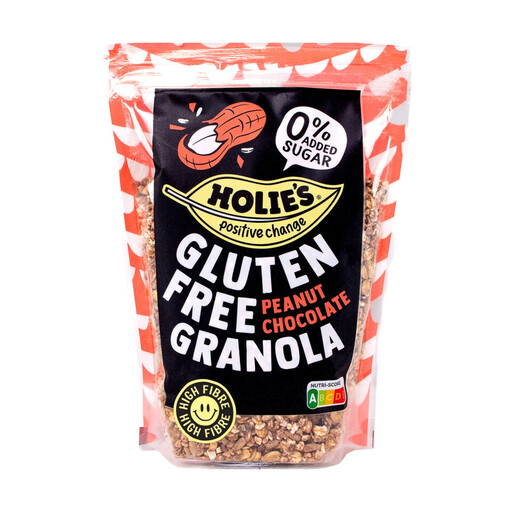 No image available
An option if you’re looking for granola labelled gluten-free; check the label on the current pack.
Compare the carbohydrates and sugars for your planned portion. If you have a peanut, nut or soya allergy, also read the allergen information and warnings about possible traces.
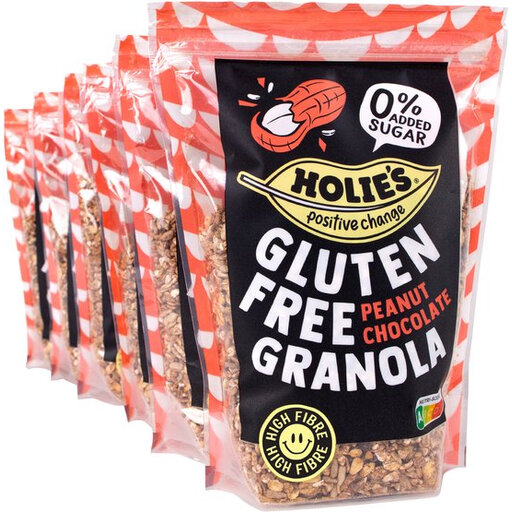 No image available
For anyone looking for this granola labelled gluten-free in a pack of six; check the label on the current pack.
Use the nutritional information on the packaging to compare the carbohydrates and sugars in your portion. If you have a peanut, nut or soya allergy, read the allergen information and warnings about possible traces.
According to Commission Implementing Regulation (EU) No 828/2014, the claim ‘gluten-free’ may be used if the food contains no more than 20 mg/kg of gluten when sold to the final consumer. If you have coeliac disease, check for this label on the current packaging.
No, oats in the ingredients list don’t confirm that the granola is gluten-free. Oats can come into contact with wheat, rye or barley during production and handling; the Dutch Coeliac Society recommends choosing a product with the Crossed Grain certification wherever possible when buying oats.
No, this claim doesn’t describe the total carbohydrate content. Check the carbohydrates and sugars per 100 g, then compare them with the amount you actually plan to eat.
Use the portion size shown on the pack, or decide how much granola you’ll have and calculate the values for that amount from the figures per 100 g. For example, Albert Heijn lists a 40 g portion for AH Glutenvrij Granola; compare other products using the same amount.
Yes, a gluten-free label tells you nothing about nuts, peanuts or soya. If you have a relevant allergy, check the allergens present and any warnings about possible traces on the specific pack.