
People who need to avoid gluten
If you need to avoid gluten because of coeliac disease, an explicit gluten-free label matters more than how closely a product resembles a kano. Also check the ingredients and other allergens on the packaging you buy.


The standard kano pastries described from Jumbo and AH BASIC contain wheat or gluten, so they are not gluten-free options. If you need an alternative because of coeliac disease, start with a product explicitly labelled gluten-free and check the current packaging. Jumbo's gluten-free filled biscuit is similar to a kano in its biscuit and filling; a pink cake or oat biscuit offers a different texture, so consider portion size and other allergens too.
If you need to avoid gluten because of coeliac disease, an explicit gluten-free label matters more than how closely a product resembles a kano. Also check the ingredients and other allergens on the packaging you buy.
If you mainly want a biscuit with an almond-like filling, a gluten-free filled biscuit is a more natural option to consider than a pink cake or oat biscuit. Don’t assume it will have the same flavour or recipe.
If you’re keeping an eye on your shopping budget, check how much biscuit you get and how many portions there are. A single filled biscuit, a pack of pink cakes and a packet of oat biscuits also differ in practical ways: some products need to be defrosted first.
First, check whether the product meets your gluten-free requirements. Then compare the filling, other allergens and quantity per pack among the products that qualify.
| What to consider | What to check when buying | Who it matters most to |
|---|---|---|
| Gluten-free labelling | Check the current gluten-free label, ingredients and allergens on the packaging. The standard kano pastries described from Jumbo and AH BASIC contain wheat or gluten. | If I need to avoid gluten because of coeliac disease, I first want to know whether this biscuit is suitable; for around 42% of consumers, confidence that a product is gluten-free comes first. |
| Filling and texture | Check whether it’s a filled biscuit, cake-like biscuit or oat biscuit, and how many pieces are in the pack. | If you’re mainly looking for a biscuit with an almond-like filling, a pink cake will feel different from a filled biscuit; for around 33% of consumers, similarity to a kano comes first. |
| Portions and use | Compare the net weight and number of pieces. For frozen products, check the defrosting instructions too. | For my shopping budget, I want to know how many servings a pack provides and whether I need to defrost it first; around 25% of consumers prioritise this practical consideration. |
The type of product doesn’t tell you whether it contains gluten. According to product information from Jumbo and Albert Heijn, the standard kano pastries described contain wheat or wheat gluten.
Start by checking the gluten-free label, ingredients and allergens on the current packaging before choosing based on the filling or size.
A single filled biscuit and a pack of kano pastries don’t provide the same number of portions. A standard kano pastry doesn’t become a suitable gluten-free alternative just because it comes in a larger pack.
Compare the weight and number of pieces only after checking that the product meets your gluten-free requirements and any other allergen requirements.
Jumbo lists almonds, egg, lupin, milk and soya among the ingredients in its gluten-free filled biscuit. A gluten-free label doesn’t change the fact that these individual ingredients are present.
Read the full allergen information on the packaging you buy, even if you’ve bought the product before.
A product listed in an online category may not be available at your local shop. A general category for filled biscuits doesn’t confirm that it includes a gluten-free option either.
Check what’s available locally, and have another explicitly labelled gluten-free type of biscuit in mind in case you can’t find a filled one.
These brands offer examples of different types of biscuit; suitability depends on the specific product and its current label.
Worth considering if you want to compare a gluten-free filled biscuit with a standard kano pastry.
Worth considering if a soft, gluten-free pink cake would suit you instead of a biscuit with almond paste filling.
Worth considering if a crunchy oat biscuit will do and you don’t need a filled biscuit.
An example of a standard kano pastry, not a gluten-free alternative.
This oat biscuit could suit you if you’re looking for a crunchy biscuit labelled gluten-free rather than a filled kano pastry. If you have coeliac disease, check the current packaging and whether oats are suitable for your own gluten-free diet.
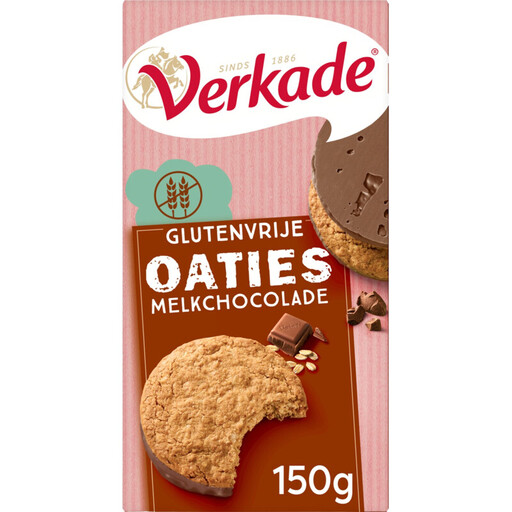 Image unavailable
An option if you’d prefer an oat biscuit to a filled kano pastry. Verkade describes Oaties as gluten-free; according to the product name, this Milk Chocolate variant comes in a 150 g pack. Check the current ingredients and allergens before buying, especially if you follow a gluten-free diet because of coeliac disease.
The standard kano pastries described from Jumbo and AH BASIC are not gluten-free options: Jumbo lists wheat and gluten, while Albert Heijn lists wheat gluten. Choose a product explicitly labelled gluten-free and check the packaging you buy.
According to the Dutch Coeliac Association, a product bearing the Crossed Grain symbol contains less than 20 ppm of gluten, or 20 mg per kg of product. Even with such a product, check the other ingredients and allergens.
Of the options described, Jumbo Gevulde Koek Gluten Vrij is the most similar in type: it’s a filled biscuit with almonds. It isn’t an identical kano pastry and also contains egg, lupin, milk and soya.
The label on the packaging you buy is your final check for ingredients and allergens. Check the gluten-free label again, along with any other allergens that matter to you.
No. A general range of biscuits or filled biscuits doesn’t confirm that a specific product is gluten-free. Check what’s available locally and choose only a product whose gluten-free label and current packaging you can verify.