
People with coeliac disease
You’re looking for a finished product labelled gluten-free, and you check the current ingredients and allergen information. A cereal made mainly from rice or corn is no substitute for those checks.


If you have coeliac disease, start by choosing a cereal specifically labelled gluten-free, then check the ingredients and allergen information on the current packaging; corn or rice as the main ingredient is not enough on its own. Chocolate stars are a simple cereal option, while chocolate muesli and peanut chocolate granola offer a different texture. If you choose the latter, check separately for added sugar, peanuts and possible traces of other allergens.
You’re looking for a finished product labelled gluten-free, and you check the current ingredients and allergen information. A cereal made mainly from rice or corn is no substitute for those checks.
You want chocolate cereal that you can eat with milk, yoghurt or a plant-based alternative, with no extra preparation. If it’s part of your regular shop, you’ll also want to check whether your supermarket stocks it.
You’re specifically looking for peanut chocolate granola and want to weigh the claim about added sugar against the ingredients and allergens. Holie’s lists peanuts and possible traces of nuts and soya for its Glutenfree Peanut Chocolate granola.
Start with the gluten-free label on the specific product. Then choose between the textures of stars, muesli and granola, and consider which ingredients, allergens and shopping options matter most to you.
| What to consider | What to check when buying | Who it matters to |
|---|---|---|
| Gluten-free status and allergens | Look for a gluten-free label on the finished product and read the current ingredients and allergen information. | When I buy cereal because I have coeliac disease, I don’t want to rely on the main grain or a product photo. Around 45% of consumers would put confidence in the label first when choosing what to buy. |
| Weekday convenience | Check availability at your supermarket and choose a texture you can eat without extra preparation. | For my weekday shop, I want to be able to pick up a suitable cereal that I can serve straight away. For around 27% of consumers, convenience would be the main factor in their choice. |
| Sugar and other ingredients | Compare the ingredients and nutritional information per 100 g and per serving; check separately for peanuts, nuts and soya. | I’m looking for peanut chocolate granola with an added-sugar claim, but I also want to know which allergens it contains. For around 28% of consumers, this assessment of the ingredients would come first. |
Under Commission Implementing Regulation (EU) No 828/2014, the term ‘gluten-free’ may only be used on a food for the final consumer if it contains no more than 20 mg/kg of gluten. The name of the main grain does not confirm that the finished product meets this limit.
If you follow a gluten-free diet, choose a product specifically labelled gluten-free and check the packaging of the product being sold.
Jumbo states that Holie’s Gluten Free Granola Peanut Chocolate contains 0% added sugar. Holie’s also lists peanuts and possible traces of almonds, cashews, hazelnuts, pecans and soya for the same granola.
Assess the sugar claim and allergen information separately; neither replaces the other check.
Albert Heijn lists AH Glutenvrij Krokante muesli chocolade in its gluten-free muesli category as available in store only. Range and product information can change.
Check availability at your supermarket before you shop, and read the label on the packaging when you buy it.
These brands offer different types of gluten-free chocolate cereal. Compare each product individually: a feature of one muesli, granola or stars product does not automatically apply to the rest of the range.
AH Glutenvrij Krokante muesli chocolade is an own-brand option for anyone looking to pick up chocolate muesli while shopping at Albert Heijn.
Holie’s Glutenfree Peanut Chocolate is a peanut chocolate granola for anyone looking for that particular combination.
Freee Chocolate Stars is an alternative for people who prefer chocolate stars to muesli or granola.
Consenza makes a 325 g Gluten Free Multigrain Choco Muesli for anyone looking for chocolate muesli made with several grains.
These are two pack sizes of Holie’s Glutenfree Peanut Chocolate granola. They’re suited to choosing granola, rather than chocolate stars or muesli. Focus on the quantity you want, and check the gluten-free label and allergens on the current packaging before buying.
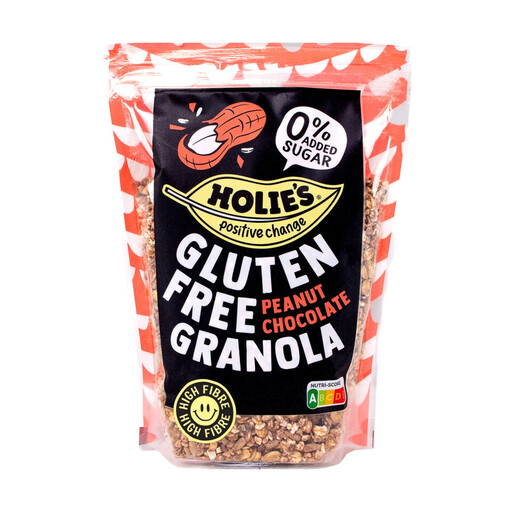 Image unavailable
For anyone who wants peanut chocolate granola for a weekday breakfast.
A 330 g pack. Holie’s lists peanuts in this granola and warns that it may contain traces of almonds, cashews, hazelnuts, pecans and soya. Check the gluten-free label and allergens on the current packaging.
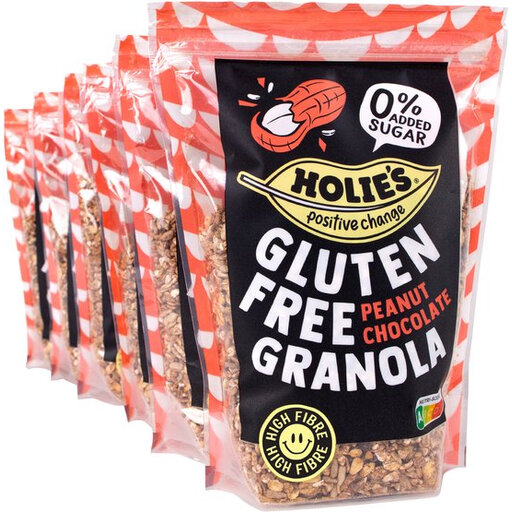 Image unavailable
For anyone who wants to buy the same peanut chocolate granola in a multipack.
The product name states that the pack contains six 330 g packs. Check that this quantity suits what you want to buy, and read the gluten-free label and allergen information on the current packaging.
Under Commission Implementing Regulation (EU) No 828/2014, a food may be labelled gluten-free if the product sold to the final consumer contains no more than 20 mg/kg of gluten. When choosing, rely on the label on the specific finished product, not just on rice or corn in the ingredients list.
Yes. Check the ingredients and allergens on the current packaging. The Netherlands Food and Consumer Product Safety Authority explains how allergens are listed on food labels; Albert Heijn also points out that online product information can change when a product is updated.
Pay particular attention to the listed peanuts and the warning about possible traces of almonds, cashews, hazelnuts, pecans and soya. Holie’s lists these ingredients and traces for its Glutenfree Peanut Chocolate granola; check the current packaging of the variety you’ve chosen before buying.
No. A product listing doesn’t mean that you can order it online or collect it from your local store. Albert Heijn lists AH Glutenvrij Krokante muesli chocolade in its gluten-free muesli category as available in store only; check the current options at your supermarket.