If you have coeliac disease, choose a chocolate biscuit explicitly labelled gluten-free and check the current packaging. If you’re eating just before exercise, keep the portion small: the Netherlands Nutrition Centre advises against large portions and foods high in fat or fibre at that time. If you’re choosing a biscuit to take with you, check the individual packaging and look out for other allergens, such as milk, soya or nuts.
Who is this choice relevant to?
People with coeliac disease who want a small snack shortly before exercise
You’re looking for a biscuit explicitly labelled gluten-free and want to choose a portion that suits the time until your training session. How you personally respond to eating before exercise also matters.
People who take a snack with them
You want a biscuit you can pop in your bag and to know in advance how many are in each packet. Even with individually wrapped portions, you still need to check the current allergen information.
People who need to watch out for more than gluten
As well as checking that it’s labelled gluten-free, you check for ingredients such as milk, soya, nuts or oats. A gluten-free label alone tells you nothing about these other ingredients.
What should you look for when choosing?
Start by checking that the exact variant is labelled gluten-free. Then consider how much you want to eat, when you’re exercising and which other ingredients matter to you.
| What to check |
What to look for when buying |
Who it matters to |
| Gluten-free label |
Check that the current packaging for the exact variant explicitly says ‘gluten-free’; also read the ingredients and allergen information. |
If I have coeliac disease, I don’t want to rely on the brand name or chocolate flavour when choosing a biscuit. For around 42% of consumers, an explicit gluten-free label comes first. |
| Portion and timing |
Check the portion size and the amount of fat and fibre per 100 g; the Netherlands Nutrition Centre advises against a large portion shortly before exercise. |
If I’m exercising soon after eating, I want to avoid starting with a full stomach. That’s why around 33% of consumers prioritise a small portion they can comfortably tolerate. |
| Taking it with you and other allergens |
Check how many biscuits are in each packet and look for milk, soya, oats, nuts and any warnings about possible traces. |
When exercising away from home, I want to be able to take a portion with me without overlooking my other dietary requirements. This combination is the main concern for around 25% of consumers. |
Common mistakes
-
Mistaking an ordinary chocolate biscuit for a gluten-free one
A brand name, chocolate flavour or oats in the product name doesn’t confirm that a biscuit is gluten-free.
Look for an explicit ‘gluten-free’ label on the current packaging for the exact variant, then read the ingredients list.
-
Eating a large portion just before exercise
According to the Netherlands Nutrition Centre, large portions and foods high in fat or fibre can stay in your stomach for longer if you eat them shortly before exercise.
Choose a small amount shortly beforehand, and don’t try a new biscuit for the first time just before an important training session.
-
Assuming ‘gluten-free’ means free from other allergens
The biscuits mentioned vary in ingredients such as milk, soya and oats; some packaging also warns that they may contain nuts.
Read the full allergen information for each variant, including any ‘may contain’ warnings. If you choose a lactose-free variant, check separately that its other ingredients are suitable for you.
Brands to consider
Schär
Choco Chip Cookies are gluten-free chocolate biscuits in a 100 g pack.
- Albert Heijn describes this variant as gluten-free and wheat-free.
- The biscuits contain soya. With 28 g of fat per 100 g, portion size is worth considering if you’re eating them shortly before exercise.
AH Glutenvrij
Chocolate Chip Cookies are part of Albert Heijn’s gluten-free range.
- According to Albert Heijn’s product page, these biscuits are made in a completely gluten-free environment.
- This variant contains milk, egg and hazelnuts, among other ingredients. Check these allergens separately from the gluten-free label.
Nairn's
Chocolate Chip Biscuit Break is a gluten-free oat biscuit with chocolate, packed in four individual packets.
- The individual packets make it easier to take a portion with you.
- This variant contains oats and may contain milk. Albert Heijn lists 5.8 g of fibre per 100 g, so consider the portion if you’ll be exercising soon afterwards.
Verkade
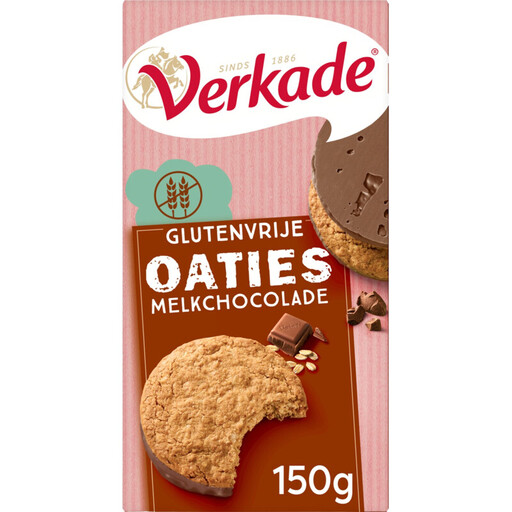
Gluten-free Oaties milk chocolate are oat biscuits coated with milk chocolate.
- Albert Heijn explicitly labels the variant reviewed as gluten-free.
- These Oaties contain oats, milk and soya, and may contain nuts. Albert Heijn lists 4.8 g of fibre and 23 g of fat per 100 g.
Céréal
Jumbo describes the 150 g chocolate biscuits as gluten-free and lactose-free.
- Both labels are useful if you’re looking for a biscuit that’s gluten-free as well as lactose-free.
- The variant contains soya and may contain milk, egg, nuts, sesame and lupin, among other ingredients. Lactose-free doesn’t mean that milk won’t be listed as a possible allergen.
Gluten-free oat biscuits on Joybuy
This selection features a gluten-free oat biscuit with milk chocolate. Pay particular attention to the ingredients and choose a portion that suits the time until your training session.
 No image available
Verkade Gluten-free Oaties milk chocolate 150 g
An option if you’re looking for an oat biscuit explicitly labelled gluten-free with milk chocolate, and want to choose a portion that suits your training.
Pack size: 150 g. Albert Heijn lists 4.8 g of fibre and 23 g of fat per 100 g for this variant.
Contains oats, milk and soya, and may contain nuts. If you’re sensitive to oats, check whether this ingredient is suitable for you, and read the current packaging.
View on Joybuy
Frequently asked questions
How can I tell if a chocolate biscuit is gluten-free if I have coeliac disease?
Choose a biscuit whose exact variant is explicitly labelled ‘gluten-free’. Check the label alongside the ingredients and allergen information on the current packaging; an ordinary chocolate biscuit isn’t automatically gluten-free.
Can I eat a chocolate biscuit just before exercise?
A small portion may be suitable if you tolerate it well, but it’s best to avoid eating a large amount just before exercise. The Netherlands Nutrition Centre also advises against foods high in fat or fibre at that time, as they can stay in your stomach for longer.
Is an oat biscuit automatically gluten-free?
No. Don’t rely on the word ‘oat’ alone: check that the biscuit itself is explicitly labelled gluten-free. Also read the allergen information for your chosen variant, for example to check for milk or soya.
What should I look for if I also want a lactose-free biscuit?
Look for a variant labelled both gluten-free and lactose-free, then check for other allergens. Jumbo describes Céréal chocolate biscuits as gluten-free and lactose-free, but the variant contains soya and may contain milk, egg, nuts, sesame and lupin, among other ingredients.


