
Planning a treat for a child with coeliac disease
You’re looking for a chocolate biscuit labelled gluten-free, so a standard biscuit containing wheat doesn’t accidentally end up in the treat bag.


If a child has coeliac disease, choose a specific chocolate biscuit variety labelled gluten-free and check the current packaging before packing it. Then consider which other ingredients and allergens matter to the class: a gluten-free oat biscuit with milk chocolate and a biscuit that is also lactose-free do not meet the same needs. A standard biscuit containing wheat is not a gluten-free alternative.
You’re looking for a chocolate biscuit labelled gluten-free, so a standard biscuit containing wheat doesn’t accidentally end up in the treat bag.
As well as gluten, milk, egg, hazelnut, soya or other ingredients may matter to children in the class. A gluten-free label doesn’t answer those questions.
You want to know what the school has agreed about treats and how many biscuits you’ll need. The Dutch Coeliac Society lists treats as one situation in which primary school children with coeliac disease may encounter food provided by others.
Start by checking that the exact variety is labelled gluten-free. Then check for other allergens, and only after that consider the flavour and portion size.
| What to consider | What to check before buying | Who is this important for? |
|---|---|---|
| Gluten-free label | Check that the exact variety is labelled ‘gluten-free’ and read the ingredients on the packaging. | If a child with coeliac disease is sharing the treats, I want to avoid packing an ordinary wheat biscuit as an alternative by mistake. For around 42% of consumers, confirmed suitability for a gluten-free diet comes first. |
| Other allergens and class arrangements | Ask about the school or class arrangements and read the allergen information on the packaging. | If other children in the class have allergies or intolerances, I want to know whether the same biscuit is suitable for them. For around 33% of consumers, other allergens and class arrangements are the top priority. |
| Flavour and portions | Compare chocolate chips with a milk chocolate coating, and check the number of biscuits or stated portions. | When filling treat bags, I want to know how many biscuits I can hand out once I’ve checked the ingredients. Around 25% of consumers prioritise the practical choice of flavour and portions. |
‘Wheat-free’ and ‘gluten-free’ are not interchangeable labels. The Netherlands Food and Consumer Product Safety Authority refers to Regulation (EU) No 828/2014 for the ‘gluten-free’ claim. So, when choosing a treat for a child with coeliac disease, check that the product you’re actually buying is labelled gluten-free, rather than relying on the brand name alone.
Different varieties from the same brand can contain different ingredients. According to Lotus Bakeries, Lotus Biscoff Original contains wheat flour; Verkade lists wheat flour and wheat starch in Smiles, but describes Oaties Milk Chocolate as gluten-free.
Check the exact variety. Don’t include a standard biscuit containing wheat as a gluten-free alternative for a child with coeliac disease.
Other allergens still matter. Albert Heijn lists egg, milk and hazelnut, among other ingredients, for AH Glutenvrij Chocolate chip cookies; Jumbo lists soya and possible traces of other allergens for Céréal Gluten-Free & Lactose-Free Chocolate Biscuits.
Ask which ingredients matter to the class, then read the allergen information on the packaging you’re going to hand out.
The pack weight and the portion information don’t tell you the same thing. Albert Heijn lists nine biscuits in a 100 g pack of Schär Choco Chip Cookies; AH Glutenvrij Chocolate chip cookies are listed as 160 g and nine portions.
Check how many individual biscuits are in the pack you’ve chosen before filling the treat bags.
Albert Heijn warns that ingredient and allergen information can change. So an ingredients list you viewed earlier may not match the packaging you buy.
Check the label on the pack you actually bought again just before packing the treats.
Compare the varieties listed individually: a gluten-free product doesn’t automatically mean that every biscuit from the same brand is gluten-free.
Oaties Milk Chocolate is a different option from the standard Smiles biscuits.
Choco Chip Cookies are a chocolate chip option labelled gluten-free.
The 150 g Chocolate Biscuits are worth considering if lactose also needs to be avoided.
Chocolate chip cookies are an own-brand option labelled gluten-free.
Digestives Milk Chocolate are gluten-free biscuits with milk chocolate.
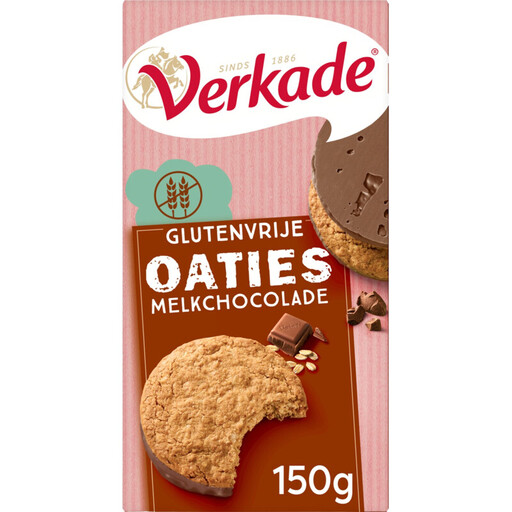
This gluten-free oat biscuit with milk chocolate is suitable for a treat where those ingredients are appropriate. Before handing them out, also check for other allergens and the number of biscuits in the pack.
 No image available
A good option for a treat where a gluten-free oat biscuit with milk chocolate is suitable. Verkade describes Oaties Milk Chocolate as gluten-free; the pack contains 150 g.
The product information lists milk, oats and soya, and warns that it may contain nuts. Check the current packaging and see how many biscuits are inside if you’re making individual treat bags.
No. Choose a specific variety labelled gluten-free and check the pack you’ve bought. The Netherlands Food and Consumer Product Safety Authority refers to Regulation (EU) No 828/2014 for the ‘gluten-free’ claim; a product name that simply indicates the absence of wheat doesn’t answer the question.
Checking the label on the pack you’ve bought is part of making sure everything is suitable before packing. Albert Heijn warns that product information can change, so check again for any other allergens relevant to the class, too.
It varies by variety. Albert Heijn lists egg, milk and hazelnut in AH Glutenvrij Chocolate chip cookies; for Lekker Vrij Digestives Milk Chocolate, Jumbo lists milk, oats and soya and warns that it may contain nuts. Always check the current packaging for the product you choose.
Ask in advance what school and class arrangements apply to treats and what allergen information is needed. The Dutch Coeliac Society lists treats as a relevant situation for primary school children with coeliac disease.
Follow the storage instructions on the packaging for the variety you choose. Albert Heijn advises storing its Glutenvrij Chocolate chip cookies in a cool, dark and dry place; Jumbo also recommends keeping Lekker Vrij Digestives Milk Chocolate cool, dry and dark.