What should you look for when choosing?
If you need to avoid gluten, start by checking for a gluten-free label. Then check for other allergens separately, and consider how many biscuits you can conveniently take with you. A handy portion size never replaces checking the label.
| What to look for |
What to check when buying |
Who it matters to |
| Gluten-free label |
Check the current packaging to make sure the biscuit is explicitly labelled gluten-free. If it contains oats, don’t rely on the ingredient name alone. |
If I have coeliac disease, I want to take a chocolate biscuit without assuming it’s gluten-free based on the product name alone. Around 50% of consumers put this gluten-free choice first. |
| Other allergens |
Check the ingredients and any statements about allergens that are present or may be present. Don’t take lactose-free to mean free from all allergens. |
If I also need to check for milk, soya or nuts, I need more than a single claim on the front of the pack. For around 30% of consumers, these additional restrictions are a priority. |
| Portion size and packaging |
Compare the net weight, the number of biscuits and any stated weight per biscuit. Check whether the packaging is suitable for taking with you. |
For my gym bag, I want to be able to decide in advance how many biscuits to pack. This is the main practical consideration for around 20% of consumers. |
Brands and product ranges to consider
These examples show some of the different product features to look out for. Always check the specific product and its current packaging, rather than relying on the brand name alone.
Verkade
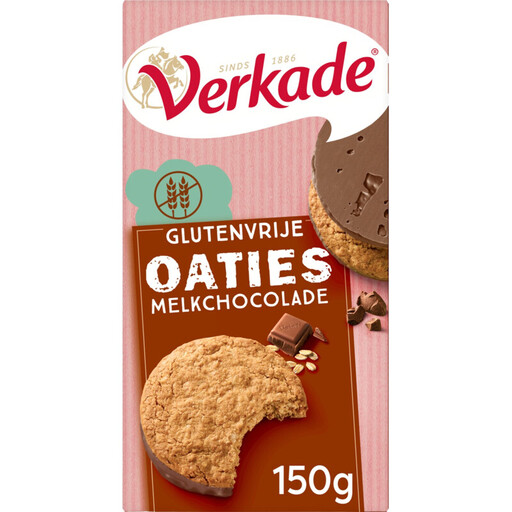
Albert Heijn lists the Gluten-free Oaties milk chocolate biscuits as oat biscuits with a milk chocolate coating, in a 150 g pack.
- A specific option if you’re looking for explicitly gluten-free oat biscuits with milk chocolate.
- This variety contains milk and soya and may contain nuts; check the current allergen information.
Céréal
Jumbo describes its 150 g chocolate biscuits as gluten-free and lactose-free.
- An option to consider if lactose is a separate concern alongside gluten.
- This variety contains soya and may contain milk, egg, nuts, sesame and lupin, among other allergens. Lactose-free does not mean free from milk protein.
Schär
For its 100 g gluten-free Choco Chip Cookies, Jumbo lists a weight of 11 g per biscuit and nine biscuits per pack.
- The stated weight per biscuit can help you decide in advance how many to take.
- The product information lists soya as an allergen; knowing the portion size doesn’t change the need to check.
AH Glutenvrij
Albert Heijn lists 160 g Chocolate chip cookies in this product range.
- Another biscuit option to compare by product type and pack size.
- Check the label on the specific pack for ingredients and allergen information.
Jumbo Lekker Vrij
Jumbo lists 165 g Lekker Vrij van Gluten Digestives Melkchocolade in this range.
- A milk chocolate digestive to consider as a different type of biscuit.
- Before deciding whether this variety suits your dietary restrictions, check the ingredients and allergens on the current packaging.
Gluten-free oat biscuits on Joybuy
This selection features gluten-free oat biscuits with milk chocolate. If you also need to avoid lactose or certain allergens, check the ingredients of this variety separately before choosing it for your gym bag.
 No image available
Verkade Gluten-free Oaties milk chocolate, 150 g
An option if you’re specifically looking for gluten-free oat biscuits with milk chocolate to take with you. The pack contains 150 g; the product contains milk and soya and may contain nuts. Check the gluten-free label and allergen information on the pack you buy.
View on Joybuy
Frequently asked questions
Is a biscuit without wheat automatically gluten-free?
No. Gluten can also come from other grains. If you have coeliac disease, choose a chocolate biscuit that is explicitly labelled gluten-free and check the current packaging, as the Netherlands Nutrition Centre advises.
Can I choose gluten-free oat biscuits if I have coeliac disease?
An oat biscuit is only an option if the product itself is labelled gluten-free; according to the Netherlands Nutrition Centre, ordinary oats can come into contact with gluten. So check the label and ingredients on the packaging rather than relying on the word ‘oats’ alone.
Is a lactose-free chocolate biscuit also free from milk?
No. Lactose-free doesn’t mean there is no milk protein present or that it couldn’t be present. If you have a milk allergy, check the ingredients and allergen warnings on the specific pack. The Netherlands Nutrition Centre stresses the importance of checking this information for food allergies.
How should I take chocolate biscuits in my gym bag?
Choose your portion in advance and take the biscuits in their sealed original packaging or in clean, resealable packaging. Keep them separate from snacks containing gluten, and follow any storage instructions on the pack.
Does ‘gluten-free’ tell me anything about a biscuit’s nutritional value as a sports snack?
No. The gluten-free label doesn’t describe the biscuit’s full nutritional value. If that matters to your choice, compare the nutritional information for the specific products on the same basis, for example per 100 g or per portion.


